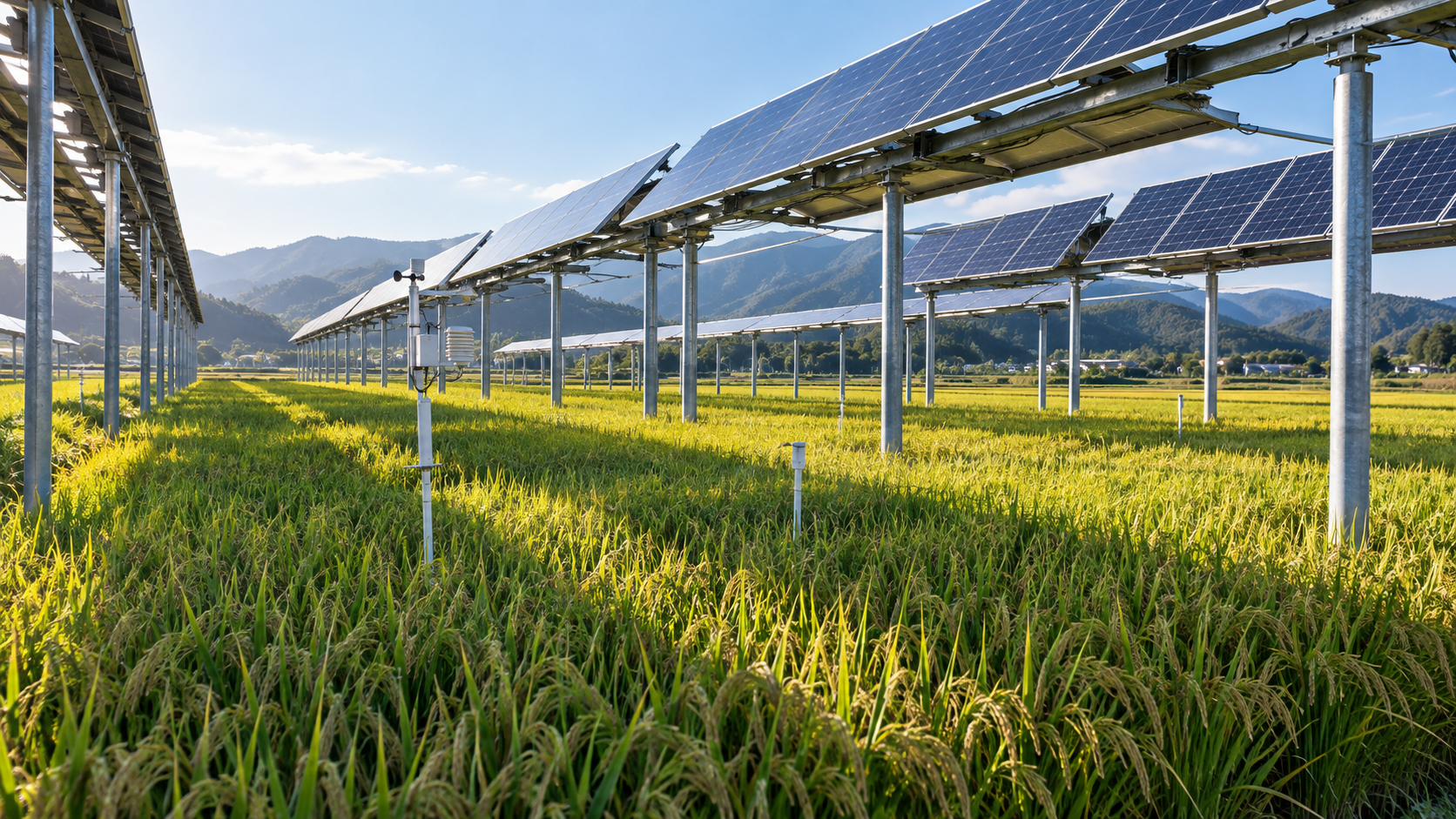
Korean field trials, Japan’s draft national standards, France’s 2024 decree and 2026 trials, and Fraunhofer’s German research: where agrivoltaic research stands on shading and crop yield.
On September 30, Korea’s president raised the idea of putting solar on idle farmland to supply local power and sell the surplus, and agrivoltaics is back in the conversation. Farmers still ask the same thing: can you really farm under panels? Korea, Japan, France and Germany have run trials for nearly a decade, and their answers converge more than you might expect.
Bottom line: research converges on “around 30% shading keeps major grain yields at 80–90%.” France has required at least 90% of control-plot yield by law since 2024; Japan’s 2026 draft standard sets shading below 30% and denies approval if yields drop more than 20%. Korean trials kept rice at 81–91% of control.
1. Korea: rice at 80–90% of control.
- RDA, Jeonju (2019): with panels covering about a third of the paddy, a tracking system (36.2% shading) yielded 81% (range 60–94%) and a fixed system (25.4% shading) 82% (69–92%). In the tracking system, each 10% more shading cut yield by about 31 kg.
- Gyeongsang National University and Gyeongnam ARES (2025): in Namhae, control rice yielded 595.0 kg per 10 a versus 541.2 kg under panels, about 91%.
- National Institute of Crop Science: at lower shading, rice held above 80% of control and above 86% in some conditions.
Research is moving from “does it work” to “how much can be kept,” with panel spacing, height and shade-tolerant varieties next. More on Korean yield data: crop yield under agrivoltaics.
2. Japan: over 6,000 sites and tightening.
By the end of fiscal 2023 MAFF had approved 6,137 sites on 1,361.6 ha (ornamental plants 36%, vegetables 28%, fruit 13%). Sites reporting farming problems rose from 22% (FY2022) to 24% (FY2023). Japan wrote agrivoltaics into farmland law in April 2024 with cultivation plans and annual reports, suspended feed-in payments for 29 installations in August and November 2024, and in March 2026 an expert committee proposed national standards: shading below 30%, panels about 3 m high, pillars 4–5 m apart, and no approval if yields fall more than 20%.
3. France: 90% of yield by law.
Decree No. 2024-318 (April 8, 2024) requires, outside livestock, at least 90% of the per-hectare yield of a nearby control zone. The control zone must be at least 5% of the installed area or up to 1 ha; it can be waived below 40% coverage if a comparable regional installation exists. TSE’s 2026 trials found winter forage barley at 90–96% of control, 20% lower evapotranspiration and air 4.1°C cooler at crop height at peak heat; in an exceptionally hot, dry year, silage maize dry matter was 19.6% higher under panels, though ear sterility hit both plots.
4. Germany: 160–186% land-use efficiency.
Fraunhofer ISE’s 194 kW Heggelbach system (since 2016, panels about 5 m high over wheat, potatoes, celery and clover) reached 160% land-use efficiency in 2017 and 186% in 2018. Crop yields were about 80% of reference in normal years and higher in the hot 2018 season. In 2025 Fraunhofer put Germany’s agrivoltaic potential at about 500 GW.
5. Measure it yourself.
Shading on paper may not match your field. On a clear day, measure illuminance under the panels at crop height and in open ground:
Shading (%) = (1 − lux under panels ÷ lux in the open) × 100
80,000 lux outside and 56,000 lux under the panels means 30% shading. Repeat in the morning, at midday and in the afternoon. Compare soil moisture under and outside the panels too: lower evaporation helps in drought but can mean waterlogging in upland fields.
Korean rules are covered in agrivoltaic law as of August 2026.
References
- RDA Nongsaro, environment and rice yield under agrivoltaic systems, 2019.
- AI Times, “Can rice grow under solar panels?”, September 30, 2026.
- pv magazine, “Japan establishes national benchmarks for agrivoltaics as sites expand,” March 12, 2026.
- pv magazine, “France issues new rules for agrivoltaics,” April 9, 2024; Decree No. 2024-318.
- pv magazine, “French agrivoltaic trials cut water loss, lift maize yields by 19.6%,” September 18, 2026.
- Fraunhofer ISE, Heggelbach results (2017–2018); pv magazine, July 8, 2025.
- Results vary by region, crop, variety, structure and weather.