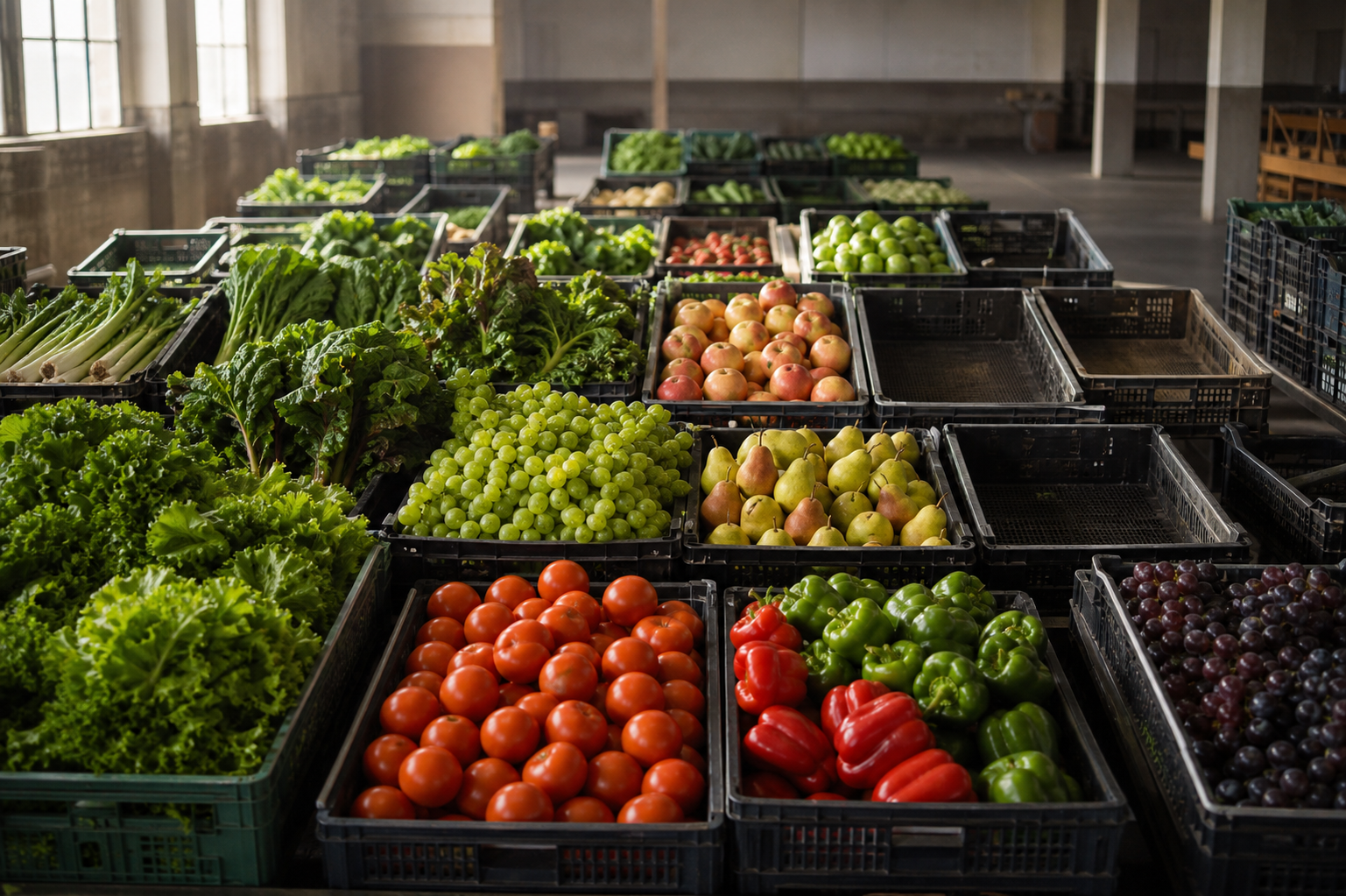
Based on late-August 2026 aT KAMIS wholesale prices, this post summarizes the biggest produce price gains and drops, including bell peppers, tomatoes, paprika, spinach, grapes, mushrooms, and zucchini.
August 2026 Korean Produce Price Movers: Numbers Farmers Should Watch
The late-August wholesale price table was not quiet. Some produce prices more than doubled from a month earlier. A few moved three or even four times higher. At the same time, grapes, mushrooms, and zucchini showed clear weakness.
For farmers, the question is not just whether a crop went up or down. The useful question is whether the month-on-month, year-on-year, and normal-year comparisons all point in the same direction. A sharp rebound from last month can still be close to normal. A monthly drop can still leave a crop above its usual level.
One-line takeaway: Late-August strength was concentrated in green bell peppers, paprika, tomatoes, small napa cabbage, and spinach. Weakness was concentrated in medium-grade oyster mushrooms, Campbell Early grapes, Shine Muscat, Geobong grapes, and zucchini. Rising crops need fast rotation; weaker crops need stricter grading and channel separation.
IMUN.FARM’s ongoing comparison page is available at Produce Prices. The numbers in this article come from a separate aT KAMIS wholesale-price check and should not be confused with the site’s generated price-table data.
1. Data basis: late-August KAMIS wholesale prices
This article uses aT KAMIS wholesale price data checked at the end of August 2026. The query date was August 29, 2026, but many same-day fields were blank in the returned table, so the latest provided August 28 price was used as the current reference.
The table compares three signals.
- Month-on-month: the short-term move versus one month earlier.
- Year-on-year: whether the market is stronger or weaker than the same period last year.
- Normal-year comparison: whether the price sits above or below the usual level.
Month-on-month alone can mislead farmers. A crop that jumped from a weak July price may only be back near normal. Another crop that fell from last month may still be expensive compared with normal years.
2. Late-August price movers in one table
The table below uses wholesale prices. Units differ by crop, so the percentage movement matters more than the absolute price alone.
| Direction | Crop | Unit | Latest price | MoM | YoY | Normal-year | Farm reading |
|---|---|---|---|---|---|---|---|
| Rising | Green bell pepper, medium | 10kg | 56,200 KRW | +431.8% | +191.4% | +89.0% | Very sharp rebound; move well-graded lots quickly |
| Rising | Green bell pepper, premium | 10kg | 73,700 KRW | +301.8% | +145.9% | +85.6% | Strong market; manage grade spread |
| Rising | Paprika, premium | 5kg | 47,200 KRW | +208.2% | -1.3% | +12.4% | Monthly jump, but near last year |
| Rising | Tomato, premium | 5kg | 33,400 KRW | +159.5% | +43.6% | +59.2% | Clear strength in regular tomatoes |
| Rising | Small napa cabbage, premium | 8kg | 37,300 KRW | +115.6% | +0.5% | -1.5% | Strong rebound, near normal |
| Rising | Water parsley, premium | 8kg | 96,000 KRW | +100.3% | +2.3% | +2.8% | Big monthly move; watch quality spread |
| Rising | Zucchini squash, medium | 20 ea | 23,200 KRW | +90.9% | +12.3% | +8.8% | Medium grades recovered too |
| Rising | Spinach, premium | 4kg | 75,000 KRW | +80.2% | +14.5% | +2.5% | Leafy-green strength; avoid over-waiting |
| Falling | Oyster mushroom, medium | 2kg | 6,120 KRW | -42.5% | -48.2% | -47.8% | Clear weakness in medium grade |
| Falling | Campbell Early grape, L | 3kg | 21,000 KRW | -32.4% | -7.4% | -7.4% | Softer than last month and normal |
| Falling | Campbell Early grape, M | 3kg | 18,400 KRW | -28.6% | +1.1% | -3.1% | Close to last year, below normal |
| Falling | Zucchini, premium | 10kg | 17,000 KRW | -25.7% | -27.5% | -16.8% | Weak market; manage volume |
| Falling | Shine Muscat, M | 2kg | 12,800 KRW | -21.8% | -6.5% | -27.7% | Weak versus normal; variety name is not enough |
| Falling | Shine Muscat, L | 2kg | 15,600 KRW | -20.7% | -7.7% | -26.3% | Separate gift-grade and home-use lots |
| Falling | Geobong grape, L | 2kg | 16,200 KRW | -15.9% | -0.6% | -12.4% | Softer than last month; quality premium matters |
The first thing that stands out is green bell pepper. The medium grade was up 431.8% from one month earlier, and the premium grade was up 301.8%. That is good news for growers with clean lots, but it is also a warning. A crop that rises this quickly can weaken just as quickly when shipments rush in.
3. For rising crops, the first question is not “wait longer”
Green bell pepper, paprika, tomato, small napa cabbage, water parsley, and spinach looked strong at the end of August. The tomato price page is useful for ongoing comparison, but farmers should still separate regular tomatoes from cherry tomatoes when making sales decisions. In the KAMIS table used for this article, regular premium tomatoes were up 159.5% from a month earlier, while some small tomato categories showed weakness. The same crop family can split into different markets.
For fast-rising crops, waiting is not always the best strategy. Leafy greens and fruit vegetables can change price quickly when weather improves or shipments increase. Once everyone sees a high price, more lots can arrive at the next market, and mixed medium-grade volume can push the average lower.
Farmers should watch three numbers.
- Crops up more than 80% month-on-month need a clear shipping schedule for premium lots.
- Crops also above last year and normal years should not be priced too cheaply.
- Crops up from last month but near normal should be graded carefully rather than treated as a runaway market.
Small napa cabbage is a good example. Premium small napa cabbage was up 115.6% from one month earlier, but it was 1.5% below the normal-year level. That is a strong rebound from July, not necessarily a long-lasting shortage signal.
4. The weak side starts with mushrooms and grapes
The clearest drop was in medium-grade oyster mushrooms. The 2kg medium-grade price was 6,120 KRW, down 42.5% from one month earlier and roughly 48% below both last year and the normal-year level. That is not just a small adjustment. It points to clear weakness in the medium-grade market.
Grapes also need caution. Campbell Early L-size was down 32.4% from one month earlier, and Shine Muscat L-size was down 20.7%. For grape and Shine Muscat price checks, size and grade matter more than the variety name alone. Shine Muscat M-size was 27.7% below the normal-year level, while L-size was 26.3% below normal.
One sentence matters here. The variety name alone no longer protects the price. For Shine Muscat, sugar level, cluster shape, berry size, color, packaging, and buyer trust decide the premium. Good lots should be separated for gift boxes, direct sales, or trusted buyers, while home-use lots should not be mixed into the same price story.
Zucchini was also weak. Premium 10kg zucchini was 17,000 KRW, down 25.7% from one month earlier, 27.5% below last year, and 16.8% below normal. That is hard to dismiss as normal seasonal noise.
5. Five numbers farmers should write down
The late-August table gives five numbers worth keeping.
- +431.8%: medium-grade green bell pepper versus one month earlier.
- +159.5%: premium 5kg tomato versus one month earlier.
- +80.2%: premium 4kg spinach versus one month earlier.
- -42.5%: medium-grade 2kg oyster mushroom versus one month earlier.
- About -27%: Shine Muscat L and M sizes versus the normal-year level.
These numbers say more than “up” or “down.” Bell peppers and tomatoes show opportunity. Medium-grade oyster mushrooms and Shine Muscat show price-defense pressure.
Numbers do not move alone. Quality, grading, packaging, buyer mix, and shipping date move with them. A strong crop can lose price if mixed lots pull the average down. A weak crop can still protect margin if premium lots are separated and sold through the right channel.
6. Early-September checklist for farmers
Early September combines holiday demand, heat-stress quality issues, and changing shipment volume. A single wholesale average is not enough for a farm price sheet.
Use this checklist.
- Set a shipping pace for fast-rising crops. Bell peppers, tomatoes, and spinach need a plan for moving clean premium lots while the market is strong.
- Grade grapes more strictly. Shine Muscat, Campbell Early, and Geobong should be separated by size, sugar level, gift quality, and home-use quality.
- Do not trust the average for weak medium grades. Oyster mushrooms show how different the premium and medium-grade markets can be.
- Do not raise farm-gate prices based only on the monthly jump. Small napa cabbage rebounded sharply but sat near the normal-year level.
- Explain direct-sale prices with quality facts. Grade, packaging, sweetness, and sorting standards matter more than a vague “market price” claim.
Farming is soil and numbers together. The market table shows the numbers, but the final price often comes from how the crop is sorted and when it reaches the buyer.
7. Conclusion: late August brought both opportunity and warning
The late-August 2026 produce price table does not tell one simple story. Green bell peppers, paprika, tomatoes, spinach, and small napa cabbage jumped strongly. Medium-grade oyster mushrooms, Campbell Early grapes, Shine Muscat, Geobong grapes, and zucchini weakened.
For farmers, rising crops are an opportunity. But a price spike may not stay long. Clean lots should move while the market is strong, and medium-grade lots should go through a separate channel.
Falling crops are not a reason to give up. They are a reason to grade harder. Size, quality, packaging, buyer type, and shipping date can still protect part of the price.
A September farm price sheet should not end at one average price. Put month-on-month, year-on-year, and normal-year comparisons in the same line, then separate premium, medium-grade, gift-grade, and home-use lots before setting the sales plan.
References
- aT KAMIS Agricultural Products Distribution Information, daily wholesale price table, checked at the end of August 2026.
- KAMIS query basis: wholesale prices, Seoul reference, grain, vegetable, specialty/seasoning, and fruit categories, latest price provided in the August 29, 2026 query.
- KAMIS prices are reference market averages. Actual transaction prices can vary by production area, market, brand, grade, quality, packaging, and buyer relationship.
- IMUN.FARM Produce Prices and crop-level price pages.