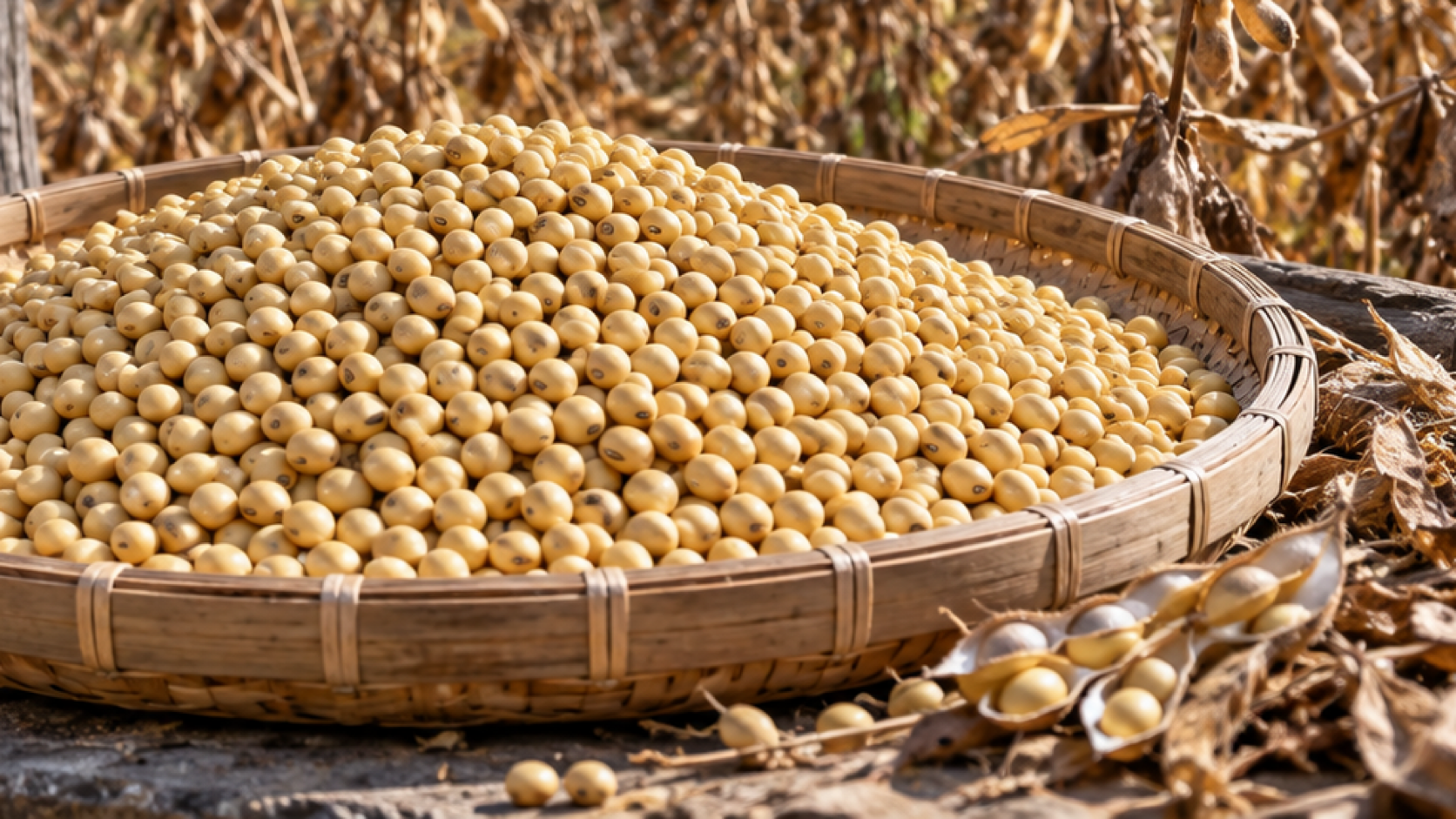
Growing Korean soybean sprouts (kongnamul) at home with official numbers: small-seeded sprouting soybeans, soaking time, watering 4–6 times a day, 20℃ as the best growing temperature and why sprouts rot, about 2.4 kg from 500 g based on a 472% yield trial for Pungsan beans, grower options, and the KAMIS retail price of 340 g sprouts (2,410 won on November 13, 2026).
New-crop soybeans are in the shops, and many households buy a bag of small sprouting soybeans too. Growing kongnamul in a pot in the living room is a winter habit in Korea. The questions are always the same: how often to water, why the sprouts rot, and how much one bag produces.
Bottom line: 500 g of sprouting soybeans can give about 2.4 kg of sprouts. In a Gyeonggi-do Agricultural Research and Extension Services trial, Pungsan sprouting beans produced 472% of their weight in sprouts (our calculation; home results are usually lower). An RDA study found 20℃ the best growing temperature; sprouts started rotting when the water reached 23–25℃. Water 4–6 times a day. KAMIS listed domestic-soybean sprouts at 2,410 won per 340 g on November 13, 2026.
Earlier notes: small black soybeans are in Small Black Soybeans 2026, and white soybean wholesale prices are on Soybean prices.
1. Use small-seeded sprouting beans
The National Institute of Crop Science says small beans give more sprouts, sprout faster and grow to a suitable length. A Gyeonggi trial treated a 100-seed weight of 10–12 g as right for sprouting. RDA sprouting varieties include Pungsan-namul, Sowon, Haepum, Aram and Haewon. Large beans such as meju soybeans crack while soaking and rot, as an RDA press release (2011) noted.
2. Soak 6–12 hours in water around 20℃
An RDA release says beans are usually soaked for 6 hours; the Honam Agricultural Experiment Station method soaks them for 12 hours in 20℃ water. Remove floating and broken beans.
3. Water 4–6 times a day and keep it dark
The Honam method waters six times a day; a trade paper suggests every 5–6 hours. Water evenly from the top and empty the tray each time. Cover the pot: a 2002 Korean Journal of Crop Science study found light turned the seed leaves green. We found no official source for the common claim that light makes sprouts bitter.
4. Temperature: keep it near 20℃
RDA researcher Kim Seon-rim grew sprouts at 17, 20, 25 and 30℃ and judged 20℃ suitable. With water at 14–20℃ no beans rotted; at 23–25℃ some rotted from day 7. In winter, keep the pot off the cold floor and away from heaters, and let tap water reach room temperature before using it.
5. Yield by variety (Gyeonggi trial, 2020–2021)
| Variety | Sprout yield | From 500 g (our calculation) |
|---|---|---|
| Haewon | 326.3% | about 1.6 kg |
| Pungsan | 472.4% | about 2.4 kg |
| Joyang 1 | 537.4% | about 2.7 kg |
The trial grew sprouts for 4 days at 23℃ with hourly watering. The often-quoted “5–7 times the beans” could not be confirmed in an official source.
6. Growing versus buying
1.1 kg of Pungsan sprouting beans sold for 12,980 won on Coupang on November 15, 2026, so 500 g costs about 5,900 won. About 2.4 kg of sprouts at the KAMIS rate (2,410 won per 340 g) would cost about 16,700 won. If the trial yield holds, the beans cost about a third of buying sprouts, before the grower, water and losses.
7. For farmers
Small packs labelled with variety and harvest year (for example “new-crop domestic Pungsan sprouting beans, 500 g”) suit home growers. Keep broken beans out of sprouting packs; they rot and spoil the whole pot. Send them to flour or meju use instead.