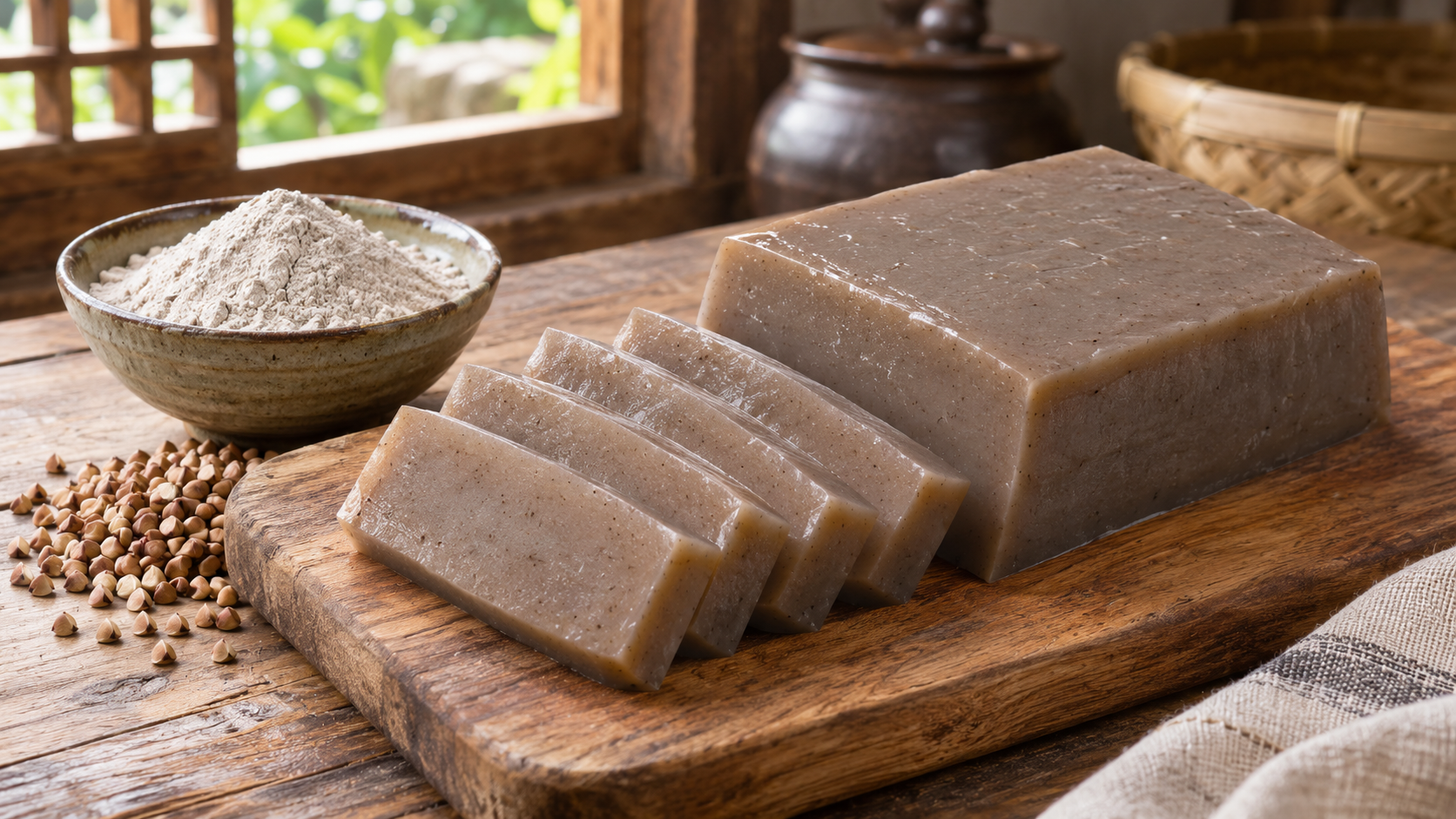
How to make memilmuk at home from the Korean Traditional Food Research Institute, the Encyclopedia of Korean Culture, Nongsaro and RDA: buckwheat flour vs memilmuk powder, the 1:6 powder-to-water ratio, stirring and resting times, setting and storage, buckwheat crepe batter, KAMIS imported buckwheat at 2,800 won per kg on November 13, 2026, and harvest seasons and regions.
Memilmuk, a soft buckwheat jelly served with soy-sesame dressing, is a Korean winter favourite. Most failures come from the wrong water ratio or scorching the pot.
Bottom line: Whisk 1 cup memilmuk powder into 6 cups cold water, stir constantly over low heat, keep stirring 5–10 minutes after it boils, rest, then pour into a dish to set. The 1:6 ratio is the Korean Traditional Food Research Institute’s guide for starch jellies. Memilmuk powder (often mixed with mung bean starch) sets more easily than pure buckwheat flour. KAMIS imported buckwheat (mid grade) was 2,800 won per kg in Seoul on November 13, 2026.
1. Flour or jelly powder
Nongmin Shinmun advises using memilmuk powder that contains mung bean starch for jelly, and pure buckwheat flour for crepes, noodles and dumplings. Check the label for the buckwheat-to-starch ratio. If the packet gives its own water ratio, follow that first.
2. Method
- Whisk powder into cold water until smooth.
- Heat gently, stirring to the bottom with a wooden spatula.
- Once it boils, lower the heat and stir 5–10 minutes more until thick and glossy.
- Cover and rest about 10 minutes.
- Pour into a lightly wetted dish and set at room temperature (forced chilling makes it stiff).
Refrigerated jelly firms up as the starch retrogrades; blanch 1–2 minutes in boiling water to restore its texture. Memilmuk is 84% water (RDA webzine).
3. Buckwheat crepe (memil-jeonbyeong)
Nongsaro: 1 cup buckwheat flour to 1/2 cup water. The Korean Traditional Knowledge Portal: 100 g flour, 100 ml water, 2 tsp salt.
4. Prices
KAMIS surveys only imported buckwheat daily: 2,800 won per kg in Seoul and 3,250 won in Daegu on November 13, 2026 (2,800 and 3,370 a year earlier). Domestic pure buckwheat flour on Coupang was about 18,900–21,800 won per kg on November 16, 2026.
5. For growers
Autumn buckwheat is harvested in October in central regions and late November to early December on Jeju; harvest when 75–80% of seeds are ripe (Nongsaro). Jeju had 73.7% of national buckwheat area in 2022 (RDA). Milling into flour adds value, but we found no official milling yield or fee data.
References
- Korean Traditional Food Research Institute, Muk
- Encyclopedia of Korean Culture, Memilmuk
- Nongmin Shinmun (2015)
- Nongsaro, buckwheat work schedule
- RDA webzine (2024.12)
- RDA webzine (2023.09)
- KAMIS imported buckwheat prices, surveyed November 13, 2026 (Buckwheat prices)