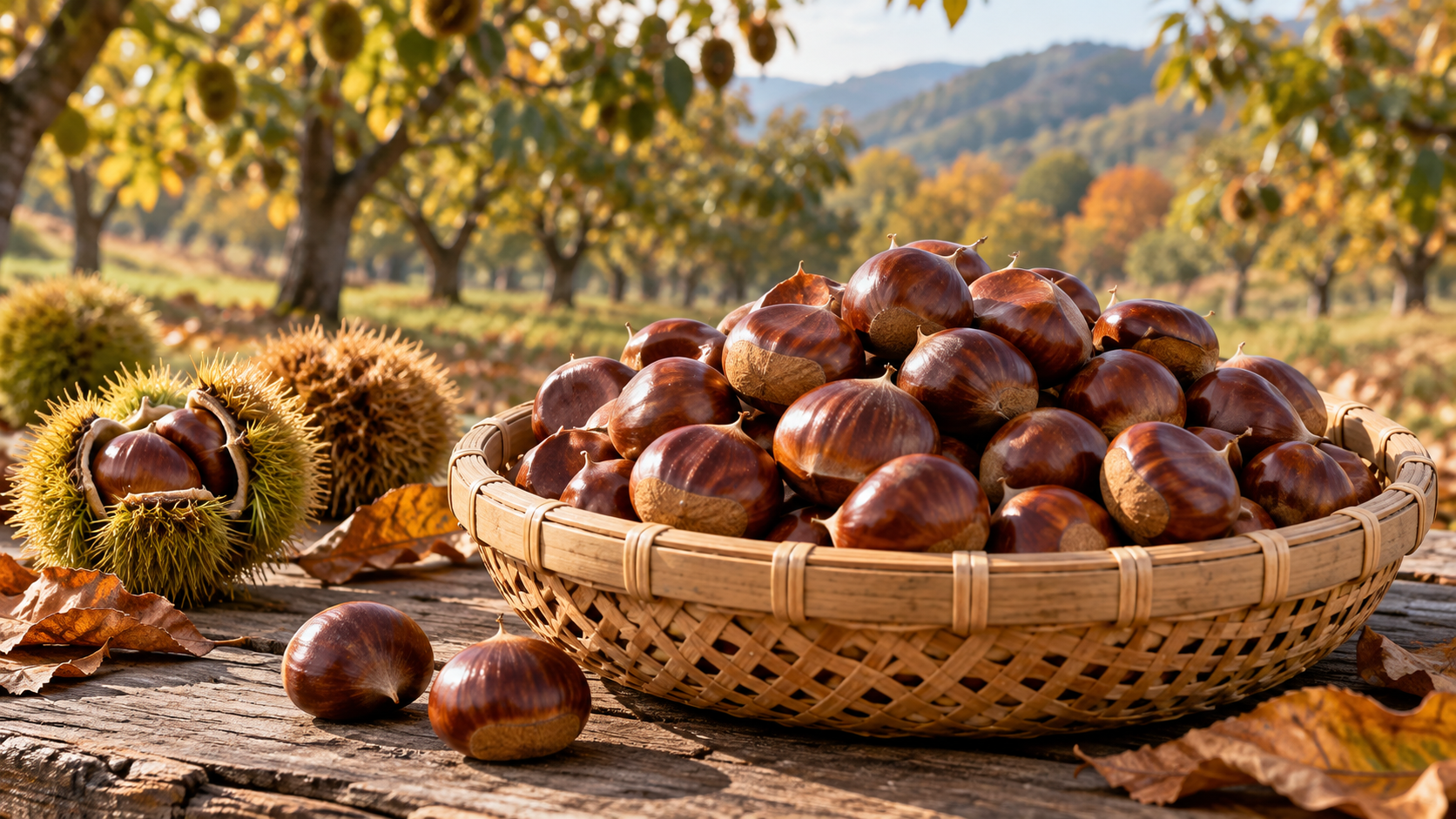
Korea Forest Service guidance on storing fresh chestnuts (2–4°C for about two months), longer storage, peeling tips from the Rural Development Administration, 2026 Gongju chestnut prices from KREI forestry outlook, and harvest timing by variety.
A box of fresh chestnuts disappears quickly for the first few days. Leave the rest at room temperature and within a week or two the shells shrivel, and some nuts sprout holes as grubs crawl out. Chestnuts lose moisture from the moment they fall, and weevil larvae can be inside nuts that look perfect. Sorting on day one and chilling right away is most of what storage takes.
Bottom line: The Korea Forest Service says chestnuts kept in perforated plastic bags at 2–4°C last about two months. Above 5°C some will rot, and after three months of ordinary refrigeration shells darken and flesh browns. Freeze anything longer. Prices are low this year: according to the Korea Rural Economic Institute (KREI) forestry outlook for October 2026, top-grade chestnuts at Garak market averaged KRW 5,061 per kilogram in September, 17.1% below a year earlier, with October expected to stay weak.
1. What to do on the first day
In a survey cited by the Korea Forest Service, chestnuts left at room temperature for 15 days lost 8.1–10.5% of their weight depending on variety. Remove rotten, insect-damaged, immature, misshapen and cracked nuts; dry any wet nuts in the shade; then refrigerate the same day.
Sorting cannot catch every pest. The chestnut weevil lays most eggs from late September to early October, and larvae feed inside for 30–40 days before boring a hole about 3 mm wide. Because they keep their droppings inside, damage is invisible until then. Mid and late varieties harvested after late September are hit hardest.
2. Refrigerating: 2–4°C for about two months
| Item | Korea Forest Service guidance |
|---|---|
| Bag | Polyethylene, 0.03–0.06 mm thick |
| Holes | Punch holes with a needle or awl |
| Temperature | 2–4°C (above 5°C some nuts may rot) |
| Duration | About two months |
| Beyond 3 months | Darkened shells, browned flesh, off odors |
A 2016 study in the Journal of Korean Forest Society stored major varieties at 4°C and −1°C for 16 weeks. Sugar rose at both, more at −1°C, and rot was lower at −1°C. The authors recommended 4°C for storage under a month and −1°C for four months or more. Home fridges rarely hold −1°C steadily, so at home aim for 2–4°C and eat within two months.
3. Freezing
For longer storage, the Korea Forest Service describes quick-freezing to −25°C to −40°C and thawing for use. At home, freeze in portion-size bags, peeled for cooking or boiled for snacks, with air pressed out. We found no official guidance on how many months home-frozen chestnuts keep, so we do not give a figure.
4. Boiling and peeling
No Korean agency publishes an official boiling time. Size is the main variable: under the standard forest product grades, extra-large nuts weigh 25 g or more and medium nuts 13–16 g. Boil nuts of similar size together, start timing once the water boils, and cut the largest nut in half: it is done when the center is yellow and crumbly. Rest with the lid on after turning off the heat.
For peeling, the Rural Development Administration’s Nongsaro suggests soaking boiled chestnuts in cold or ice water for about 20 minutes. For raw chestnuts, slice off a thin piece of the rounded end and soak in boiling water for 8–10 minutes before peeling.
5. Chestnut prices in 2026
Chestnuts are not in the KAMIS daily survey, so the benchmark is KREI’s monthly forestry outlook.
| Measure | Value | Source |
|---|---|---|
| Garak wholesale, top grade, Sep 2026 | KRW 5,061/kg (KRW 6,105 a year earlier) | KREI outlook, Oct 2026 |
| Garak wholesale, Jul and Aug 2026 | KRW 5,477/kg (−15.7% year on year) | KREI outlook, Aug & Sep 2026 |
| Farm purchase price, regular top grade | KRW 3,100–3,300/kg (about 4,000 in 2025) | Hankyung, Oct 14, 2026 (aT) |
| Traditional market retail | KRW 5,000–6,000 per 500 g | Same |
KREI expects larger harvests this year (Gongju early varieties +5.7%, mid +6.1%, late +6.3%) with more large nuts, while high carry-over stocks pushed purchase prices down.
”Gongju chestnut” is an origin: Gongju (8,380 t), Buyeo (6,655 t) and Cheongyang (4,649 t) produced 53% of Korea’s 37,010 t in 2024. “Okgwang” is a variety: a mid-season nut averaging 18 g that the Forest Service lists among high-priced varieties with Daebo and Ipyeong.
6. For growers: harvest timing and grading
| Group | Harvest | Varieties (average weight) |
|---|---|---|
| Early | Before early Sep | Tanzawa late Aug–early Sep (20 g), Hangawi early Sep (24 g) |
| Mid | Early to late Sep | Okgwang (18 g), Daebo (20 g), Ipyeong (22 g), Daegwang (29 g) |
| Late | After late Sep | Seokchu late Sep–early Oct (20 g), Mipung late Sep–early Oct (27 g) |
Collect early in the morning, sort out damaged nuts, and grade by size: extra-large 25 g+, large 16–25 g, medium 13–16 g, small under 13 g. In a weak-price year, careful grading protects returns. With large carry-over stocks, holding stored nuts for a price rise is risky; check local cooperative purchase schedules first.
References
- Korea Forest Service, cultivation guide “Nut trees: Chestnut” (harvest timing, weight loss, sorting, refrigerated storage at 2–4°C, freezing, pests).
- Joo et al., “Quality changes of chestnut by storage temperature and variety,” Journal of Korean Forest Society 105(1), March 2016.
- Rural Development Administration Nongsaro, “Easy ways to peel chestnuts.”
- Korea Rural Economic Institute, Forestry Outlook (Chestnut), August, September and October 2026; December 2025 (2024 production).
- Hankyung, October 14, 2026 (purchase and retail prices citing aT).