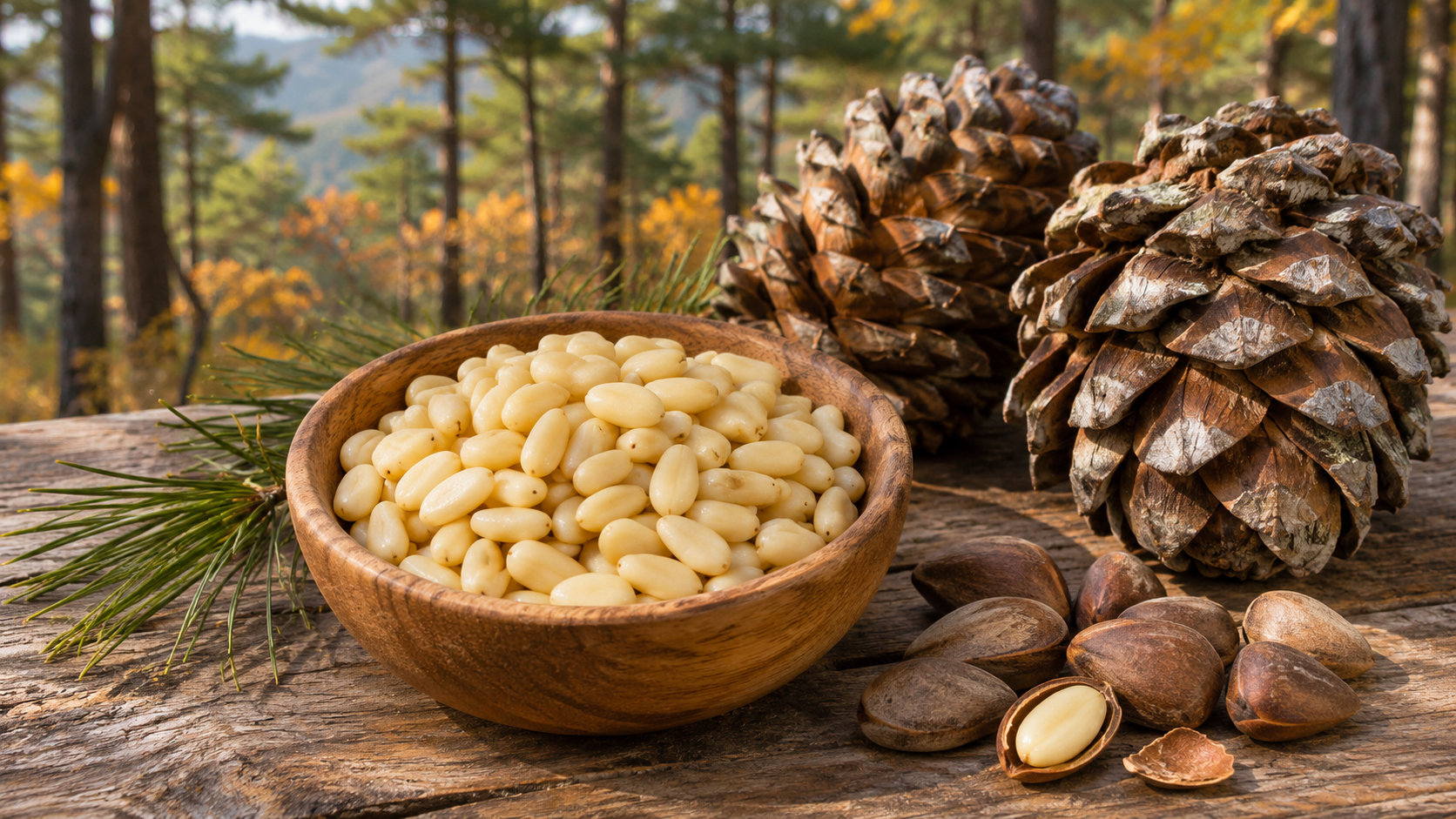
The Gapyeong shelled pine nut (top grade) producer price of KRW 155,000 per kg on October 19, 2026 versus KRW 63,000 in 2016, online prices on November 3, the collapse of Gapyeong pine nut output from 2,205t in 2014 to 9.2t in 2024, the difference between in-shell, skin-on and white pine nuts, how to shell and store them, and what growers face.
Pine nuts are a small ingredient in Korean kitchens, a garnish on porridge or a few floating in water kimchi, but this autumn their price stops shoppers. Shelled domestic pine nuts cost over KRW 150,000 per kilogram, more than double the level of ten years ago.
Bottom line: On October 19, 2026, the producer price for top-grade shelled Gapyeong pine nuts was KRW 155,000 per kg, 146% above KRW 63,000 on the same day in 2016 (Korea Forestry Cooperatives Federation data, reported by Segye Ilbo). On November 3, new-crop Gapyeong skin-on pine nuts sold online for KRW 145,000–150,000 per kg and KRW 62,000–79,000 per 500g. The reason: Gapyeong output fell 99.6%, from 2,205t in 2014 to 9.2t in 2024 (Korea Forest Service).
1. Current prices.
| Item | Price | Basis |
|---|---|---|
| Gapyeong shelled, top grade, producer | KRW 155,000/kg | Oct 19, 2026 |
| Same item ten years earlier | KRW 63,000/kg | Same day, 2016 |
| Online Gapyeong new-crop, 1kg | KRW 145,000–150,000 | Coupang, Nov 3, 2026 |
| Online Gapyeong, 500g | KRW 62,000–79,000 | Same day |
Pine nuts are not covered by KAMIS daily produce prices.
2. Why so expensive.
| Year | Gapyeong | Korea total |
|---|---|---|
| 2014 | 2,205t | 6,671t |
| 2016 | 3,865t | 9,682t |
| 2018 | 183t | 1,223t |
| 2021 | 82t | 445t |
| 2022 | 335t | 828t |
| 2023 | 24t | 816t |
| 2024 | 9.2t | – |
Causes cited: the leaf-footed pine seed bug (Leptoglossus occidentalis), which empties the cones; pine wilt disease; and heavy rain during the mid-September to mid-October harvest in 2025. Pine nut yields also swing on a two-to-three-year cycle, but not by this much.
3. In-shell, skin-on, or white.
In-shell (pijat) still has the hard brown shell. Skin-on (hwangjat) has the shell removed but keeps the thin brown skin and tastes nuttier. White (baekjat) has the skin removed too and looks clean as a garnish. Prices are about the same within a seller.
4. Buying tips.
Check origin and harvest year, be wary of “domestic” pine nuts priced far below the producer price, and buy 500g or 1kg to freeze in portions rather than 100g packs. No official visual method to tell Korean from imported pine nuts was found, so labels and seller details are the evidence.
5. Shelling and storage.
Stand an in-shell nut on its pointed end and press gently with pliers or a nut cracker. To whiten, soak briefly in warm water, rub off the skin and dry. Shelled pine nuts are oily and go rancid, so freeze them in airtight single-use portions and use them straight from the freezer.
6. For growers.
Cones are picked from tall trees and dried before the nuts are threshed and shelled. Growers choose between selling in-shell nuts to forestry cooperatives or shelled nuts direct. With output this low, the problem is having nothing to sell, and high prices are cutting consumption.
References
- Segye Ilbo, October 20, 2026 (Korea Forest Service production survey; Korea Forestry Cooperatives Federation price system): segye.com
- Hankyung (Yonhap), June 19, 2025 (Gapyeong County data): hankyung.com
- Nongmin Shinmun, November 1, 2025: nongmin.com
- Coupang Partners product search prices, checked November 3, 2026.