KAMIS data as of October 28, 2026: autumn napa cabbage wholesale prices and the cost of 10 or 20 heads, brine strength and salting time from RDA and the World Institute of Kimchi, rinsing rules from MFDS, a comparison with 20kg pre-salted cabbage, and harvest and frost guidance for growers.
Every kimjang season, Korean households decide whether to order pre-salted cabbage or buy whole heads and salt them at home. This year the math shifted. Autumn napa cabbage reached the wholesale market two weeks earlier than last year, and its first price is nearly 40% below last November’s average. Here is the cost, the salt and the hours, from official sources.
Bottom line: In the KAMIS survey on October 28, 2026, a 10kg net of autumn napa cabbage (3 heads, top grade) sold at wholesale in Seoul for KRW 9,400, about KRW 3,100 a head. That puts 10 heads at about KRW 31,000 and 20 heads at about KRW 63,000 wholesale. Korea Price Research Center budgets 5kg of sea salt for 20 heads. The RDA’s Nongsaro guide salts in roughly 15% brine for about 8 hours, turning once or twice. MFDS advises rinsing no more than three times.
Earlier records: 20kg pre-salted cabbage prices, the 2026 kimjang cost checklist and jjokpa prices.
1. What a net of cabbage costs now
Autumn cabbage entered the KAMIS survey on October 26 this year; last year it first appeared on November 10.
| City | 10kg net (3 heads), KRW | Per head | Medium grade |
|---|---|---|---|
| Gwangju | 11,200 | 3,733 | 9,000 |
| Seoul | 9,400 | 3,133 | 7,250 |
| Busan | 9,000 | 3,000 | 7,000 |
| Daegu | 8,400 | 2,800 | 6,160 |
| Daejeon | 6,800 | 2,267 | 5,300 |
Seoul’s November averages over 11 years ran from KRW 4,667 (2015) to KRW 15,527 (2025), the highest. Today’s KRW 9,400 is 39% below last November and close to 2022 and 2023. With only three days of data, the direction from here is unknown. Daily prices: napa cabbage.
2. Cost of salting 10 or 20 heads yourself
| Heads | Cabbage (Seoul wholesale) | Sea salt |
|---|---|---|
| 10 | about 31,300 | 2.5kg |
| 20 | about 62,700 | 5kg |
Korea Price Research Center priced 5kg of sea salt at KRW 6,000 in traditional markets in 2025. Supermarket pre-orders for 20kg of pre-salted cabbage started at KRW 39,900 for Haenam (29,900 with a card discount), 35,900 for Goesan and 59,900 for Pyeongchang. Salting removes water and trimming removes leaves, so 20kg of pre-salted cabbage takes more than 20kg of raw heads; compare by the head count printed on the box. On ingredients alone, salting at home is cheaper this year, at the cost of a large basin, a night and your back.
3. Brine and salt
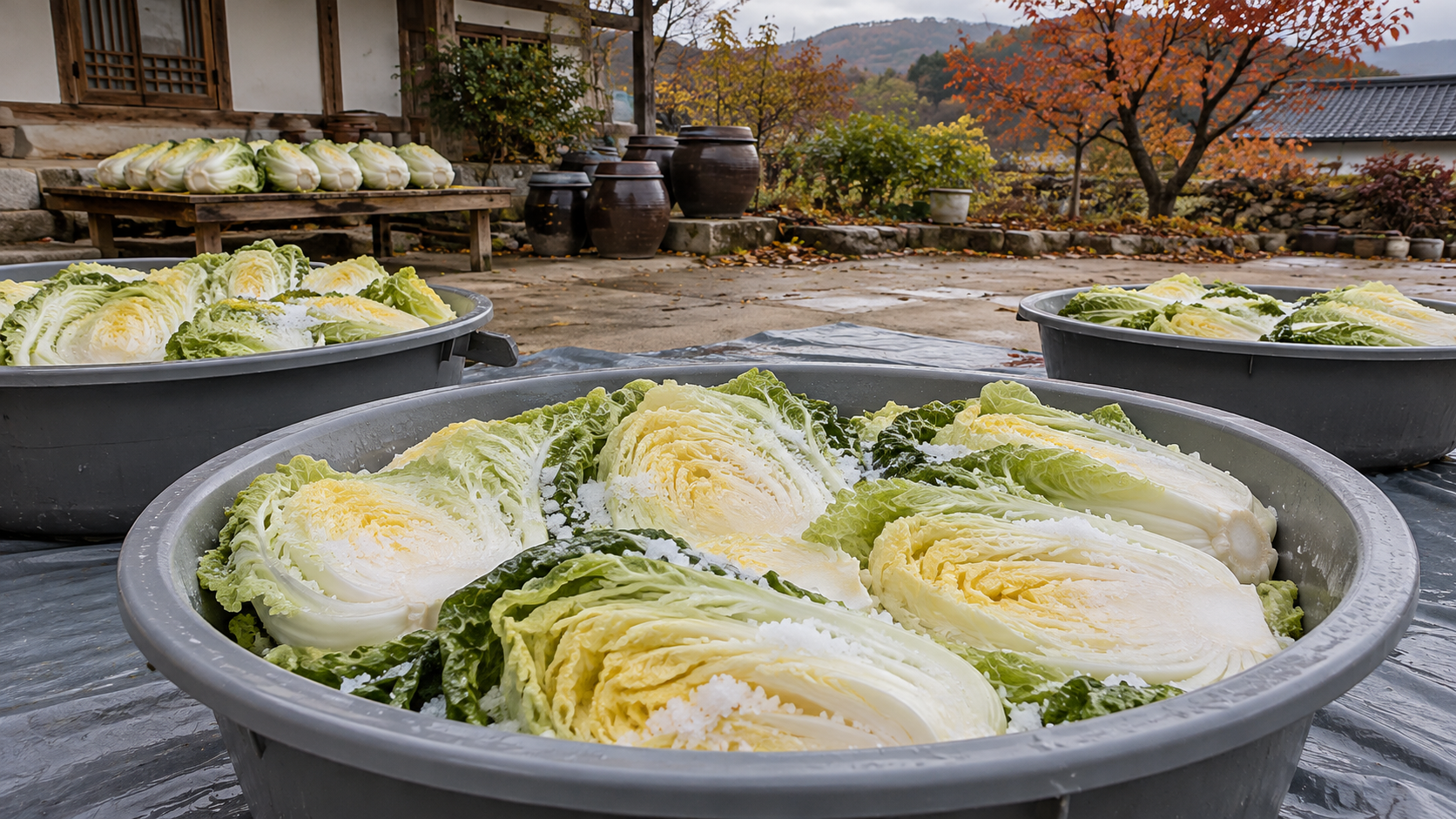
The RDA’s Nongsaro method: halve the heads, dip them in roughly 15% brine, sprinkle coarse salt between the stems, stack them, pour the brine back over, and salt for about 8 hours, turning once or twice. A 15% brine is about 1.8kg of salt in 10 liters of water. The World Institute of Kimchi gives 80–100g of salt per liter as an example and notes that salt, time and temperature vary by region, season and household. Use sun-dried coarse sea salt with the bittern drained.
4. Checking, rinsing and draining
Nongsaro describes properly salted cabbage only as “wilted just right”; at home, people bend the thick stem to see that it curves instead of snapping. MFDS tests found that three rinses cut total bacteria by 95% and coliforms by 93%; more rinsing can make the cabbage soft. A Gyeonggi agricultural research center found that three rinses after 6 hours in 10% brine removed aphids and parasite eggs. Drain the halves cut side down on a large rack, and use them the same day or the next morning.
5. For growers: harvest and frost
The RDA treats kimjang cabbage as ready 110–120 days after sowing, about 60 days after transplanting, when the head gives 1–2cm when pressed from the top. Seoul’s agricultural technology center puts the best harvest time around mid-November. Outer leaves begin to freeze around −3°C (RDA); the Seoul center warns of frost damage at −8°C, or at −3°C after a sudden drop. Do not harvest right after freezing; wait for the plant to recover. Store at 0–3°C and 90–95% humidity. Farms selling pre-salted cabbage should follow the MFDS hygiene guideline and check licensing with the local government first.
6. Checklist
- Seoul autumn cabbage KRW 9,400 per 3-head net (Oct 28), 39% below last November’s average.
- 10 heads about KRW 31,000 wholesale; 5kg of salt for 20 heads.
- About 15% brine, about 8 hours, turn once or twice.
- Rinse up to three times, drain cut side down, use within a day.
- Growers: harvest before a −3°C forecast.
References
- aT KAMIS, intermediate wholesaler prices: autumn napa cabbage, five cities, November 10, 2025 and October 26–28, 2026; Seoul November averages, 2015–2025.
- RDA Nongsaro, kimchi-making guide (brine about 15%, about 8 hours).
- World Institute of Kimchi, “Is the salt in kimchi bad for you?” May 13, 2024.
- Gyeonggi-do Agricultural Research and Extension Services via Nongsaro (2009).
- MFDS pre-salted cabbage rinsing test (Kuki News, November 13, 2019) and hygiene guideline.
- Segye Ilbo, November 16, 2025 (Korea Price Research Center 2025 kimjang survey).
- RDA webzine, November 2020 and August 2021; Seoul Agricultural Technology Center; Gimpo Agricultural Technology Center (News Seoul, November 8, 2022).
- Ministry of Agriculture, Food and Rural Affairs, October 29, 2024.
- Wholesale prices are intermediate wholesaler selling prices, not farm-gate or retail prices.