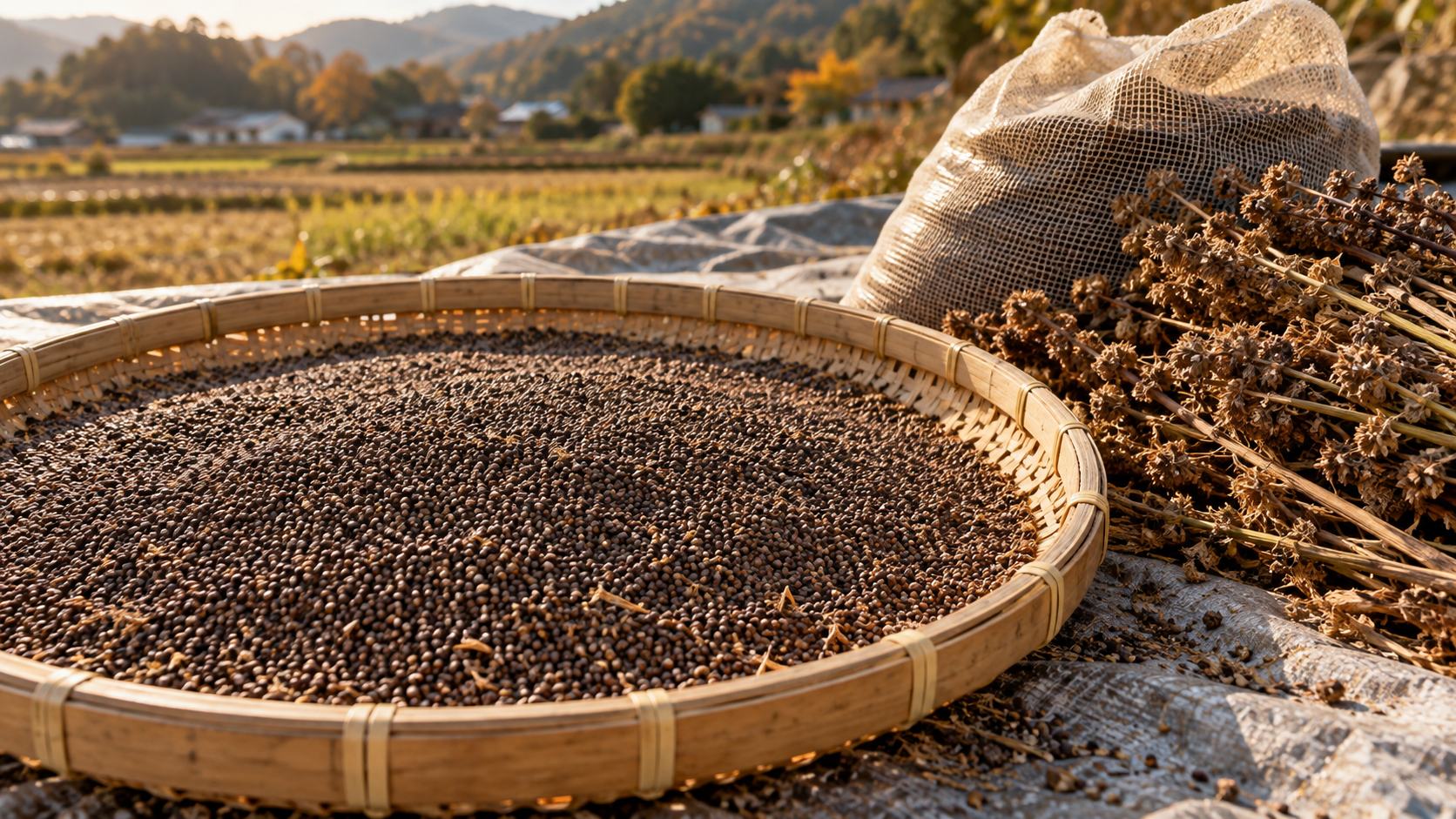
KAMIS data as of October 16, 2026: domestic and imported perilla seed wholesale prices per kilogram, how October prices moved by December and February over 11 years, and when buyers and growers should act after harvest.
By mid-October most Korean perilla fields have been cut, dried and threshed. “New-crop perilla” listings start to appear, buyers ask whether to buy now, and growers ask whether to sell now. Both questions start from the same table: what domestic perilla seed sells for at wholesale today, and how October prices moved by year-end in past seasons.
Bottom line: In the KAMIS survey on October 16, 2026, domestic perilla seed (top grade, 23 kg) averaged KRW 381,800 at wholesale across five cities, about KRW 16,600 per kilogram, 9.9% higher than a year earlier. Imported perilla (mid grade, 45 kg) averaged KRW 293,000, about KRW 6,500 per kilogram, up 15.8%. Over the past 11 years in Seoul, December was higher than October six times and lower five times. There is little evidence that waiting after harvest pays.
1. Wholesale price today
| City | 23 kg, KRW (Oct 16) | Per kg | A year earlier | Change |
|---|---|---|---|---|
| Daegu | 397,000 | 17,261 | 355,000 | +11.8% |
| Gwangju | 382,000 | 16,609 | 346,000 | +10.4% |
| Busan | 380,000 | 16,522 | 337,000 | +12.8% |
| Daejeon | 376,000 | 16,348 | 359,000 | +4.7% |
| Seoul | 374,000 | 16,261 | 340,000 | +10.0% |
Only two cities changed in the past month: Gwangju rose 7.3% on October 6 and Daejeon rose on September 29. Seoul has held at KRW 374,000 since June 16. Perilla wholesale prices move in steps and then stay flat for weeks or months. Daily prices are on perilla seed prices.
Imported perilla averaged KRW 293,000 per 45 kg, about 39% of the domestic price per kilogram. It rose faster than domestic over the year (Seoul +28%).
2. Reading “one mal” prices
Direct sales in Korea are often quoted per mal, a traditional volume unit. Sellers pack one mal as 5 kg or 6 kg, so convert to kilograms first. At the wholesale rate of about KRW 16,600 per kilogram, 5 kg is about KRW 83,000 and 6 kg about KRW 100,000. Higher direct prices include cleaning, packing and shipping. Much lower prices suggest uncleaned seed or imported content.
3. For buyers
Timing matters less than condition. Check the harvest year (much “domestic perilla” on sale is still 2025 crop), how clean the seed is, and the origin if the price is close to the imported wholesale rate. Store unused seed cool and dry or refrigerated, because perilla is oily and turns rancid in warm rooms.
4. For growers: sell in October or hold?
Seoul domestic top-grade monthly averages in KRW (KAMIS); the last two columns show change from October:
| Crop year | October | December | Dec. | Next Feb. |
|---|---|---|---|---|
| 2015 | 196,429 | 184,762 | −5.9% | −8.4% |
| 2016 | 180,000 | 162,143 | −9.9% | −9.7% |
| 2017 | 158,000 | 155,000 | −1.9% | −1.9% |
| 2018 | 205,000 | 230,474 | +12.4% | +14.0% |
| 2019 | 247,429 | 220,250 | −11.0% | −11.6% |
| 2020 | 292,500 | 322,500 | +10.3% | +18.5% |
| 2021 | 320,895 | 337,500 | +5.2% | +3.2% |
| 2022 | 311,000 | 286,857 | −7.8% | −9.1% |
| 2023 | 255,000 | 262,000 | +2.7% | −3.9% |
| 2024 | 271,900 | 283,700 | +4.3% | −1.4% |
| 2025 | 340,000 | 367,619 | +8.1% | +12.8% |
December beat October in 6 of 11 years; the following February beat October in only 4. Stored seed also loses weight and risks rancidity and pests. This year starts from a record October level (Seoul KRW 374,000, 10% above last October), which makes holding for further gains harder to justify. A practical approach: sell well-dried seed through regular buyers in late October and November when “new crop” demand peaks, or sell half now and decide on the rest after seeing December prices. Wholesale prices are what intermediaries charge, so farm-gate prices are lower. Compare markets with the produce market calculator.
References
- aT KAMIS period wholesale prices (data.go.kr): perilla seed domestic top grade 23 kg and imported mid grade 45 kg, five cities, October 16, 2025, September 16 and October 16, 2026.
- aT KAMIS monthly wholesale averages (data.go.kr): Seoul domestic perilla seed, October 2015 to October 2026.
- IMUN.FARM price pages for domestic and imported perilla seed.
- Per-kilogram figures divide KAMIS wholesale prices by unit weight; they are not farm-gate or retail prices. October 2026 monthly average covers data through the 16th.