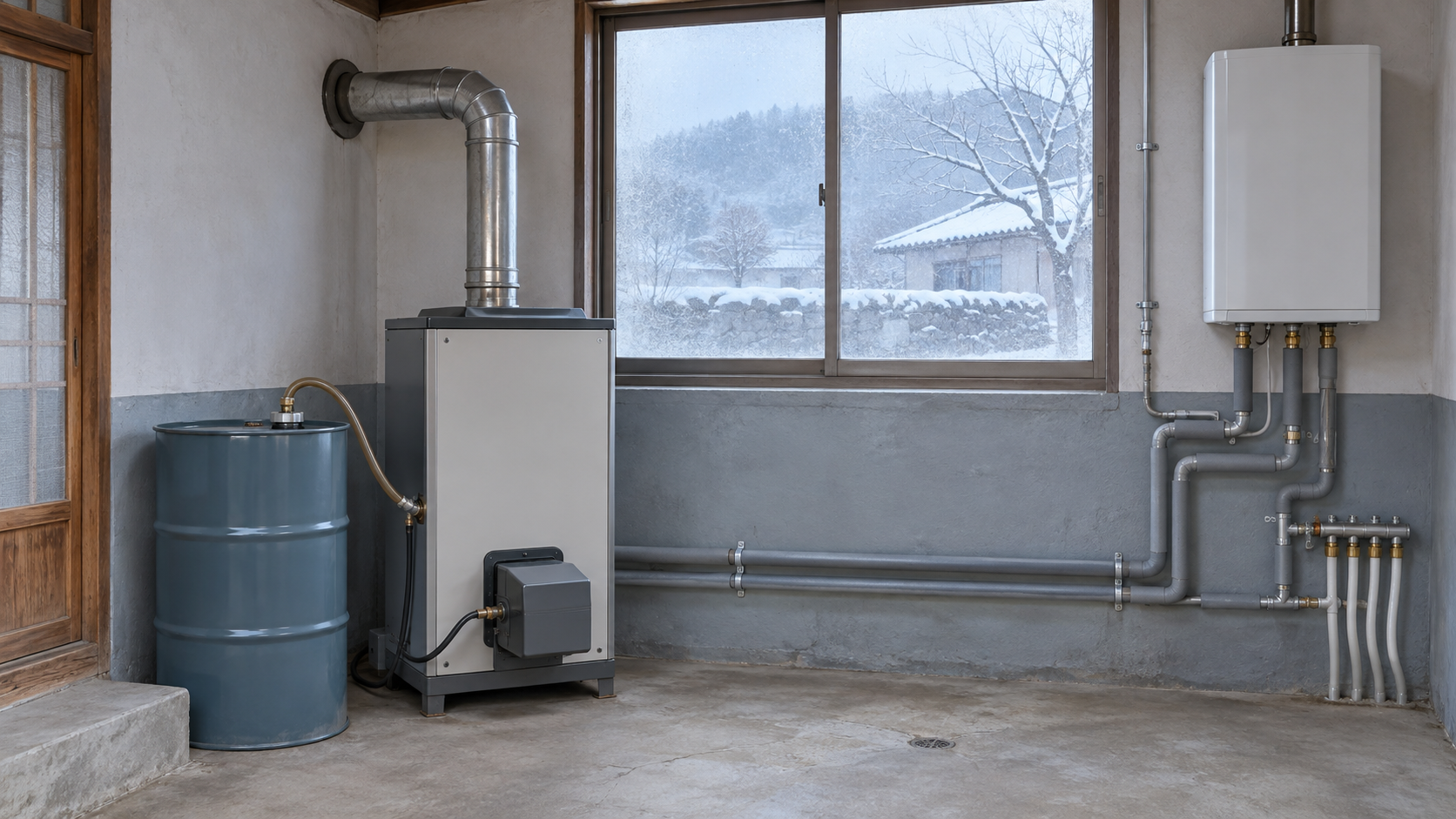
A same-heat comparison of kerosene oil boilers, electric boilers and off-peak (night-rate) electric boilers for a rural Korean house, using the Opinet national average indoor kerosene price of 1,568.41 won per liter (November 22, 2026) and KEPCO residential and off-peak tariffs, with how long a 200-liter drum lasts and what happened to boiler replacement subsidies.
Winter in a country house starts with watching the oil tank gauge. Once the first drum is filled in November, the question is how many more the season will take, and whether switching to an electric boiler would be cheaper.
Bottom line: The Opinet national average for indoor kerosene was 1,568.41 won per liter on November 22, 2026, so a 200-liter drum costs about 313,700 won. At 10 liters a day a drum lasts 20 days; at 5 liters, 40 days. Producing the heat of one liter of kerosene with regular residential electricity costs about 3,130 won in the top progressive tier and about 7,300 won in the winter “super user” tier, but about 1,140 won on the off-peak (Gap) winter rate. We assume 85% efficiency for the oil boiler and 100% for electric, excluding delivery and installation costs.
1. How long does a drum last?
| Kerosene per day | Days per 200 L drum | 30-day fuel cost |
|---|---|---|
| 5 L | 40 | about 235,300 won |
| 8 L | 25 | about 376,400 won |
| 10 L | 20 | about 470,500 won |
| 15 L | 13 | about 705,800 won |
Measure your own daily use by dividing 200 liters by the days between two fills.
2. Converting to the same heat
Under the Energy Act enforcement rules, kerosene has a gross calorific value of 8,740 kcal per liter and delivered electricity counts as 860 kcal per kWh. At an assumed 85% boiler efficiency, one liter of kerosene puts about 7,430 kcal, or 8.64 kWh, into the house.
3. Electric boiler costs
KEPCO’s residential low-voltage tariff (in effect since November 9, 2023) charges 120.0, 214.6 and 307.3 won per kWh across its three tiers, plus a 9.0 won climate charge, a 5.0 won fuel adjustment for Q4 2026, 10% VAT and a 2.7% power fund levy. From December to February, usage above 1,000 kWh a month is billed at 736.2 won.
| Heating method | Cost per kWh (incl. tax) | Heat of 1 L kerosene |
|---|---|---|
| Oil boiler | – | about 1,568 won |
| Residential, 201–400 kWh | about 257.6 won | about 2,226 won |
| Residential, above 400 kWh | about 362.1 won | about 3,128 won |
| Residential, winter above 1,000 kWh | about 845.5 won | about 7,304 won |
| Off-peak (Gap), winter | about 132.4 won | about 1,144 won |
| Off-peak (Eul I), winter | about 116.1 won | about 1,003 won |
A house that normally uses 250 kWh a month and replaces 10 liters a day of kerosene heat with a regular electric boiler would add about 2,590 kWh, taking a winter bill from about 44,880 won to about 1.86 million won, against about 470,000 won of kerosene.
4. Off-peak electric boilers
Off-peak power is metered separately for use between 22:00 and 08:00. Winter rates (November to February) are 103.5 won for Gap and 89.0 won for Eul I. Storage boilers heat water at night for daytime use. Before switching, ask KEPCO (123) whether new off-peak contracts are available at your address, and price the storage tank, separate meter and capacity upgrade. Our calculation ignores storage heat loss.
5. Replacement subsidies in 2026
News1 reported on June 23, 2026 that the national budget for household low-NOx boiler subsidies (mostly gas boilers) was cut entirely for 2026; we could not find the government notice itself. A trade paper reported a 2026 heating electrification program that replaces kerosene and LPG boilers with air-source heat pumps in warmer regions, applied for by contractor consortia after local notices. Check with your county office. Low-income households can buy kerosene with the Energy Voucher (Energy Voucher 2026).
6. Cut heat loss first
Fuel cost times quantity is the bill. Draft stoppers and window bubble wrap cost far less than a new boiler and reduce use whatever the fuel (Draft Stoppers and Insulation Film).
References
- Korea National Oil Corporation Opinet, national average indoor kerosene price, November 21–22, 2026 (checked November 23, 2026).
- KEPCO Cyber Branch, residential low-voltage and off-peak tariffs, effective November 9, 2023; climate and environment charge.
- SBS Biz, Q4 2026 fuel cost adjustment held at 5 won per kWh, September 21, 2026.
- Korea.kr, power industry fund levy cut to 2.7% from July 2025, May 28, 2024.
- Energy Act Enforcement Rules, energy calorific value conversion table.
- News1, household eco-friendly boiler subsidy budget cut, June 23, 2026 (government notice not found).
- Korea Air-conditioning Refrigeration News, 2026 heating electrification program, August 8, 2026.
- Figures are worked examples assuming 85% oil boiler and 100% electric efficiency.