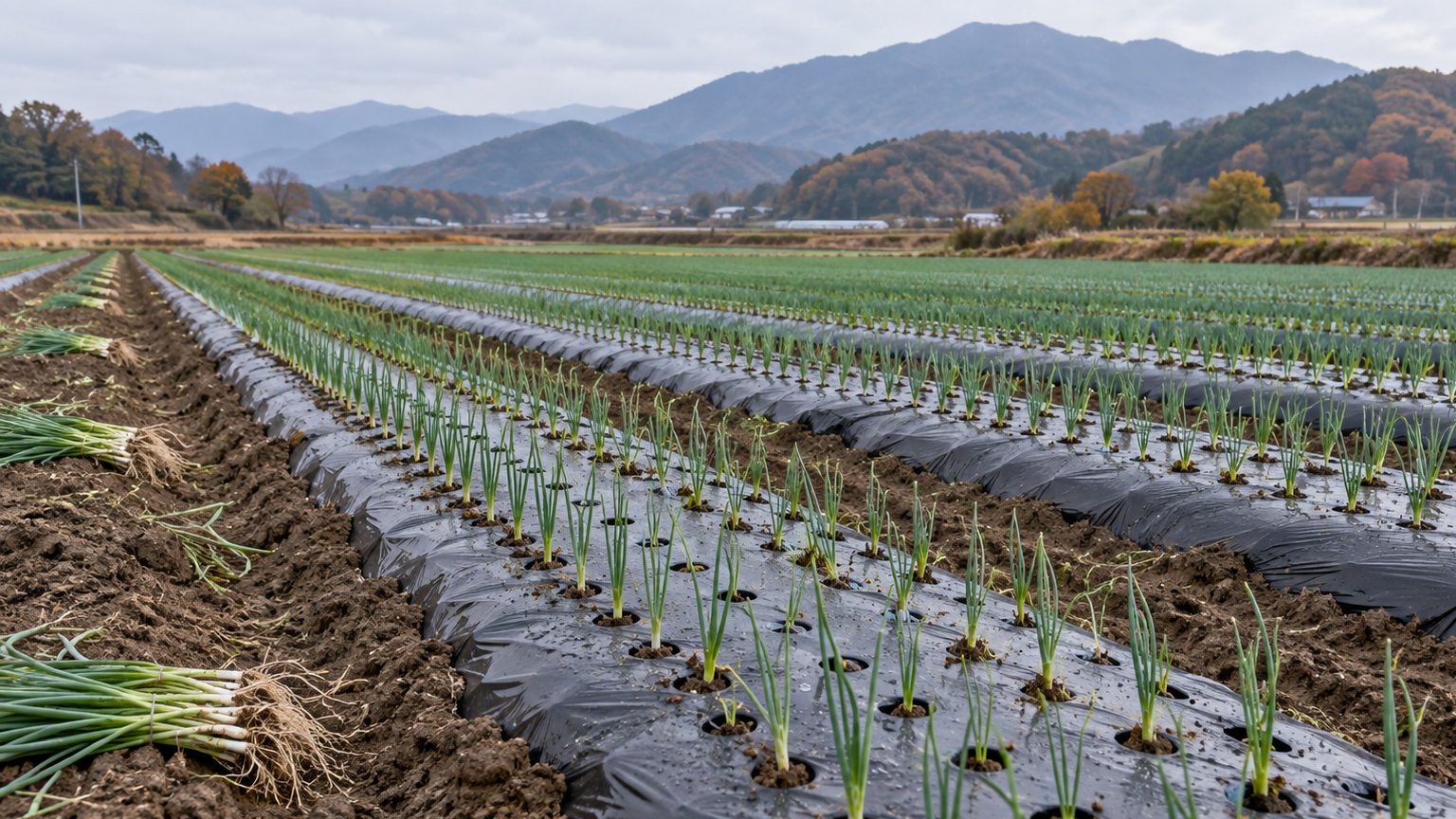
Onion transplanting in Korea follows a daily mean temperature of about 15°C: mid-to-late October inland, early November in the south, November for late types on Jeju. Seedling size, 3 cm depth, plants per square meter, frost-heave care, and October 2, 2026 KAMIS onion wholesale prices.
Onions go into the field a little after garlic. Get the timing wrong and you lose in one of two ways. Plant large seedlings too early and they bolt in spring. Plant too late and the roots are still weak when the ground freezes, so frost heave pushes seedlings out of the soil.
Bottom line: Transplant 45–60-day-old onion seedlings when the daily mean temperature falls to about 15°C. That is mid-to-late October inland, early November in the south, and early-to-late November for mid-late varieties on Jeju. Choose seedlings with a 6–7.5 mm stem, 25–30 cm tall, with four leaves, and plant them 3 cm deep. About 110 plants fit in one pyeong (3.3 m²). On October 2, 2026, top-grade onions sold for KRW 18,800 per 15 kg at Seoul wholesale (KAMIS).
1. Transplanting windows
The Rural Development Administration (RDA) advised in August 2026 to transplant 45–60-day seedlings when the daily mean temperature is around 15°C. For mid-late types in the south, that means sowing after September 18 and transplanting from early November. Because temperature sets the date, plant earlier in the north and inland, later in the south and on Jeju.
| Type / region | Transplant window |
|---|---|
| Early types | Early to mid-October |
| Mid types | Early October to early November |
| Late types | Late October to mid-November |
| Southern mid-late types | From early November (RDA 2026) |
| Jeongeup, North Jeolla | Mid-to-late October |
| Jeju early / mid-late types | Mid-October / early-late November |
We found no official date specific to Gyeonggi or Chungcheong. Inland central Korea can start a little before Jeongeup, around mid-October.
2. Seedling size
RDA’s Nongsaro guide lists a good seedling as 6–7.5 mm thick at the leaf sheath, 25–30 cm tall, with four leaves. Thick seedlings look strong, but planted early they grow too large before winter and are more likely to bolt or split in spring. Thin seedlings have weak roots and suffer more from cold and frost heave. When buying trays, compare the price per plant: a 200-cell and a 400-cell tray at the same price differ twofold.
3. Depth, spacing and plant count
| Item | Guide |
|---|---|
| Depth | 3 cm, upright, press soil lightly |
| Beds | 120 cm wide, six rows, at least 20 cm high |
| Spacing | About 15 cm in the row (rows 15–20 cm, plants 10–15 cm) |
| Per 10 a | About 33,000 plants |
| Per 3.3 m² | About 110 plants |
| Late planting | Plant slightly deeper |
Lay clear or black mulch film before planting. The 0.015 mm black perforated film used for garlic also works for onions. Pin the edges so winter wind does not lift the film.
4. Base fertilizer (per 10 a, Nongsaro)
Compost 3,000 kg and fused phosphate 38.5 kg go in all at once before planting. Of the urea (52.2 kg total) and potassium chloride (25.6 kg total), 17.4 kg and 15.2 kg go in as base fertilizer; the rest is top-dressed in early spring and finished before late March. Late nitrogen makes bulbs soft and prone to rot in storage. A local soil test gives the most accurate amounts.
5. Winter care: frost heave
Frost heave happens when soil water freezes and lifts the soil. Seedlings with few roots are pushed up, roots snap, and plants dry out. It is worst in poorly drained fields and shallow topsoil. Jeju’s agricultural extension service notes that onions with three to four roots longer than 10 cm withstand frost heave and survive down to −8°C. Press heaved seedlings back and cover them with soil; replant where losses are widespread.
6. When do growers get better prices?
| City | Onion, top grade, 15 kg (Oct 2, 2026) | Same day 2025 | June 19, 2026 |
|---|---|---|---|
| Seoul | 18,800 | 18,300 | 11,000 |
| Busan | 18,400 | 18,000 | 10,300 |
| Daegu | 16,800 | 18,200 | 11,300 |
| Gwangju | 19,100 | 18,500 | 9,750 |
| Daejeon | 21,800 | 18,300 | 11,600 |
Prices in KRW. Seoul’s current price is about KRW 1,250 per kg, more than 70% above mid-June harvest prices. Seoul monthly averages from 2016 to 2026 show the same pattern every year: May (KRW 13,347) and June (13,734) are cheapest, and February–March (19,607–19,869), when stored onions run low, are the most expensive. Growers who can store part of the crop and sell after late summer usually do better, though storage rot and weight loss eat into the gap. Harvest storage onions when all tops have fallen, and onions for immediate sale at 70–80%. Daily prices are on the onion price page. For garlic dates, see When to Plant Garlic in Korea 2026.
References
- Rural Development Administration press release (August 23, 2026), onion sowing and transplanting timing.
- RDA Nongsaro, onion work schedule and transplanting guide (seedling standard, 3 cm depth, 33,000 plants per 10 a, fertilizer rates).
- RDA weekly farming information (posted by Jeju ARES), transplant windows by maturity type.
- Jeju Special Self-Governing Province Agricultural Research and Extension Services, onion cultivation guides.
- RDA onion income improvement manual (frost heave, bolting, harvest timing).
- Jeongeup Agricultural Technology Center, transplanting notice (October 2026).
- aT KAMIS wholesale prices (middle wholesaler selling price), onion top grade 15 kg, five cities, September 2025 to October 2, 2026; monthly averages for Seoul, 2016–2026.
- Actual planting dates and prices vary by variety, local climate, weather and sales channel.