KAMIS data as of October 28, 2026: the wholesale price of 20kg of rice, how long 20kg lasts by household size, RDA test results on storage temperature, containers and refrigerator storage, reading the milling date, and how farms dry and store paddy.
When the new-crop rice arrives at the end of October, many Korean households bring home a 20kg bag. Left in the bag on a balcony or under the sink, it loses flavor within a month or so, and after a summer, rice weevils show up. With rice now twice what it cost ten years ago, wasted rice hurts more. Here is how to decide whether 20kg suits your household, and where to keep it.
Bottom line: In the KAMIS survey on October 28, 2026, top-grade 20kg rice sold at wholesale in Seoul for KRW 59,500, and new-crop rice for KRW 62,000, about KRW 3,000 per kilogram. In a Rural Development Administration (RDA) test, milled rice began to change in quality after 12 days at room temperature (about 25°C), 58 days at 15°C and 82 days at 4°C. A family of four eats 20kg in a little over a month. Households that take longer should buy 10kg at a time or keep part of it in an airtight container in the refrigerator.
1. What 20kg of rice costs now
| City | 20kg, KRW (latest) | Per kg | A year earlier (Oct 28, 2025) | Change |
|---|---|---|---|---|
| Daegu | 60,500 (Oct 28) | 3,025 | 62,700 | −3.5% |
| Busan | 60,000 (Oct 26) | 3,000 | 66,000 | −9.1% |
| Seoul | 59,500 (Oct 28) | 2,975 | 59,400 | +0.2% |
| Daejeon | 58,600 (Oct 28) | 2,930 | 60,200 | −2.7% |
| Gwangju | 55,000 (Oct 26) | 2,750 | 58,600 | −6.1% |
Seoul is flat on the year; the other four cities are 3–9% lower. Over ten years the picture changes: the Seoul October average rose from KRW 27,550 in 2016 to KRW 59,029 this year, 2.1 times higher. Daily prices: rice and new-crop rice.
Statistics Korea’s 2025 grain consumption survey puts rice eaten at home at 53.9kg per person per year, 147.7g a day, or about 4.5kg a month.
| Household | Monthly use | 20kg lasts |
|---|---|---|
| 1 person | 4.5kg | about 4.5 months |
| 2 people | 9kg | a little over 2 months |
| 4 people | 18kg | a little over 1 month |
2. Temperature decides the flavor
The RDA National Institute of Crop Science stored milled rice in airtight containers for 12 weeks. Quality began to change after 12 days at room temperature, 58 days at 15°C and 82 days at 4°C. Warmth lets the fat in rice react with oxygen, acidity rises, and the rice smells and tastes worse. The institute names an airtight container in the refrigerator as the best method. From October to April, when average temperatures stay below 15°C, a cool, shaded spot is enough. In summer, find a cool, dry place.
Put the two tables together: a family of four can keep 20kg in a cool place through the winter. One- or two-person households will hold it past the 58-day mark, so they should buy 10kg or refrigerate half.
3. Choosing a container and using the refrigerator
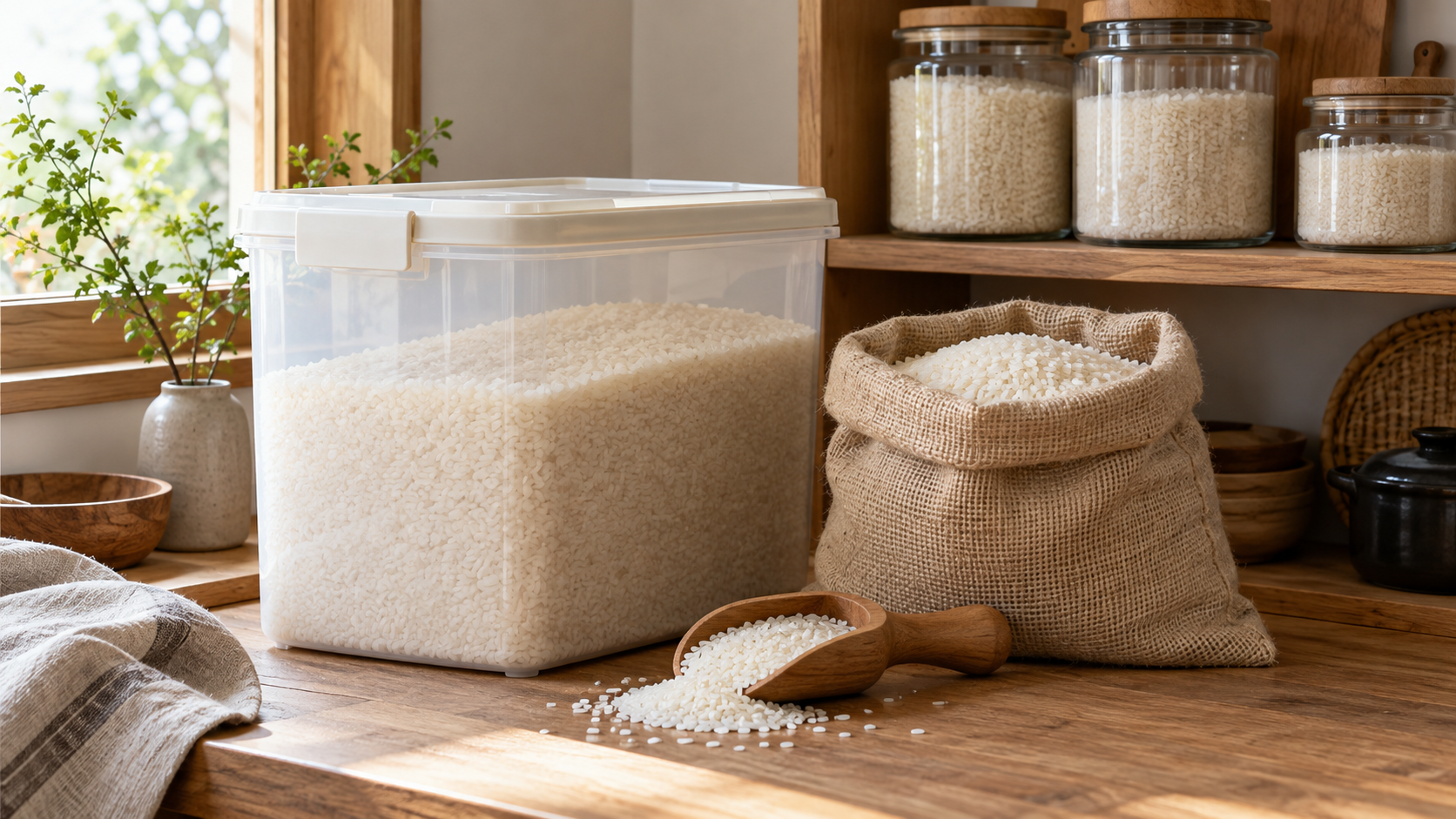
| Type | Good for | Watch out |
|---|---|---|
| 20–25kg bin | Pour in a whole bag | Too big for a fridge; keep it cool |
| 10kg airtight bin | Fits a kimchi-fridge drawer | Store the other half separately |
| PET bottles, sealed tubs | Fridge door and drawers | Dry the bottles completely first |
Airtight comes first even in a refrigerator. Rice absorbs odors, so do not leave an open bag next to kimchi or salted seafood. Empty old rice and dust from the bin before pouring in a new bag.
4. Rice weevils
The pests in household rice are usually rice weevils or Indian meal moth larvae. The RDA says insects, mold and bacteria can appear when rice sits at room temperature in hot, humid summers, and recommends cool, dry, airtight storage. We could not find an official source for the temperature figures or the garlic-and-chili remedies that circulate online, so we do not recommend them. What works: seal it, buy only what you will eat before summer, and if you see insects, empty and wash the container and dry it completely before refilling.
5. Reading the milling date
Korean law requires these items on a rice bag: product, weight, producer or seller address and phone number, origin, variety, production year, milling date and grade (special, high, standard, or below grade). Since October 14, 2018, ordinary rice may not be labeled “not inspected.” The RDA test counts from the milling date, so buy the bag with the most recent date.
6. Farms: store paddy, mill when needed
According to RDA post-harvest guidance, paddy should be dried to about 15% moisture, at 45–50°C for eating rice and 40°C or below for seed rice. Hotter drying hardens protein and stales starch. Dried paddy keeps at 15% moisture, 10–15°C and 70–80% relative humidity. Given how fast milled rice changes at room temperature, direct-sale farms keep the best flavor by storing paddy and milling to order, with an accurate milling date on the bag.
7. Checklist
- Seoul 20kg rice KRW 59,500; new crop KRW 62,000 (Oct 28). About KRW 3,000 per kg.
- 53.9kg per person per year; 20kg lasts a family of four about a month.
- Quality changes: 12 days at room temperature, 58 days at 15°C, 82 days at 4°C.
- Cool spot from October to April; refrigerate in summer or for long storage.
- Check the milling date and production year.
- Farms: dry paddy to 15% moisture and store at 10–15°C.
References
- aT KAMIS, intermediate wholesaler prices (Public Data Portal): 20kg rice and new-crop rice, five cities, October 2025 and October 26–28, 2026; monthly averages for Seoul, 2016, 2025, 2026.
- Statistics Korea, 2025 Grain Consumption Survey, January 22, 2026.
- RDA National Institute of Crop Science, “How to keep rice tasty longer” (storage temperature test).
- RDA Nongsaro, post-harvest management for top-quality rice (paddy drying and storage).
- Ministry of Agriculture, Food and Rural Affairs and NAQS press releases: September 21, 2026; October 14, 2018; December 28, 2020.
- Wholesale prices are intermediate wholesaler selling prices, not farm-gate or retail prices.