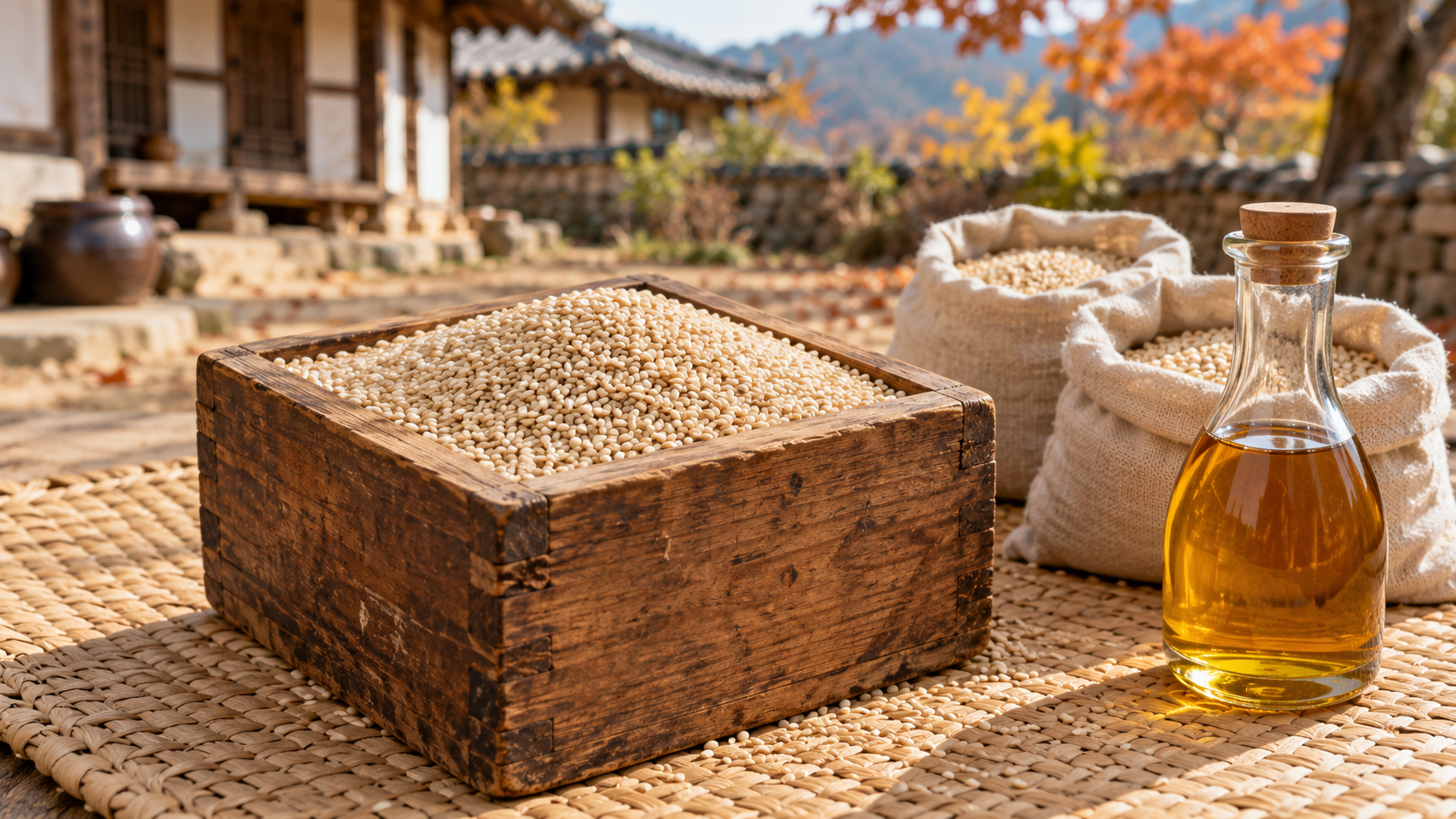
KAMIS data as of October 29, 2026: domestic, Chinese and Indian sesame wholesale prices per kg and per mal (5kg or 6kg), comparison with direct-sale prices, the October trend, 11 years of October-to-November changes, how much sesame oil a mal can yield, and the red bean price per kg.
Direct-sale sesame in Korea is still priced by the mal, an old volume unit. Buyers ask “how much for a mal this year,” but a mal can mean 5kg or 6kg depending on the seller. The quickest check is to convert the wholesale price to a kilogram and multiply back.
Bottom line: In the KAMIS survey on October 29, 2026, domestic white sesame (top grade, 30kg) averaged KRW 703,000 across five cities, about KRW 23,430 per kg. Seoul was KRW 773,000 (about KRW 25,770/kg). A 6kg mal works out to about KRW 141,000 at wholesale (Seoul: about KRW 155,000); a 5kg mal to about KRW 117,000. Prices are 6.8% below early October and 11.8% below a year ago.
Earlier records: domestic sesame prices 2026, domestic sesame oil prices and perilla seed prices in late October.
1. How many kg is a mal
A mal is a volume unit of about 18 liters (ten doe). Its weight depends on how dry and clean the seed is, so sellers now state kilograms. A Gangwon regional farm mall listed “new-crop sesame 6kg, one mal” at KRW 210,000 (list KRW 240,000) on October 30, which is KRW 35,000/kg, about 36% above the Seoul wholesale equivalent. Some sellers use 5kg.
2. Wholesale per kg and per mal
| City | 30kg, KRW | Per kg | 5kg mal | 6kg mal |
|---|---|---|---|---|
| Seoul | 773,000 | 25,770 | 128,800 | 154,600 |
| Daegu | 758,000 | 25,270 | 126,300 | 151,600 |
| Daejeon | 701,000 | 23,370 | 116,800 | 140,200 |
| Busan | 693,000 | 23,100 | 115,500 | 138,600 |
| Gwangju | 590,000 | 19,670 | 98,300 | 118,000 |
| Average | 703,000 | 23,430 | 117,200 | 140,600 |
Imported sesame (medium grade, 30kg) averaged KRW 213,600 for Chinese (about KRW 7,120/kg, 30% of domestic) and KRW 157,000 for Indian (about KRW 5,230/kg, four cities). Daily prices are on the domestic sesame price page.
3. October trend and the November question
The five-city average fell from KRW 754,000 on October 1 to KRW 731,400 on October 13 and KRW 703,000 on October 29. Seoul held at KRW 773,000 while Gwangju, Busan, Daegu and Daejeon came down as new-crop sesame arrived. In Seoul’s KAMIS monthly averages from 2015 to 2025, the October-to-November change was within 1% in 7 of 11 years; the big moves (2020: +11.5%, 2021: +14.8%) were increases. Waiting for November has rarely meant a lower price.
4. How much oil from a mal
No official standard yield exists. Research on Korean sesame germplasm put crude fat at 46.5–50.9%. At 48% oil and a density of 0.92, a 6kg mal holds at most about 3.1 liters of oil, or about 10 bottles of 300ml; a 5kg mal about 8.7 bottles. Real pressing yields less, so ask the mill how many ml it usually gets per kg.
5. For growers
State the weight in the listing (“one mal, 6kg”), treat the wholesale equivalent as a floor for direct sales that include cleaning, packing and shipping, state the crop year, and do not count on a November jump.
6. Red bean per mal
Domestic red beans (top grade, 40kg) averaged KRW 644,200 on October 29, about KRW 16,100/kg, 16.6% below a year ago. Ask how many kg the mal is and multiply. See the red bean price page.
References
- aT KAMIS daily wholesale prices (data.go.kr): domestic white sesame 30kg, Chinese and Indian sesame 30kg, domestic red beans 40kg, five cities, October 29, 2025 and October 1, 13 and 29, 2026.
- aT KAMIS monthly prices: Seoul domestic sesame October and November averages, 2015–2026.
- National Institute of Korean Language, Standard Korean Dictionary, “mal”.
- Gangwon The Mall listing, checked October 30, 2026.
- National Agrobiodiversity Center sesame germplasm crude fat study (koreascience).
- Naver Search Ad keyword tool, October 30, 2026.