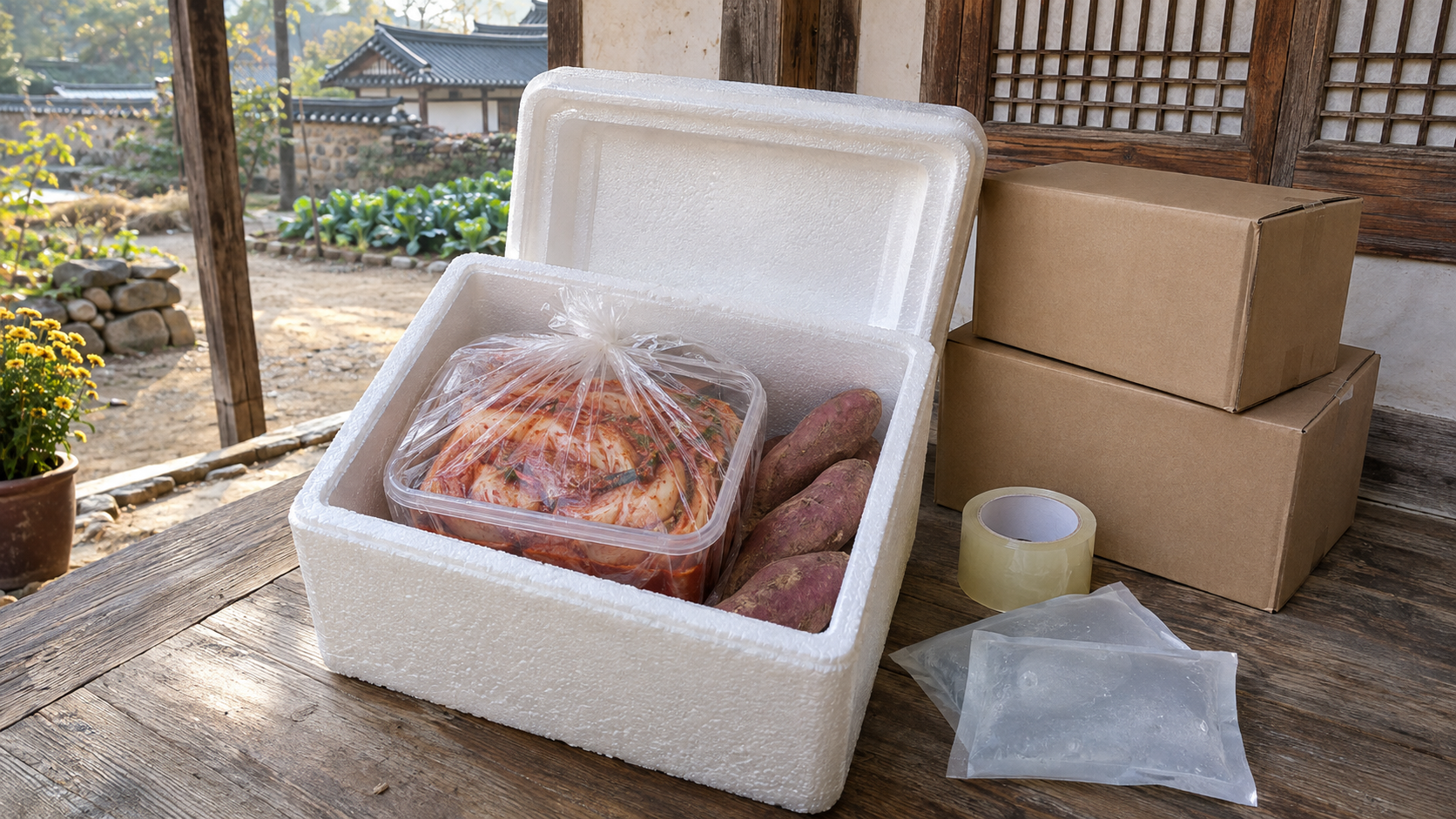
How to choose styrofoam and cardboard boxes for sending kimjang kimchi, sweet potatoes, rice and perilla seeds within Korea, Korea Post domestic parcel rates for counter and pickup service as listed on November 3, 2026, why the higher of weight or size tier applies, a leak-proof kimchi packing sequence, winter chilling protection and summer ice packs, and how farms selling direct should cost packaging.
After kimjang comes one more job: sending kimchi to children in the city. Will the brine leak, what size box, and why did the post office charge more than expected? Farms selling sweet potatoes or perilla seeds direct face the same questions all winter.
Bottom line: A registered parcel at a Korea Post counter costs KRW 6,000 for up to 10kg (sum of three sides up to 120cm) and KRW 8,000 for up to 20kg. Home pickup costs KRW 8,000 for 10kg (100cm) and KRW 10,000 for 20kg (120cm). The higher of the weight or size tier applies. Double-bag kimchi with the air pressed out; protect sweet potatoes from cold with styrofoam in winter. Rates are from the Korea Post parcel rate guide checked on November 3, 2026.
1. Korea Post domestic parcel rates.
| Weight (sum of sides) | Counter registered | Counter ordinary | Home pickup |
|---|---|---|---|
| ≤3kg (80cm) | 4,000 | 2,700 | – |
| ≤5kg (80cm) | – | – | 5,000 |
| ≤5kg (100cm) | 4,500 | 3,200 | – |
| ≤7kg (100cm) | 5,000 | 3,700 | – |
| ≤10kg (100cm) | – | – | 8,000 |
| ≤10kg (120cm) | 6,000 | 4,700 | – |
| ≤15kg (120cm) | 7,000 | 5,700 | – |
| ≤20kg (120cm) | 8,000 | 6,700 | 10,000 |
| ≤25kg (120cm) | 11,000 | 9,700 | – |
| ≤30kg (160cm) | 13,000 | 11,700 | 14,000 |
Registered parcels arrive the next day on the mainland; ordinary parcels take three days and are not compensated if lost. Limits: 30kg, sides summing 35–160cm, no side over 100cm. Discounts: 3–15% at the counter if address details are entered in advance online, KRW 500 per pickup parcel with prior entry and payment, and KRW 3,000 off when a heavy shipment is split into parcels over 10kg each under the same sender, recipient and time.
2. Which box.
Use styrofoam for kimchi (contains leaks, holds temperature), for sweet potatoes from November to February (chilling injury), and with ice packs for side dishes and meat. Cardboard is fine for rice, perilla and sesame seeds. Add the three sides before buying: a 45 × 37cm box must be no taller than 38cm to stay within 120cm.
3. Packing kimchi.
Use two thick kimchi bags, fill only two-thirds to leave room for fermentation gas, press out the air and tie each bag separately, fill gaps with newspaper or bubble wrap, tape the whole lid seam, and ship Monday to Thursday.
4. Sweet potatoes, grain and ice packs.
Sweet potatoes store best at 12–15°C and rot more easily below 10°C (Rural Development Administration), so insulate them in winter and remove damaged roots. Bag sesame and perilla seeds before boxing. In summer, put frozen ice packs on the top and bottom; they count toward the weight.
5. Costing direct sales.
Price the shipping tier, box, cushioning and tape, any discount, and an allowance for damage. A 10kg box over 100cm moves home pickup from KRW 8,000 to KRW 10,000, which adds up over a season.
References
- Korea Post (Internet Post Office), parcel rate guide, checked November 3, 2026: m.epost.go.kr
- Sweet potato storage temperature: references in Sweet Potato Curing 2026.