How Korea's pumpkin (hobak) and chestnut (bam) sweet potatoes differ, using National Institute of Crop Science research on moist and dry flesh types and fiber content. Includes KAMIS 10 kg wholesale prices on October 22, 2026 versus a year earlier, grade gaps, Hopungmi and Beniharuka, home storage, and when growers get more.
Order a 10 kg box of sweet potatoes in Korea and the first choice is between hobak (pumpkin) and bam (chestnut). Names like “honey sweet potato”, Hopungmi and Beniharuka are mixed in, and box prices differ by more than KRW 10,000. On Naver, “pumpkin sweet potato” is searched 29,380 times a month and “chestnut sweet potato” 15,520 times. This note sets out what actually differs, what they cost now, and how to keep them, using official research and KAMIS data.
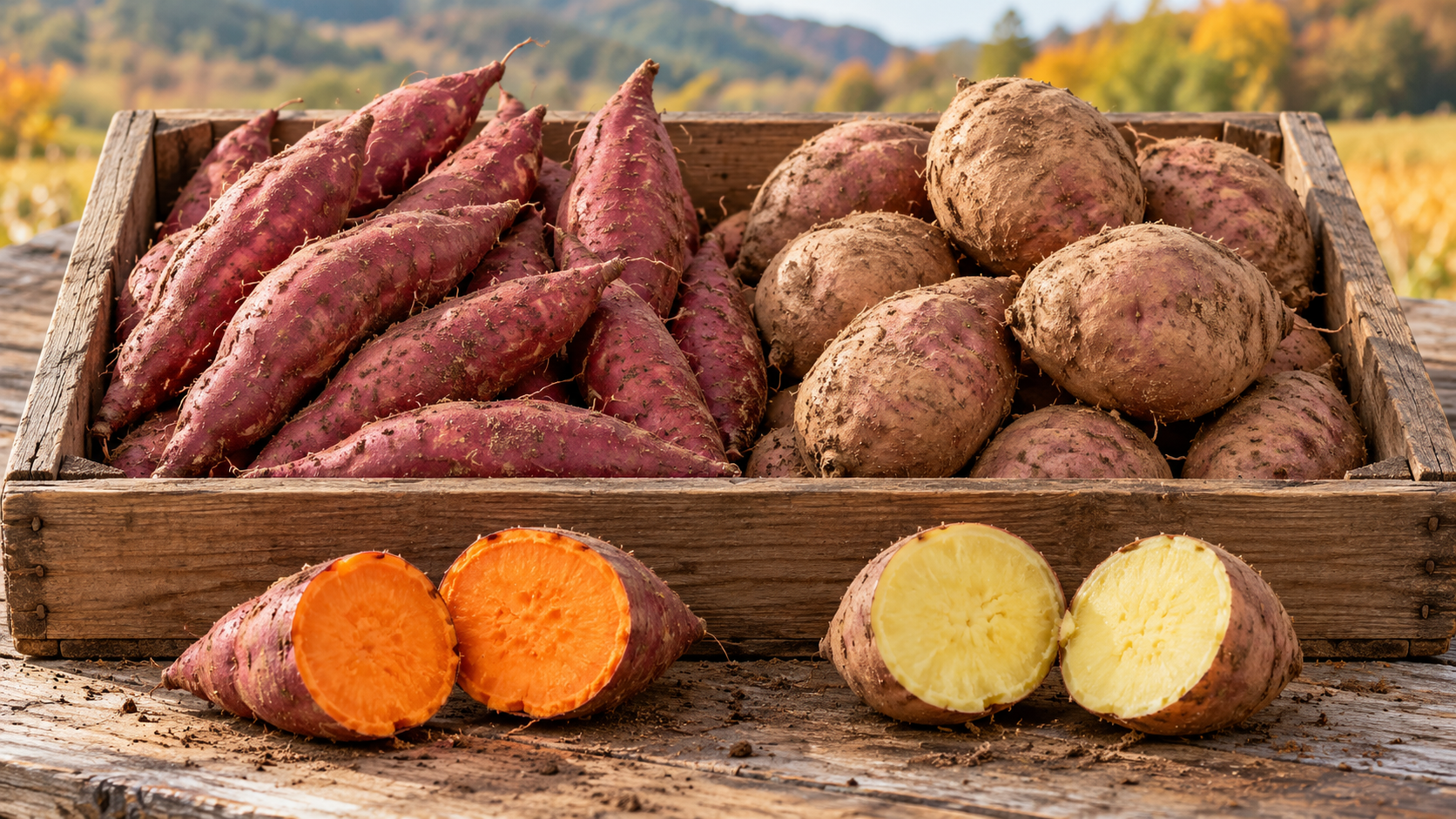
Bottom line: Pumpkin sweet potatoes have orange, moist flesh (the “moist” type); chestnut sweet potatoes have yellow, floury flesh (the “dry” type). In National Institute of Crop Science research, moist-type cultivars had more stringy fiber. On October 22, 2026, KAMIS chestnut sweet potato (top grade, 10 kg) averaged KRW 31,040 across five cities, 2.7% below the same day last year (KRW 31,900). KAMIS does not survey pumpkin sweet potatoes separately. Either type keeps best at 12–15 °C, not in the fridge.
Earlier notes: Sweet potato 10 kg price and harvest timing 2026, sweet potato curing and winter storage 2026. Daily wholesale prices are on the sweet potato price page.
Try it: see what you would net in each city with the produce market calculator.
1. What is the difference?
It is the flesh. Sweet potato texture falls into two groups: a moist type that is soft and almost syrupy when steamed, and a dry type that is firm and floury. What Koreans call pumpkin sweet potato is the moist type; chestnut sweet potato is the dry type.
A 2022 paper by the National Institute of Crop Science in the Korean Journal of Crop Science grouped cultivars this way: light-orange Hogammi, Sodammi and Pungwonmi as moist types, and light-yellow Jinyulmi as a dry type. It also measured fiber in steamed roots.
| Cultivar | Type | Fiber (mg per 100 g fresh, 3-site mean) |
|---|---|---|
| Hogammi | Moist (pumpkin) | 95.71 |
| Sodammi | Moist (pumpkin) | 66.73 |
| Pungwonmi | Moist (pumpkin) | 44.55 |
| Danjami | Purple | 40.55 |
| Jinyulmi | Dry (chestnut) | 38.53 |
Those strings that get stuck in your teeth are the fiber. Among pumpkin types it varied more than twofold by cultivar. The chestnut cultivar Jinyulmi had the least.
2. Honey sweet potato, Hopungmi and Beniharuka
”Honey sweet potato” is a selling name, not a cultivar. It usually means a moist, very sweet pumpkin-type root.
Hopungmi is an RDA-bred cultivar that the RDA describes as a pumpkin sweet potato with high cultivation stability; it was pushed into wide distribution by early 2025. In an RDA trial at 13 °C and 85–90% humidity, its sucrose rose 1.9-fold after 30 days of storage, with little change up to 90 days.
Beniharuka is an introduced Japanese cultivar, mostly sold as “honey sweet potato” in Korea. Jinyulmi is the main domestic chestnut-type cultivar. If a box does not name the cultivar, check the flesh color in buyer photos: yellow means chestnut, orange means pumpkin.
3. Prices: is pumpkin dearer than chestnut?
KAMIS surveys only “sweet potato (chestnut)“. There is no official wholesale price for pumpkin sweet potatoes, so chestnut prices serve as the reference.
| City | Top grade 10 kg (Oct 22, 2026) | Same day 2025 | Change | Mid grade 10 kg |
|---|---|---|---|---|
| Seoul | KRW 30,600 | KRW 33,300 | −8.1% | KRW 25,000 |
| Busan | KRW 32,000 | KRW 33,000 | −3.0% | KRW 24,000 |
| Daegu | KRW 32,600 | KRW 29,000 | +12.4% | KRW 28,300 |
| Gwangju | KRW 28,000 | KRW 34,000 | −17.6% | KRW 22,600 |
| Daejeon | KRW 32,000 | KRW 30,200 | +6.0% | KRW 26,600 |
| 5-city average | KRW 31,040 | KRW 31,900 | −2.7% | KRW 25,300 |
KRW 31,040 per 10 kg is about KRW 3,104 per kg, 3.5% lower than the October 1 average of KRW 32,160. On October 23, 10 kg boxes of pumpkin sweet potatoes on Coupang ranged from roughly the low KRW 20,000s to the mid KRW 30,000s, depending on size. Retail boxes and wholesale prices are not directly comparable, but about KRW 3,000 per kg is a useful baseline.
4. Size and grade
Top grade averaged KRW 5,740 (22.7%) more than mid grade per 10 kg. Retail size labels differ by seller; one box lists “medium” as 50–100 g and “large” as 300 g or more, so read the grams. Even, medium-to-large roots roast evenly; bite-size roots steam quickly; for candied or rice dishes, cheaper mid grade or “ugly” boxes are fine.
5. Storing them at home
Open the box on arrival, remove any cut or soft roots and eat those first. Keep the rest at 12–15 °C and 85–90% humidity, the RDA storage range. Long periods below 10 °C promote rot, so the fridge is the wrong place. For sweetness, be patient: in the Hopungmi trial sugars jumped around day 30, so roots bought in October are sweeter from late November. That trial covered Hopungmi and Sodammi; other cultivars may differ.
6. Growers: which type, and when to sell
Consumers search for pumpkin types almost twice as often (29,380 vs 15,520). Because pumpkin types have no official wholesale price, direct-sale box prices become the benchmark; naming the cultivar and gram size on the box helps buyers find it.
Fiber also depends on the field. The same study measured Hogammi from 19 farm fields in 13 counties: 87–116 mg per 100 g. Fiber rose with soil phosphorus, organic matter and pH, so avoiding excess phosphorus is part of quality control for pumpkin types.
Timing depends on storage. Using KAMIS Seoul monthly averages for chestnut sweet potato (top grade, 10 kg) over 2015–2024, with October = 100, December averaged 108, February 116 and March 118. February was above October in all ten years. Growers who cure properly and can hold 12–15 °C did better selling in stages from December to February; without storage, selling top grade quickly in October–November limits losses.
7. FAQ
Which is sweeter? Pumpkin types are moister. Sweetness depends on cultivar and storage time, so neither is always sweeter. Hopungmi’s sucrose rose 1.9-fold after 30 days.
How much is a 10 kg box of pumpkin sweet potatoes? There is no official wholesale price. On October 23, 2026, Coupang boxes ranged roughly from the low KRW 20,000s to the mid KRW 30,000s. Chestnut sweet potato (top grade) wholesale averaged KRW 31,040 on October 22.
Can I keep them in the fridge? No. Long periods below 10 °C promote rot.
References
- Park W. et al., “The Influence of Soil Characteristics and Sweet Potato Varieties on Fiber Content”, Korean Journal of Crop Science 67(3), 2022 (National Institute of Crop Science): koreascience.or.kr
- RDA announcement on Hopungmi distribution, reported by Newsseoul, January 20, 2025: newsseoul.co.kr
- RDA findings on sugar changes in stored Sodammi and Hopungmi (September 2024), reported by Newsseoul: newsseoul.co.kr
- RDA Nongsaro, sweet potato post-harvest management: rda.go.kr
- aT KAMIS period wholesale (intermediate wholesaler) prices via data.go.kr: sweet potato (chestnut), top and mid grade 10 kg, five cities, October 22, 2025, and October 1 and 22, 2026.
- aT KAMIS monthly wholesale prices via data.go.kr: sweet potato (chestnut) top grade 10 kg, Seoul, October 2015–October 2026.
- Naver Search Ad keyword tool monthly searches (checked October 23, 2026).
- Coupang Partners product search “pumpkin sweet potato 10 kg” (October 23, 2026; prices change often).