A practical guide to converting an empty warehouse into an indoor vertical farm or aquatic plant farm, covering insulation, lighting, electricity, ventilation, humidity, racks, tanks, and sales channels.
An empty warehouse often looks like an opportunity. Add racks, install LEDs, bring in water trays, and it feels like a smart farm waiting to happen. That idea can work. But a warehouse smart farm is not just crops inside a building. It is a project that turns the whole building into a controlled climate machine.
Four things decide the result: insulation, electricity, humidity, and sales channels. If those four line up, an unused warehouse can become a small vertical farm or aquatic plant nursery. If they do not, the space becomes an expensive room full of heat, condensation, and electricity bills.
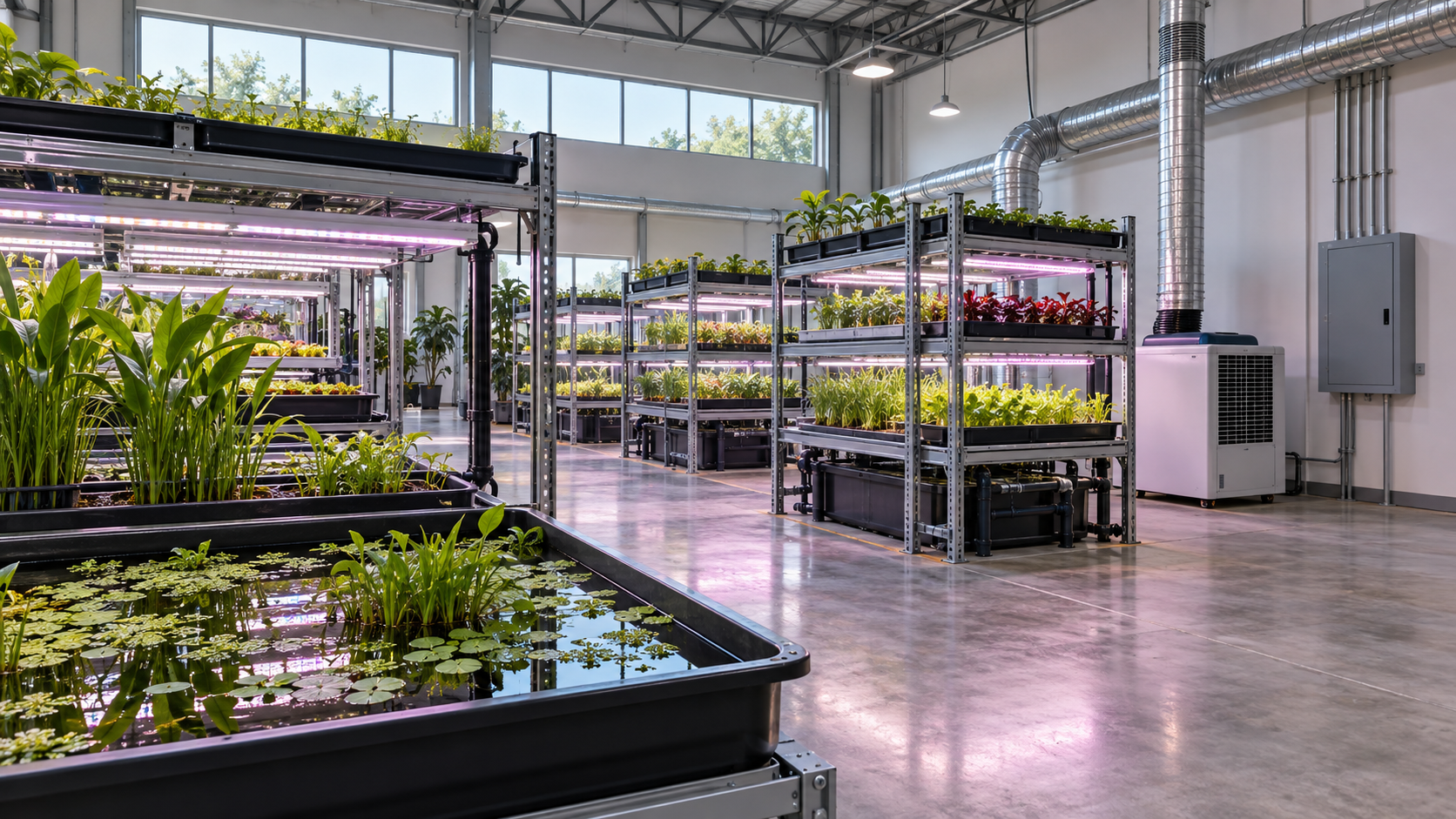
Short answer: it can work, but start with a narrow crop plan
Do not begin with a large lettuce factory. A warehouse has no free sunlight. Light, air, temperature, water, drainage, and humidity all have to be purchased and controlled. That makes warehouse farming better for manageable, higher-value small products than for bulk low-margin crops.
| Direction | Fit | Reason |
|---|---|---|
| Aquatic plant farm | High | Small products, hobby-market demand, repeatable propagation |
| Herbs and microgreens | Medium | Fast turnover but needs food-grade sales discipline |
| Bulk leafy greens | Low to medium | Electricity and labor can eat the margin |
| Mushrooms | Conditional | Low light need, but strict humidity and hygiene required |
| Seedling nursery | Conditional | Works when seasonal demand and buyers are secured |
For a small farm or side business, aquatic plants, herbs, microgreens, or seedlings are more realistic than a large general-purpose indoor farm. Aquatic plants also connect well with ornamental fish and aquaponics traffic.
1. Inspect the warehouse before buying equipment
Space diagnosis comes before equipment. Check for leaking roofs, condensation, weak floors, limited power, and poor drainage. A room that looks dry as storage can become damp quickly after water trays, pumps, and plants are installed.
| Item | What to check |
|---|---|
| Floor | Drainage, waterproofing, level, load capacity |
| Walls and ceiling | Insulation, condensation, leaks, mold |
| Electricity | Contract power, panel capacity, breakers, grounding |
| Water | Supply, drainage, filtration needs |
| Ventilation | Exhaust route, filtered intake, fan installation |
| Temperature | Summer heat, winter cold, heating and cooling load |
In older warehouses, waterproofing and electrical safety come before crop choice. Water and power must be treated carefully.
2. Cost depends more on equipment density than floor area
Warehouse smart farm cost is hard to explain as a simple cost per pyeong. A 20-pyeong warehouse can be cheap or expensive depending on rack levels, lighting density, tanks, pumps, ventilation, and dehumidification.
A planning range can be separated into three levels.
| Type | 20-pyeong startup range | Best use |
|---|---|---|
| Minimum test setup | 10 million to 20 million KRW | Aquatic plant or herb testing, education |
| Small sales setup | 30 million to 60 million KRW | Aquatic plants, microgreens, small herbs |
| Full vertical farm setup | 80 million to 150 million KRW or more | Leafy greens, seedlings, contract growing |
Existing building space can reduce shell-construction cost. But electrical upgrades, waterproofing, HVAC, dehumidification, racks, trays, pumps, and LEDs still enter the budget.
3. Aquatic plant farms change the cost structure
Aquatic plant farming is one of the more realistic warehouse options. The products are small, propagation can be repeated, and the hobby market can support higher unit prices than bulk greens. The trade-off is water. A lot of water means leak control, humidity control, and electrical safety become critical.
A small 20-pyeong aquatic plant setup may look like this.
| Item | Cost range |
|---|---|
| Waterproofing and floor work | 3 million to 8 million KRW |
| Two- or three-level racks | 5 million to 12 million KRW |
| Tanks, trays, and plumbing | 7 million to 15 million KRW |
| LED lighting | 5 million to 15 million KRW |
| Air, circulation, filtration | 3 million to 8 million KRW |
| HVAC and dehumidification | 5 million to 15 million KRW |
| Backup gear and packaging | 2 million to 5 million KRW |
A small sales setup often starts around 30 million to 60 million KRW. Rather than beginning with rare and expensive plants, start with repeatable products: Anubias, mosses, easy stem plants, and common Bucephalandra lines.
4. In a vertical farm, lighting cost is the core issue
A warehouse vertical farm replaces sunlight with LEDs. That light is not free. More rack levels increase growing area, but they also increase electricity use, heat, and dehumidification load.
A simple 20-pyeong example can look like this.
| Equipment | Assumption | Monthly use |
|---|---|---|
| LED lighting | 3kW for 12 hours per day | About 1,080kWh |
| Pumps and fans | 0.5kW for 24 hours per day | About 360kWh |
| Dehumidification and cooling | Seasonal variation | About 300kWh to more than 1,000kWh |
At 150 to 250 KRW per kWh, this can already mean roughly 260,000 to 610,000 KRW per month before fixed charges and seasonal peaks. The crop must be able to pay for that light.
5. Good and bad products for a warehouse setup
An indoor warehouse gives environmental control. It also removes free sun and natural ventilation. The crop choice decides whether the economics make sense.
| Product | Judgment |
|---|---|
| Aquatic plants and moss | Strong fit for small high-value packages |
| Basil and mint | Good if buyers are secured |
| Microgreens | Fast turnover but hygiene and repeat buyers matter |
| Bulk lettuce | Harder because unit price is low |
| Strawberries | High technical and climate-control burden |
| Mushrooms | Possible, but hygiene and humidity must be excellent |
For beginners, a warehouse aquatic plant farm is the most practical first direction. Herbs and microgreens come next. Bulk lettuce can look good in a spreadsheet but often struggles against electricity and labor cost.
6. Check use, permits, and business scope
A warehouse does not automatically allow every agricultural use. Building use, farmland status, drainage, electrical upgrades, food sales, and livestock or ornamental-aquatic activity may all matter.
If the project sells aquatic plants and ornamental fish repeatedly, check whether the activity enters the ornamental fish industry framework. If herbs or microgreens are sold as food, packaging, labeling, hygiene, and buyer requirements matter. If the warehouse sits on farmland, the approved use of the building must be checked with the local office.
The safe approach is to ask the local government before renovation. A cheap renovation becomes expensive if the use is challenged later.
7. Recommended start sequence
Do not renovate the whole warehouse on day one. Use a small test area and measure the numbers.
- Check leaks and condensation.
- Check electrical capacity and breaker panel room.
- Test only 5 to 10 pyeong first.
- Choose one or two products.
- Record LED electricity use.
- Measure how much water the dehumidifier collects.
- Treat the first month as survival and growth testing.
- Test packaging and shipping in the second month.
- Expand racks only after repeat buyers appear.
- Check registration or reporting rules as business scale grows.
Control comes before expansion. A warehouse is small, but the variables are not.
Conclusion
An empty warehouse can become a smart farm. But it becomes a space that consumes electricity, water, climate control, and labor. For small operators, aquatic plants, herbs, microgreens, or seedlings are safer starting points than a large leafy-green factory.
The winner is not the farm with the most LEDs. It is the farm whose product can pay for the LEDs. Choose the sales channel first, then build the room around it.
References
- Smart Farm Korea: smart farm concept, controlled-environment farming, data, education, and support-program context.
- IMUN.FARM, “Legal Types and Rough Costs of Agricultural Smart Farms and Warehouses”: reference for vertical farms, container farms, and agricultural warehouse use.
- Korean Law Information Center, Act on Fostering and Supporting the Ornamental Fish Industry: referenced for the possible business scope of aquatic plants and ornamental fish.
- Rural Development Administration and Nongsaro facility horticulture materials: referenced for the importance of temperature, humidity, ventilation, and energy management in controlled facilities.