A practical comparison of goldfish, guppies, and tilapia for small home aquaponics, covering temperature, water quality, feed load, breeding, and side-business potential.
Once the tank and grow bed are connected, the same question comes up fast. Which fish should go in first. Goldfish look sturdy, guppies are small and easy to sell, and tilapia appears in many aquaponics videos. For a home setup, the answer is more practical than romantic.
The short answer is this: start with guppies if you also care about side-business potential, and start with goldfish if your first goal is learning the system. Tilapia is useful in larger systems, but it is not the best first fish for a spare room, veranda, or small home rack. It needs stable warm water, stronger filtration, more feed, more space, and a clearer sales plan.
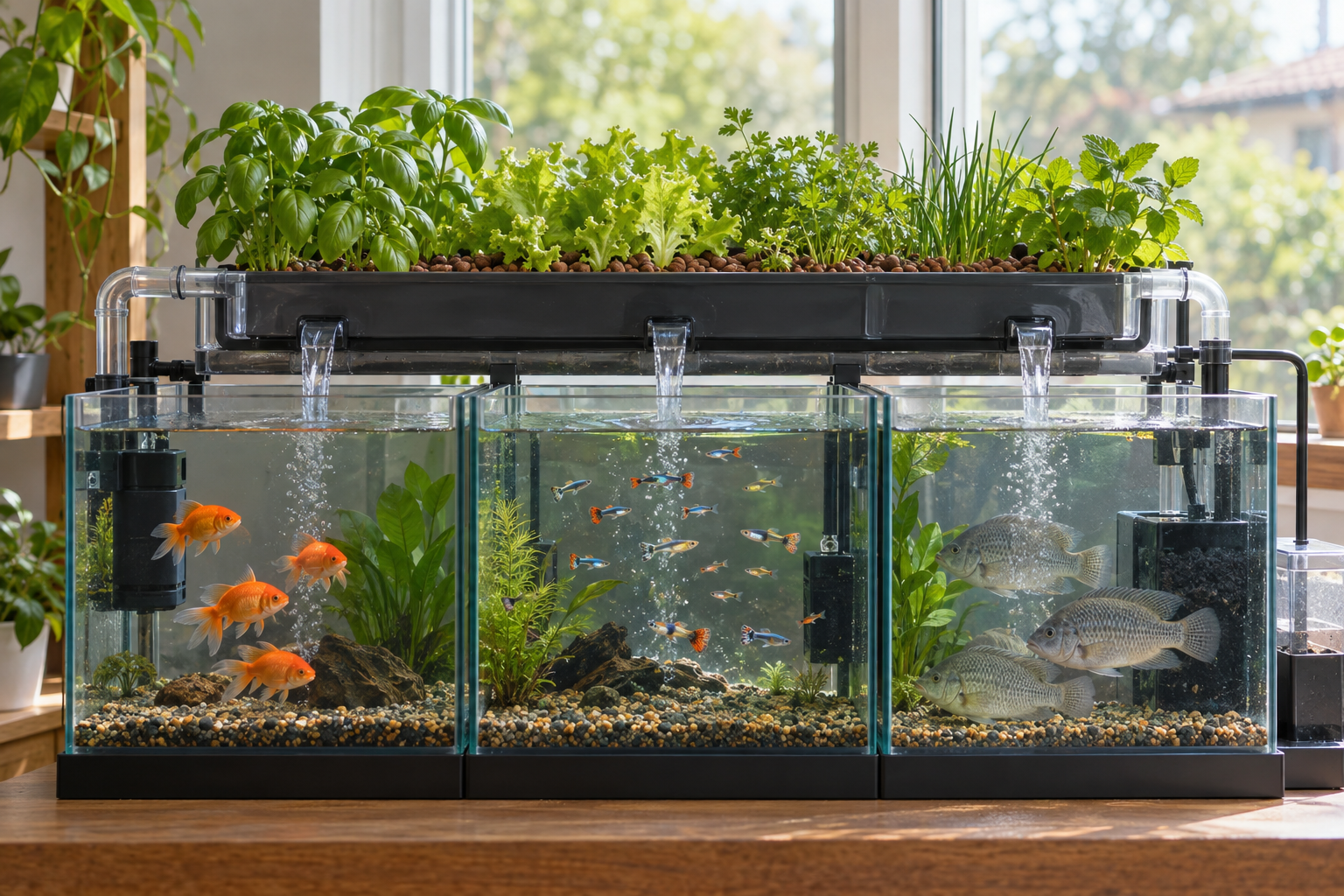
Short answer: guppies are the most realistic home choice
For home aquaponics, the main question is not only whether the fish can survive. The better question is whether the fish keeps a small system stable. A fish that grows too large or eats too much can overwhelm the filter before the plants start helping. A fish that is too sensitive can turn the first month into a discouraging cycle of losses.
| Fish | Beginner difficulty | Sales potential | Nutrient output | Home suitability |
|---|---|---|---|---|
| Guppy | Easy | High | Low to medium | Very good |
| Goldfish | Easy | Low to medium | Medium | Good |
| Tilapia | Hard | Conditional | High | Low |
Guppies are small, prolific, and easy to turn into starter sets. Goldfish are hardy and useful for learning the nitrogen cycle, but they are not as strong as a home side-business product. Tilapia can work, but it belongs in a more deliberate aquaculture setup.
The four criteria that matter
Choose fish by temperature, feed load, filtration risk, and marketability. These matter more than the fish looking impressive in a video.
Temperature comes first. Guppies prefer warm water, goldfish tolerate cooler conditions, and tilapia needs a stable warm environment. In winter, that becomes electricity cost.
Feed load comes next. More feed means more nutrients for plants, but it also means more ammonia risk. Small systems do not forgive sudden overfeeding.
Filtration is the third point. Aquaponics depends on pumps, air, biological media, and bacteria. If one part stops, both fish and plants suffer.
Marketability is the fourth point. For a side business, keeping fish and selling fish are different skills. Guppies are easier to package with aquatic plants, shrimp, and starter kits. Goldfish and tilapia require a clearer plan.
Guppies: the best side-business candidate
Guppies are the most practical first choice for a small home aquaponics business. They are compact, breed quickly, and have steady demand among beginners. They also allow separate tanks for breeding, fry, quarantine, and selected lines.
Do not start by selling cheap mixed guppies. That market is crowded. A better approach is to choose one or two stable lines and sell them as part of a complete starter package.
| Product | Sales angle |
|---|---|
| Selected guppy pairs | Beginner breeding set |
| Guppy fry shelter plant set | Links well with aquatic plants |
| Guppy, shrimp, and moss package | 30cm tank starter set |
| Mini aquaponics observation kit | Education and hobby product |
The weakness is nutrient output. Guppies are small, so they do not produce enough waste for heavy vegetable production unless stocking density increases. That is why guppy aquaponics fits ornamental fish, aquatic plants, herbs, and small greens better than bulk lettuce production.
Goldfish: good for learning, weaker for profit
Goldfish are tough. They reduce the chance that a beginner gives up after losing fish in the first month. They eat well and produce enough waste to support plant growth, which makes them useful for learning how the system works.
For a home side business, goldfish are less attractive. Common fish face price competition. Higher-value goldfish require more space, better selection, body-shape management, and cleaner water. A small home setup can become messy if too many goldfish are stocked.
Goldfish fit these cases:
- The goal is learning before selling.
- The setup is for education or family observation.
- The room is cooler and heating cost must stay low.
- Herbs and greens matter more than fish sales.
Use one 100L to 200L tank rather than many fish in a small tank. Goldfish are hardy, but water quality still has limits.
Tilapia: good on paper, heavy at home
Tilapia is common in aquaponics examples for a reason. It grows fast, eats well, and produces enough nutrients for plants. It can make sense in a dedicated aquaponics facility.
At home, the burden is much higher. Tilapia needs stable warm water, stronger aeration, larger tanks, and a robust filter. Heating cost rises in winter. Feed load increases smell and maintenance. If edible fish sales are part of the plan, hygiene, labeling, and sales-channel requirements become more serious.
Tilapia is not a beginner’s first fish. It is better to spend six to twelve months learning water quality with guppies or goldfish before considering a separate warm-water system.
Match fish with the crop plan
Aquaponics is not just a fish choice. The fish and crop plan must match.
| Goal | Fish | Crops |
|---|---|---|
| Beginner learning | Goldfish | Lettuce, bok choy, mint |
| Home side business | Guppy | Aquatic plants, moss, basil, herbs |
| Education or experience | Goldfish or guppy | Greens, herbs, aquatic plants |
| Small facility production | Tilapia | Leafy greens and herbs |
For a modest side business, guppies plus aquatic plants are the most realistic pair. Leafy vegetables are low-priced and require repeated harvests. Aquatic plants and ornamental fish can make higher-value small packages.
Recommended first setup
Do not put everything into one large tank at the beginning. Separated small tanks are easier to manage. They also let you isolate disease, fry, and breeding stock.
| Item | Recommendation |
|---|---|
| Fish tanks | Two to four 60L tanks |
| Grow bed | Small one- or two-tier bed |
| Lighting | Plant LED for 8 to 10 hours per day |
| Filtration | Sponge filter plus biological media |
| Backup tank | One quarantine or fry tank |
| First livestock | Two guppy lines or a small number of goldfish |
The first four weeks should be treated as a stabilization period, not a sales period. Watch pH, feeding response, ammonia risk, and plant growth before adding more animals.
Conclusion
For home aquaponics, guppies are the most realistic first fish. Goldfish are useful for learning and education. Tilapia may look attractive in large aquaponics examples, but it is too heavy for a first home setup.
If side income matters, choose guppies, aquatic plants, and herbs as a small repeatable system. Aquaponics is not only about picking a fish. It is about choosing a small ecosystem that you can keep stable.
References
- Korean Law Information Center, Act on Fostering and Supporting the Ornamental Fish Industry: definitions of ornamental fish, ornamental fish industry, and ornamental fish aquaculture business.
- IMUN.FARM, “Home Tropical Fish and Aquatic Plant Side Business”: home tank count, product mix, lighting, and monthly-income assumptions.
- IMUN.FARM, “Aquaponics Profitability at Home”: home aquaponics profitability ranges and small-system constraints.