A practical aquaponics biofilter setup guide for beginners, focused on ammonia, nitrite, nitrification, pH stability, and a safe 30-day cycling process.
The water looks clear, but the fish stay near the bottom. The lettuce turns pale. Yesterday’s pH test looked fine, but today the color is different.
That is one of the most common first failures in aquaponics. The problem is not always a bad pump or a bad grow bed. Many systems fail because fish and plants are added before the biofilter has matured.
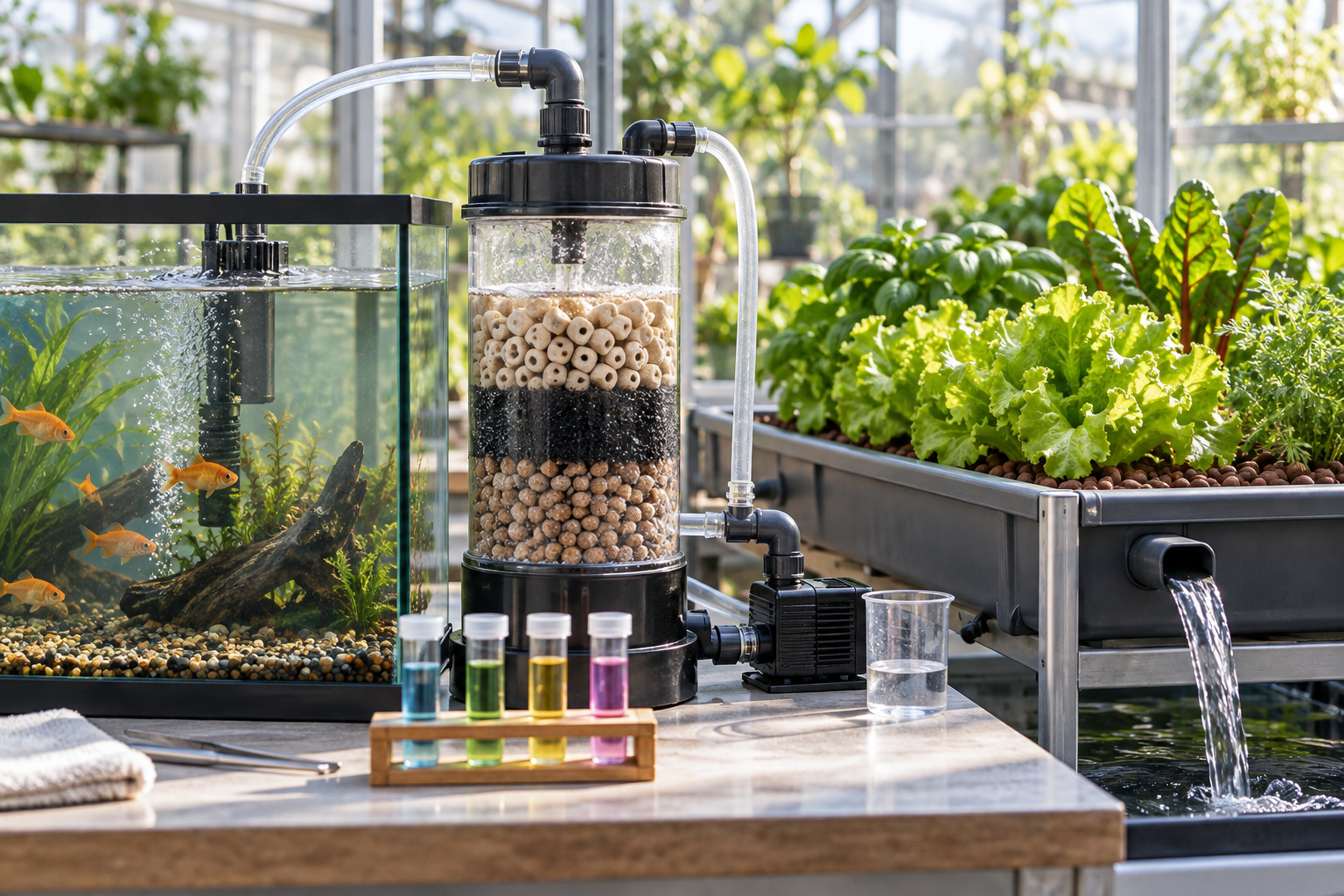
The system starts with ammonia
Aquaponics water quality starts with ammonia. Fish eat feed and release waste. Uneaten feed and organic debris also break down. That produces ammonia, which can harm fish if the system cannot process it fast enough.
The biofilter does not simply “remove” ammonia. It gives nitrifying bacteria a place to live. Those bacteria convert ammonia into nitrite, then nitrite into nitrate. Nitrate is less toxic and can be used by plants.
| Step | What happens in the water | Management point |
|---|---|---|
| 1 | Fish waste and feed create ammonia | Avoid overfeeding |
| 2 | Bacteria convert ammonia into nitrite | Provide media and oxygen |
| 3 | Bacteria convert nitrite into nitrate | Keep circulation stable |
| 4 | Plants absorb nitrate | Match fish load and plant load |
Beginners often miss the second and third steps. Moving water is not the same as having a working biofilter. Bacteria need time, oxygen, surface area, and steady conditions.
Surface area and oxygen matter more than a large tank
A larger filter can help, but size alone is not the answer. The real question is whether bacteria have enough surface area and whether oxygen-rich water passes through that media.
Ceramic rings, bio balls, sponge media, and porous stone-type media can all work. The exact product matters less than the flow pattern. If water bypasses the media, even a large filter becomes an empty container.
A safe beginner setup looks like this.
| Component | Practical direction |
|---|---|
| Fish tank | Start with a low fish load |
| Mechanical filtration | Capture large solids before the biofilter |
| Biological filtration | Use enough media for bacteria to colonize |
| Oxygen | Add aeration or falling-water movement |
| Pump | Use a stable pump that can run continuously |
| Backup | Keep a small spare pump ready |
The biofilter is more like the gut of the aquaponics system than a decorative accessory. It is not very visible, but the whole system depends on it.
Do not skip the 30-day cycling period
A new system tempts people to add fish and lettuce right away. That is the risky moment. The bacteria are not ready yet.
The first 30 days should be treated as a cycling period, not a production period. The goal is to see ammonia and nitrite rise and then fall as the bacteria population grows.
| Period | What to do | What to check |
|---|---|---|
| Week 1 | Test leaks, flow, pump noise, and temperature | Confirm stable 24-hour circulation |
| Week 2 | Add a small ammonia source or very light feed | Watch for ammonia spikes |
| Week 3 | Adjust aeration and biofilter flow | Check whether nitrite appears |
| Week 4 | Add a very small fish load | Confirm ammonia and nitrite stay low |
During cycling, less is safer. Too much feed can destabilize the water. Too many plants can also create unrealistic expectations before the nutrient cycle is ready.
Aim for pH stability first
Aquaponics pH must serve fish, bacteria, and plants at the same time. Plants may prefer one range, fish another, and nitrifying bacteria another. A balanced system usually performs better than a system forced toward one extreme.
For many beginner systems, keeping pH near 6.8 to 7.2 is a practical first target. The exact range depends on fish species, water source, temperature, and crop choice.
The bigger mistake is changing pH too fast. If pH is 7.8 today, do not try to force it to 6.8 immediately. Fish and bacteria experience that as shock. Slow correction is safer than a perfect number reached too quickly.
If pH keeps rising, check these points.
- Shells, coral sand, limestone, or alkaline media may be in the system.
- The source water may already be alkaline.
- Evaporation may be replaced without enough water exchange.
- Alkalinity and nitrate accumulation may need to be reviewed together.
If pH keeps falling, check these points.
- Nitrification can gradually acidify the water.
- The water may have low buffering capacity.
- Organic matter may be decomposing in the system.
- A water change and top-up plan may be needed.
The goal is not just to hit a number. The goal is to prevent sudden movement.
If ammonia appears, reduce feed first
When ammonia rises, many beginners look for additives first. In most small systems, the first move should be to reduce feed. Feed is the beginning of the ammonia load.
A simple response sequence is safer.
- Reduce or stop feeding for one to two days.
- Remove dead leaves, uneaten feed, and solids.
- Increase aeration.
- Do a partial water change if fish show stress.
- Check pump flow and filter blockage.
- Reduce fish load or increase biofilter and plant capacity.
Ammonia becomes more dangerous when pH and temperature are high. That is why ammonia, pH, and temperature should be read together.
A safe setup order
For a small beginner aquaponics system, this order works well.
- Place the fish tank and grow bed first.
- Plan where overflow water will go.
- Put mechanical filtration before biological filtration.
- Make sure the biofilter media stays wet or submerged.
- Add oxygen to the filter section.
- Avoid overly strong pump flow.
- Run a 24-hour circulation test.
- Cycle the system for three to four weeks.
- Add a small number of fish.
- Start with a modest amount of plants and watch leaf color.
A simple system is easier to fix than a complex system with hidden failure points. Start small and visible.
Seven common beginner mistakes
The first mistake is adding too many fish too early. The water is not ready to process their waste.
The second mistake is overfeeding. Uneaten feed becomes a water quality problem.
The third mistake is washing biofilter media too aggressively. Chlorinated tap water and heavy cleaning can reduce the bacteria colony.
The fourth mistake is changing pH too quickly. The number may look better, but the organisms can be stressed.
The fifth mistake is having no backup pump. One stopped pump can endanger both fish and plants.
The sixth mistake is planting too heavily before the nutrient cycle is ready.
The seventh mistake is not keeping records. Trends matter more than a single test result.
Daily and weekly checks
You do not need to test everything every day. Separate fast visual checks from scheduled tests.
| Frequency | What to check |
|---|---|
| Daily | Pump sound, water flow, fish breathing, feeding response |
| Twice a week | pH, ammonia, temperature, leaf color |
| Weekly | Nitrite, nitrate, filter blockage, leaks |
| Monthly | Spare pump, air line, filter media condition, electrical safety |
Aquaponics looks automated, but it is not a set-and-forget system. Three minutes of daily observation can prevent most serious failures.
Stability comes before yield
For a beginner aquaponics setup, the first goal is not harvest volume. The first goal is stable ammonia, low nitrite, steady pH, and reliable circulation.
Once the system is stable, fish and plant load can be increased slowly. Without stability, buying more equipment will not solve the real problem.
Clear water is not enough. The invisible bacterial work must be in balance with fish waste and plant uptake. That is why the biofilter comes first. Yield, profit, and attractive photos come later.
References
- FAO,
Small-scale aquaponic food production: Integrated fish and plant farming. - University of Florida IFAS Extension, aquaponic system overview materials.
- IMUN.FARM,
Aquaponics profitability: how much can a home system earn?. - IMUN.FARM,
Recommended fish for aquaponics: goldfish, guppy, and tilapia in practice. - The water-quality values in this article are planning guidance for small recirculating aquaponics systems. Actual targets vary by fish species, temperature, stocking density, crop choice, and source water.