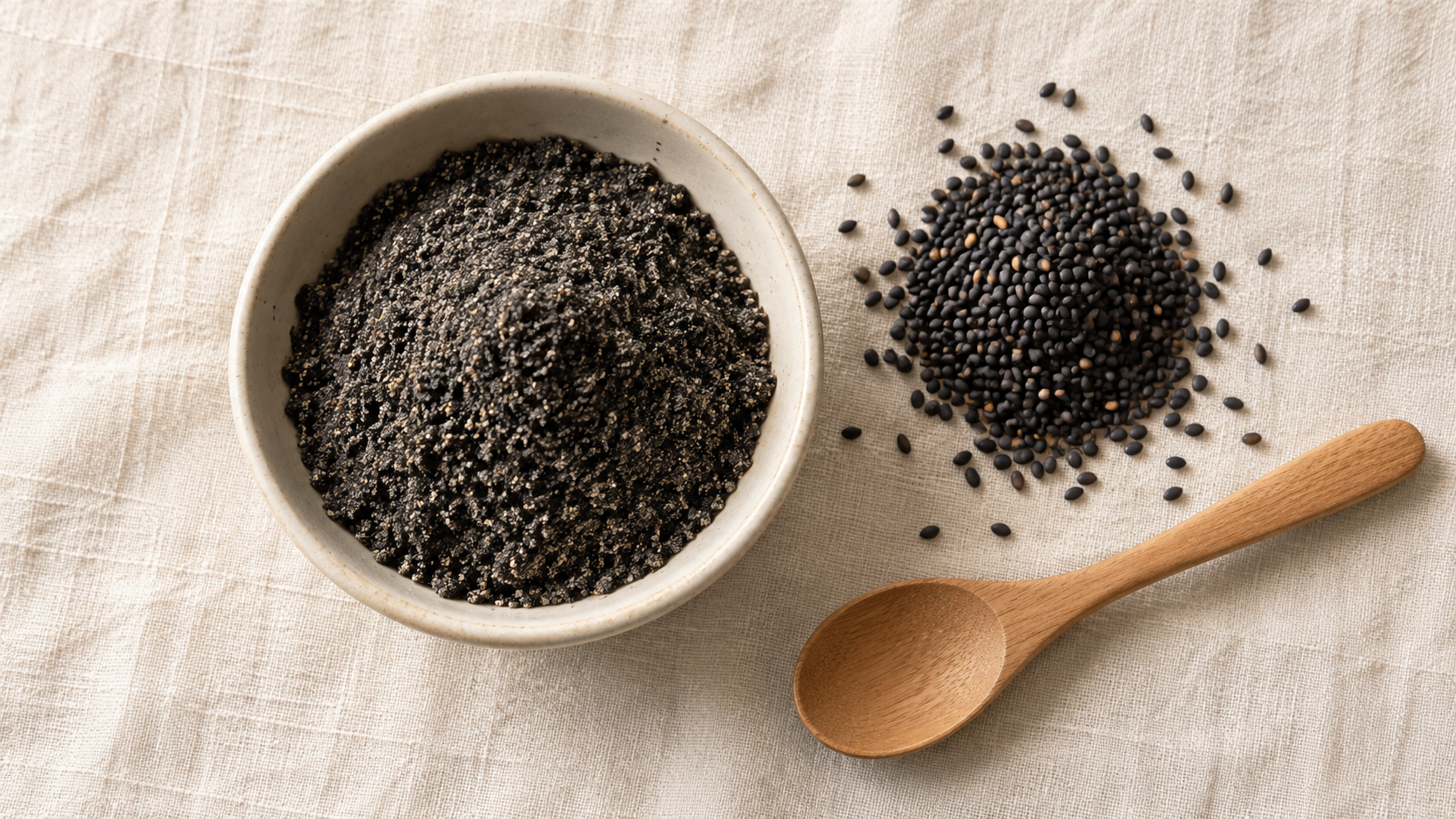
Online prices on October 16, 2026 for black sesame powder labelled Korean, converted to per-kg, compared with unlabelled products and KAMIS domestic and Chinese sesame wholesale prices on October 15. What heukimja is, why "made in Korea" is not the same as Korean-grown, how to roast and grind black sesame, storage, and what growers should check before selling powder.
Look for black sesame powder (heukimja) to make black sesame porridge and prices are all over the place: one 500 g bag costs KRW 13,000, another KRW 36,000. Here is where the gap comes from, by price per kilogram and origin labelling.
Bottom line: On October 16, 2026, black sesame powder labelled Korean or domestic sold online for KRW 53,000–94,000 per kilogram equivalent. A 500 g product with no origin in its title was about KRW 27,000 per kilogram. Black sesame is not a KAMIS item; domestic white sesame was about KRW 24,100 per kilogram at wholesale on October 15 and Chinese sesame about KRW 7,100. “Made in Korea” or “processed in Korea” does not mean Korean-grown seed.
Earlier notes: Korean sesame seed price 2026, roasted sesame price 2026.
1. Korean black sesame powder per kilogram
Coupang Partners list prices on October 16, 2026 for products whose title says Korean or domestic. Discounts change daily.
| Product (as titled) | Size | Oct 16 price | Per kg |
|---|---|---|---|
| Gusuhan Saramdeul, Korean | 450 g | KRW 23,900 | KRW 53,111 |
| 2026 crop, 100% Korean, roasted | 200 g | KRW 10,900 | KRW 54,500 |
| Korean black sesame powder | 200 g | KRW 13,900 | KRW 69,500 |
| Bangatgan Cheongnyeon, domestic, roasted | 500 g | KRW 36,000 | KRW 72,000 |
| Joanna, roasted, 100% domestic | 200 g | KRW 15,900 | KRW 79,500 |
| Boki-ne, 100% Korean | 300 g | KRW 23,900 | KRW 79,667 |
| Boki-ne, 100% Korean | 110 g | KRW 10,390 | KRW 94,455 |
Smaller packs cost more per kilogram. A 500 g “twice-roasted” powder with no origin in its title was KRW 13,490, about KRW 26,980 per kilogram.
2. Raw sesame at wholesale
Heukimja is sesame with a black seed coat, not perilla. The National Institute of Crop Science bred the black sesame variety Ganghuk in 2003, with 47.1% oil content. KAMIS does not survey black sesame separately, so white sesame is the reference. October 15, 2026:
| Type | 30 kg, five-city average | Per kg | A year earlier |
|---|---|---|---|
| Domestic white, top | KRW 723,400 | KRW 24,113 | KRW 796,800 |
| Chinese, mid grade | KRW 214,200 | KRW 7,140 | KRW 219,200 |
Sesame carries a 630% base tariff, or 40% for quota imports recommended by aT. Tariff lines do not separate seed colour. Daily prices: domestic sesame, Chinese sesame.
3. “Domestic” versus “made in Korea”
| Label wording | Meaning |
|---|---|
| Korean, domestic, 100% Korean | Origin of the seed |
| Made in Korea, produced in Korea | Where it was ground, possibly |
| 100% processed in Korea | Where it was roasted and ground |
| 100% black sesame | No other grains mixed in |
Sesame is subject to origin labelling, including heated seed whose shape is still recognisable. Powder has no visible shape, so check the ingredient and origin fields on the product page, not the title. Both Korean-labelled products we checked showed “see product details” in the origin field.
4. Roasting and grinding at home
A National Institute of Crop Science study (Park et al., 2011) found 220 °C for 3 minutes best for small-batch household roasting, and white sesame needed a higher temperature than black. We found no official figure for black sesame alone. Colour change is hard to see on black seeds, so use other cues: a thin layer in the pan, constant stirring, lower the heat when a few seeds pop, and stop when a seed crushes easily and smells nutty. Cool fully before grinding, and grind only what you will use within a few weeks.
5. Storage
We found no official storage period for sesame powder. Sesame oil research (Lee et al., 2008) showed rancidity indicators rising slowly even at 25 °C in the dark, and powder exposes far more surface to air. Keep it airtight, away from light and heat, portion what you will keep longer into the fridge or freezer, and follow the label.
6. For growers
Powder fetches the highest per-kilogram price but is a further processing step. Food Sanitation Act Enforcement Decree Article 25 exempts simple cutting or drying of produce without additives from business reporting; we found no official ruling on whether roasting and grinding qualifies. Ask the city or county food sanitation office before selling.
7. Conclusion
Korean black sesame powder starts around KRW 50,000 per kilogram, two to four times the wholesale price of domestic sesame, with the gap coming from roasting, grinding and small packaging. Compare per-kilogram prices, check the origin field, and do not confuse “made in Korea” with Korean-grown.
References
- Online prices: Coupang Partners product search for Korean black sesame powder (checked October 16, 2026).
- aT KAMIS daily wholesale prices (data.go.kr API): domestic white sesame top grade and Chinese mid grade, 30 kg, five cities, October 2025 to October 15, 2026.
- Shim et al. (2012), new black sesame variety Ganghuk, Korean Journal of Breeding Science 44(3): koreascholar
- Park et al. (2011), sesame quality by roasting temperature and time, Korean Journal of Crop Science 56(3): koreascience
- Seo et al. (2009), roasting conditions and PAHs in sesame oil, Korean Journal of Food Science and Technology 41(4): earticle
- Lee et al. (2008), quality changes in stored sesame oil: koreascience
- National Agricultural Products Quality Management Service, origin labelling items: naqs.go.kr
- Korea Customs Service release (December 23, 2022), sesame import rights auction: korea.kr
- Food Sanitation Act Enforcement Decree, Article 25: law.go.kr