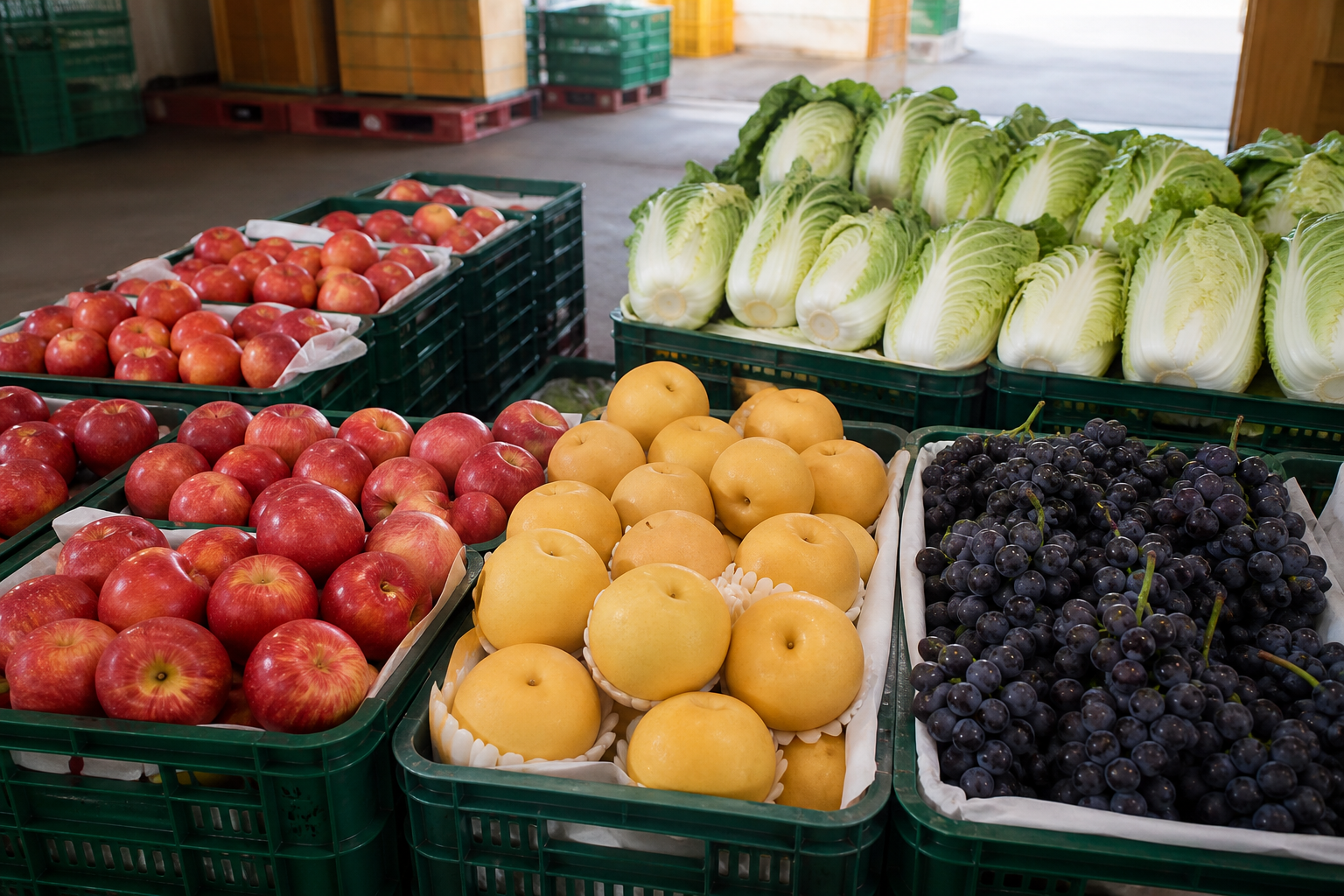
A farmer-facing pre-Chuseok price outlook for apples, pears, grapes, and cabbage using KAMIS wholesale prices and the KREI August 2026 fruit outlook.
Pre-Chuseok Produce Price Table: Apples, Pears, Grapes, and Cabbage
Pre-Chuseok produce prices matter to both farmers and consumers. Farmers need to decide whether to ship now or wait. Consumers watch gift boxes and grocery prices.
As of August 27, 2026, the picture differs by crop. Spot prices show relatively strong levels for Hongro apples and Wonhwang pears. But KREI’s August 2026 fruit outlook points to larger shipments and weaker year-on-year price direction for apples, pears, and grapes. So farmers should separate “strong current price” from “strong price through Chuseok.”
Bottom line: Current price tables look strongest for pears and Hongro apples. Grapes are weaker by variety, while regular highland cabbage is below last year and normal-year levels but has recovered from a month earlier.
1. Data used
This article uses two main sources.
- aT KAMIS wholesale price data as of August 26, 2026
- KREI Agricultural Outlook Center, 「Fruit Outlook, August 2026」, published August 4, 2026
KAMIS shows a daily market snapshot. KREI provides monthly supply and price direction. Both should be read together.
Chuseok falls on September 25 in 2026. KREI notes that earlier Chuseok timing can pull some apple and pear shipments forward. Holiday demand supports prices, but if shipments also increase, average prices can still soften.
2. Price table as of August 26, 2026
The table below uses KAMIS wholesale prices. Units differ by crop, so compare year-on-year and normal-year positions together.
| Crop | Variety/grade | Unit | Aug. 26 price | One year ago | Normal year | Reading |
|---|---|---|---|---|---|---|
| Apple | Hongro premium | 10kg | 91,000 KRW | 90,297 KRW | 76,231 KRW | Similar to last year, above normal |
| Pear | Wonhwang premium | 15kg | 59,500 KRW | 45,669 KRW | 52,263 KRW | Above last year and normal |
| Grape | Campbell Early L | 3kg | 22,800 KRW | 22,666 KRW | 22,670 KRW | Near last year and normal |
| Grape | Geobong L | 2kg | 16,400 KRW | 16,300 KRW | 18,485 KRW | Similar to last year, below normal |
| Grape | Shine Muscat L | 2kg | 16,000 KRW | 16,906 KRW | 21,154 KRW | Below last year and normal |
| Cabbage | Summer highland premium | 10kg, 3 heads | 13,000 KRW | 19,854 KRW | 18,586 KRW | Below last year and normal |
| Small napa cabbage | Premium | 8kg | 38,600 KRW | 37,131 KRW | 37,858 KRW | Slightly above last year and normal |
From this table, pears, Hongro apples, and small napa cabbage look relatively strong. Shine Muscat and regular summer highland cabbage look weak versus normal-year levels. Cabbage must be split by type: large kimchi cabbage is weak, while small napa cabbage is holding better.
3. Apples: Hongro is strong, but averages need caution
KAMIS showed Hongro premium apples at 91,000 KRW/10kg on August 26. That is close to last year and clearly above the normal-year level.
However, KREI forecasts 2026 apple production at 487 thousand tons, up 8.7% from last year. September apple shipments are forecast at 70.1 thousand tons, up 2.2% from last year and 10.4% above normal.
This means premium Hongro can still hold value before Chuseok, but the overall apple market should not be read as simply strong. Gift-grade fruit may sell well, while medium-grade and marked fruit may weaken first.
For apple farmers:
- Hongro premium: separate for Chuseok gift boxes
- Hongro medium: move quickly through home-use packs
- Fuji: focus more on October and later storage strategy
- Marked fruit: keep it out of premium channels
For apples, the key is not just “strong price.” It is the widening gap between premium and medium grades.
4. Pears: the strongest crop in the current table
Pears look strongest in the current price table. KAMIS showed Wonhwang premium pears at 59,500 KRW/15kg on August 26. That is above both last year and the normal-year level.
KREI forecasts 2026 pear production at 200 thousand tons, up 1.3% from last year. August fresh pear shipments are expected to increase 15.6% year-on-year, while shipments after September are expected to increase 0.6%.
Supply is not structurally tight. Still, spot prices remain strong because Chuseok gift demand, large-fruit availability, and shipment timing all interact.
Pear farmers should separate grades strictly:
- Large, clean fruit: gift boxes
- Mid-size fruit: home-use boxes and local-food stores
- Damaged fruit: processing or bulk channels
- Early Shingo shipments: check sweetness and appearance before rushing
Pears are strong now, but that does not mean prices must keep rising into Chuseok.
5. Grapes: overall weaker by variety
Grapes are more cautious. Campbell Early L was 22,800 KRW/3kg, close to last year and normal. Geobong L was 16,400 KRW/2kg, similar to last year but below normal. Shine Muscat L was 16,000 KRW/2kg, below both last year and normal-year levels.
KREI also expected August grape prices to be lower year-on-year. It forecast August grape shipments to increase by 8.0%. By variety, shipments were forecast up 7.5% for Campbell Early, 9.2% for Geobong types, and 8.0% for Shine Muscat.
Even if quality is good, larger shipments pressure average prices. For Shine Muscat especially, the variety name alone no longer protects the price. Sweetness, berry size, cluster shape, and buyer trust matter more.
For grape farmers:
- Premium Shine Muscat: gift and reservation sales
- Medium Shine Muscat: lower price and faster turnover
- Campbell Early: price near last year and normal levels
- Geobong: avoid holding inventory too long because normal-year comparison is weak
Chuseok demand helps grapes, but grade discipline is essential.
6. Cabbage: split regular highland cabbage and small napa cabbage
Cabbage is easy to misread if treated as one item. KAMIS showed summer highland cabbage at 13,000 KRW/10kg on August 26. That is below last year and below the normal-year level. Small napa cabbage, however, was 38,600 KRW/8kg, slightly above both last year and normal.
So large kimchi-use cabbage is weak, while small napa cabbage is holding better. For consumers, both may appear as “cabbage,” but for farmers the market is different.
Regular highland cabbage rose from 9,778 KRW a month earlier to 13,000 KRW. That is a recovery from last month, but still weak versus last year and normal. Small napa cabbage rose sharply from 17,304 KRW a month earlier to 38,600 KRW.
For cabbage farmers:
- Highland cabbage: watch shipment timing and avoid oversupply
- Small napa cabbage: consider moving good-quality lots while price is strong
- Medium-grade cabbage: turnover matters more than storage
- Weather and shipment volume can still move prices quickly around Chuseok
7. Which crop is strongest before Chuseok?
| Rank | Crop | Why | Caution |
|---|---|---|---|
| 1 | Pear | Wonhwang price is above last year and normal | Shipment increase limits upside |
| 2 | Hongro apple | Premium grade is above normal | Medium grade may weaken |
| 3 | Small napa cabbage | Slightly above last year and normal, sharply up from last month | Must not be confused with regular highland cabbage |
| 4 | Campbell Early grape | Holding near last year and normal | Limited upside |
| 5 | Geobong and Shine Muscat | Below normal, especially Shine Muscat | Quality sorting is critical |
| 6 | Highland cabbage | Up from last month but below last year and normal | Weather and shipment timing matter |
The practical answer is simple. Before Chuseok, pears and Hongro apples look strongest, but mostly for good-grade fruit. Grapes need conservative pricing, especially Shine Muscat. Cabbage must be split between regular highland cabbage and small napa cabbage.
8. Farmer checklist
Before setting a Chuseok price table:
- Check today’s KAMIS price and the one-week trend.
- Compare both one-year-ago and normal-year prices.
- Sort your crop into premium, medium, home-use, and damaged lots.
- Add packaging and delivery cost separately for gift boxes.
- Do not hold medium-grade fruit too long just because premium prices look strong.
- For grapes, prioritize reservation sales and fast turnover.
- For cabbage, separate regular highland cabbage from small napa cabbage.
Around Chuseok, grade and channel often matter more than the crop name. The same apple can have very different prices by grade. The same cabbage market can move differently by type.
9. Bottom line
The 2026 pre-Chuseok produce market is not a simple “apple up, grape down” story. Current prices look strongest for pears and Hongro apples. Small napa cabbage is also relatively firm. But KREI’s fruit outlook shows larger shipments and price pressure for apples, pears, and grapes.
Farmers should not rely on one average market price. They should separate gift-grade, home-use, medium-grade, and damaged lots. In this Chuseok season, the strongest item may not be a crop name. It may be the best-sorted box.
References
- aT KAMIS Agricultural Price Information, wholesale prices as of August 26, 2026.
- KREI Agricultural Outlook Center, 「Fruit Outlook, August 2026」, published August 4, 2026.
- KREI apple, pear, and grape sections: production, shipment, and price outlooks.
- KAMIS cabbage and small napa cabbage wholesale prices were used for the August 26 comparison.