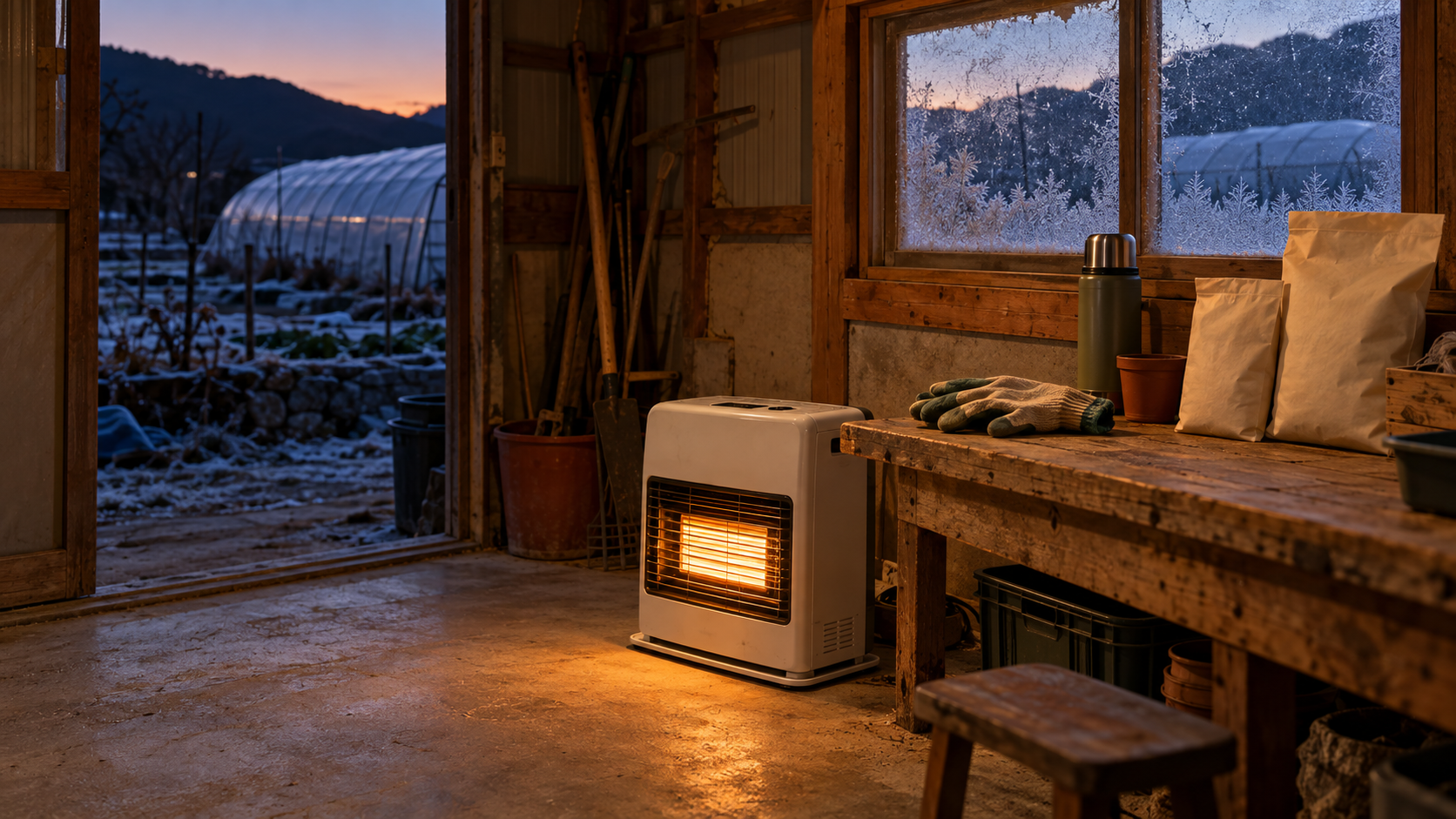
How to choose a fan heater. Kerosene and electric fan heaters compared, hourly fuel cost of a 9L kerosene fan heater (Shinil SFH-1200MG listing specs, about 227–1,019 won per hour at the Gyeonggi indoor kerosene average of 1,587 won/L on October 23, 2026), a 2kW electric heater for comparison, and ventilation and CO alarms in a farm shed.
After sunset the air inside a farm shed feels colder than outside. Before sorting seed packets you have to warm your hands. Most people reach for a fan heater. In Korea, “fan heater” is searched about 16,990 times a month and “Shinil fan heater” 13,550 times. But two very different machines share the name: one burns kerosene, the other runs on electricity. This note works out which to buy, what an hour costs, and whether it belongs in a farm shed, using listing specs and official prices.
Bottom line: Long sessions with limited electrical capacity point to a kerosene fan heater. Short sessions, or a room you sleep in, point to an electric one. The Shinil 9L (SFH-1200MG) is listed at 0.143–0.642 L of kerosene per hour. At the Opinet Gyeonggi indoor kerosene average of 1,587 won/L on October 23, 2026, that is about 227 won per hour on low and 1,019 won on high. A 2kW electric heater costs about 302, 515 or 724 won per hour depending on a household’s progressive tier. A kerosene fan heater burns indoor air, so ventilation and a carbon monoxide alarm are not optional.
1. Two kinds of fan heater
Kerosene fan heaters burn fuel from a tank and blow the heat forward with a fan. They still need a power cord for ignition, the fan and the thermostat, so they stop in a power cut. Models without a flue release combustion gases into the room.
Electric fan heaters warm a PTC or similar element and blow air across it. Nothing burns, so there is no smell or exhaust. A 2kW unit draws 2kW the whole time it runs, which can trip the breaker in a shed with a small supply contract.
| Kerosene fan heater | Electric fan heater | |
|---|---|---|
| Heat source | Burns kerosene (a little electricity) | Electric element |
| Output | High (Shinil 9L up to 6.6kW listed) | Usually about 2kW |
| Ventilation | Required | Not needed |
| Smell | Kerosene smell at start and stop | Almost none |
| Best for | Workshops, sheds, large rooms used for hours | Short use, bathrooms, under a desk |
2. Reading the Shinil 9L specs
| Item | Listed |
|---|---|
| Fuel | Kerosene |
| Tank | 9L |
| Output | 1.46–6.60kW |
| Fuel use | 0.143–0.642 L/h |
| Burn time | About 14–62.9 hours per tank |
| Heating area | 38㎡ |
| Power | 220V 60Hz |
| Electricity | up to 428W briefly at ignition, 210W high / 90W low while burning |
The numbers agree: 9 L divided by 0.642 L/h is 14 hours, and by 0.143 L/h is 62.9 hours. At four hours a day on high, a tank lasts three and a half days; on low, more than two weeks.
38㎡ comfortably covers a Korean farm shed, which is limited to 20㎡ of floor area under the Farmland Act enforcement rules. It is far too small to heat a plastic greenhouse. Greenhouse heating needs its own kW calculation, covered in our greenhouse heater guide.
3. Cost per hour: kerosene vs electricity
Opinet regional indoor kerosene averages on October 23, 2026 were 1,694 won/L in Seoul, 1,587 in Gyeonggi, 1,564 in Gyeongbuk and 1,561 in Jeonnam and Gwangju. At 1,587 won:
| Setting | Fuel per hour | 1 hour | 4 hours a day | 30 days at 4 h/day |
|---|---|---|---|---|
| Low | 0.143 L | about 227 won | about 908 won | about 27,000 won |
| High | 0.642 L | about 1,019 won | about 4,076 won | about 122,000 won |
A full 9L tank costs about 14,280 won. In practice the burner cycles between these settings.
A 2kW electric heater uses 2 kWh per hour: about 302, 515 or 724 won depending on the progressive tier (KEPCO residential tariff, see our electricity cost note).
Per unit of heat, the Shinil on high delivers 6.6 kW for about 1,019 won, roughly 154 won per kWh of heat. The electric heater costs about 151, 258 or 362 won per kWh. In the first tier the two are similar; in higher tiers kerosene is cheaper, and one electric heater tops out at 2kW.
4. Safety in a shed or workshop
A flueless kerosene heater uses the room’s oxygen and leaves its exhaust in the room. Carbon monoxide has no smell or colour. Korea’s National Fire Agency counted 471 carbon monoxide poisoning incidents in 2019–2021, with misuse of heaters in winter a leading cause.
- Air the room on a fixed schedule, following the manual.
- Never sleep with it running. Use electric heat in a bedroom.
- Fit a carbon monoxide alarm near where people sit.
- Switch off and let it cool before refuelling, and refuel outside.
- Keep sacks, boxes, plastic and curtains away from the front and sides.
- Do not use it in a tent or car.
Electric heaters need care too: plug them straight into a wall socket, not a shared power strip, and unplug them when you leave.
5. What to check before buying
- Heating area and maximum output: a little more than you need lets it run on low.
- Tank size: about 9 L means refilling every few days at a few hours a day.
- Safety features: tip-over shut-off, overheat protection, automatic off timer.
- Noise and smell: read reviews for start-up and shut-down smell and fan noise.
- After-sales service: kerosene heaters need filter cleaning and occasional servicing.
Summary
The choice comes down to how long and where you run it. Long sessions in a larger space favour kerosene on both cost and power. Short sessions or a bedroom favour electric. If you burn kerosene in a farm shed, buy a carbon monoxide alarm the same day.
References
- Opinet (Korea National Oil Corporation), regional average indoor kerosene prices, October 23, 2026 (Seoul 1,694.32, Gyeonggi 1,586.53, Gyeongbuk 1,564.39, Jeonnam/Gwangju 1,561.06 won/L).
- Shinil fan heater SFH-1200MG Coupang listing spec sheet, checked October 24, 2026 (9L tank, 1.46–6.60kW, 0.143–0.642 L/h, 14.0–62.9 h burn time, 38㎡, 428W ignition peak, 210W/90W burning, made in Japan). Seller-listed specs; confirm with the manufacturer before buying.
- KEPCO residential (low-voltage) tariff, effective November 9, 2023.
- National Fire Agency carbon monoxide poisoning statistics 2019–2021, reported by Safety Journal, October 24, 2022.
- Korea Consumer Agency and Korean Agency for Technology and Standards, winter camping heater safety campaign, February 2024 (regular ventilation, CO alarms).
- Farmland Act enforcement rules (farm shed floor area up to 20㎡).
- Costs are worked examples; real costs depend on local fuel price, insulation, outdoor temperature and thermostat setting.