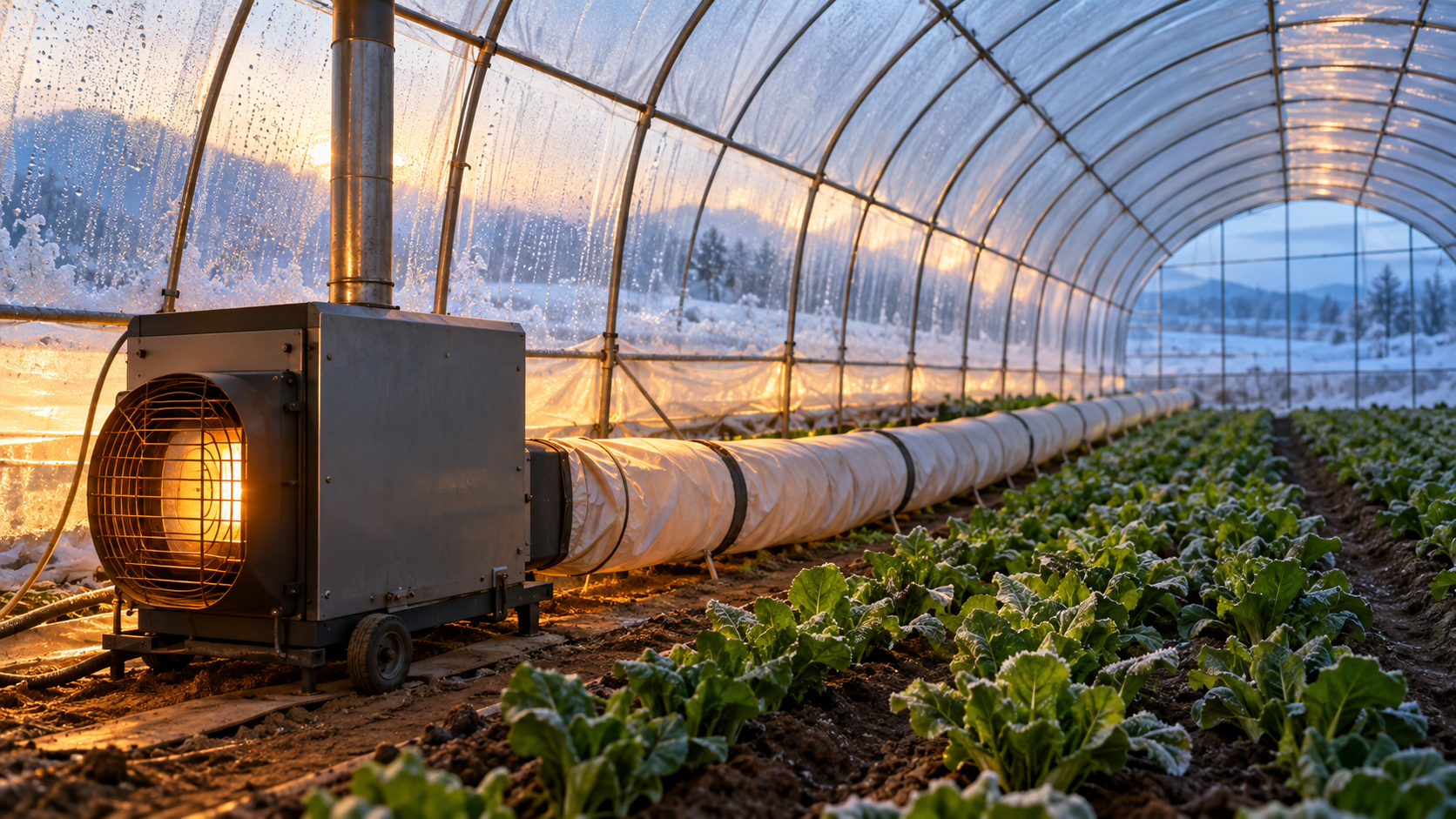
What to check before buying a heater for a vinyl greenhouse or farm shed: sizing (1 kW = 860 kcal/h), electric, kerosene, gas and wood fuels, a monthly electric cost example, sealing heat leaks, and carbon monoxide safety.
When the first frost warnings come in late October, greenhouse growers and farm-shed owners start shopping for heaters: electric, kerosene, gas, wood. Before price, decide three things: how much heat you need, which fuel you can use, and whether people breathe in that space.
Bottom line: choose by heat output (kW), then fuel, then safety. 1 kW is about 860 kcal per hour. In greenhouses, sealing leaks is cheaper than a bigger heater: Korea’s Rural Development Administration found that closing gaps equal to just 0.6% of the curtain area cut heat loss by about 12%. If you burn fuel in a shed where people stay, a carbon monoxide alarm is essential.
1. Size first.
1 kW ≈ 860 kcal/h, so a 2 kW heater gives about 1,720 kcal/h. Need depends on the temperature gap and how fast heat leaks. For greenhouses, ask your local agricultural technology center for a heating-load assessment; for a small uninsulated shed used for short work sessions, people often start with a 1–2 kW electric heater.
2. Fuels compared.
| Fuel | Pros | Cons | Suits |
|---|---|---|---|
| Electric | No combustion gas, easy install | Contracted power limits, electricity cost | Sheds, small greenhouse backup |
| Kerosene/diesel hot-air | High output | Needs exhaust, fuel handling | Main greenhouse heating |
| Gas (butane/LPG) | Cheap, light | High CO risk; never in closed spaces | Brief use in ventilated space |
| Wood stove | Cheap fuel | CO and fire risk, flue upkeep | Spaces with a proper flue |
Greenhouse kerosene/diesel heaters may qualify for tax-exempt farm fuel; ask your local cooperative.
3. Monthly electric cost.
2 kW × 8 hours × 30 days = 480 kWh. On KEPCO’s agricultural (B) low-voltage tariff (₩1,150/kW basic, ₩65.9/kWh, April 2025), that is about ₩34,000 a month before VAT and surcharges. Residential or general-service contracts cost much more, so check your contract type.
4. Seal leaks before upsizing.
RDA’s thermal-imaging diagnosis found that sealing gaps equal to 0.6% of the curtain area cut heat loss about 12%, and multi-layer thermal curtains can nearly halve heating costs. Check curtain seams, the bottom edge, doors, side vents and torn film. In sheds, draft strips and floor insulation often beat a bigger heater.
5. Carbon monoxide.
Korea’s fire agency recorded 471 CO poisoning incidents in 2019–2021; 85.1% happened October–March, with January highest (98). Causes split among gas (33.3%), coal (32.5%) and wood or charcoal (30.4%), with 27 cardiac arrests. CO is colourless and odourless. Install a CO alarm wherever fuel is burned, ventilate often, switch combustion heaters off before sleeping (farm sheds are not dwellings), and check flues every season.
References
- Korea fire agency CO statistics (2019–2021), Safety Journal, October 24, 2022.
- RDA, greenhouse heat-loss diagnosis, February 13, 2012.
- YTN, multi-layer greenhouse curtains, December 17, 2015.
- KEPCO tariff, agricultural (B) low voltage, April 1, 2025.
- Actual needs vary with structure, insulation, climate, crop and power contract.