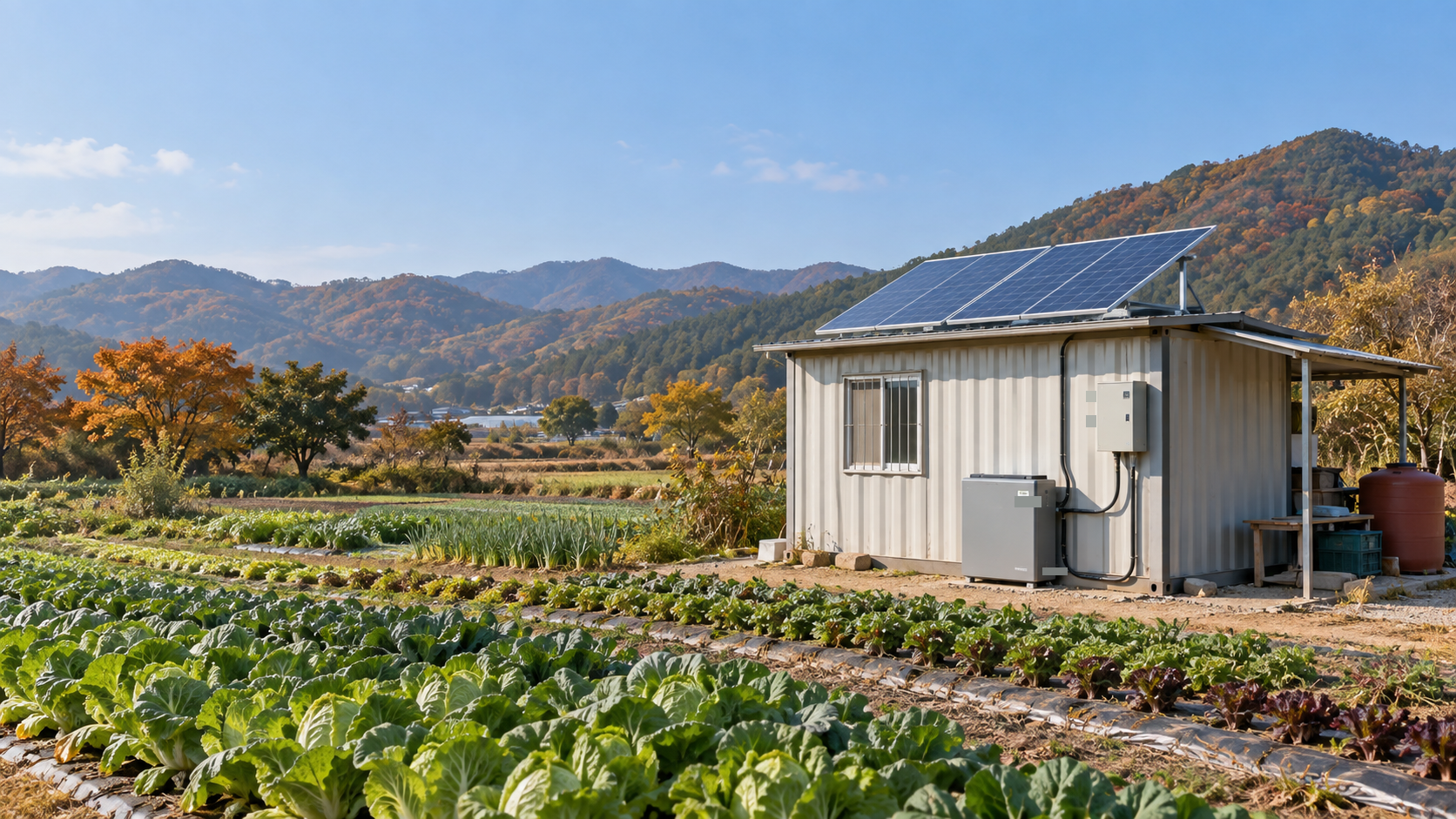
How to size panels, MPPT controller, pure sine inverter and LiFePO4 battery for a Korean farm hut, with 200W, 1kW and 3kW examples, market prices, farm hut rules and winter battery cautions.
A farm hut starts as shade and a tool store. Within a year most owners want a light after dark, a fan in summer, a CCTV camera, phone charging and eventually a water pump. Bringing in grid power means poles and connection costs.
That is why small off-grid solar systems are popular for farm huts. The common mistake is buying a system that is either too small for the loads or much larger than needed.
Bottom line: lights, a fan and CCTV can run on 200W of panels and one 12V 100Ah LiFePO4 battery. A small fridge pushes you to about 1kW, and a water pump or chainsaw needs a 3kW-class inverter. Complete 1kW off-grid kits in Korea sell for roughly 3.6–4.5 million won.
1. How much does 1kW of panels produce in Korea
An analysis of about 3,800 Korean solar plants by Haezoom put the national average at 4.02 generating hours per day in the first half of 2020 (3.99 in 2019). Industry estimates usually use 3.4–3.8 hours.
- 1kW of panels makes roughly 3.5–4kWh per day.
- 200W makes roughly 0.7–0.8kWh per day.
- Winter, the rainy season and cloudy spells produce less.
The calculations below assume 25% system losses through the controller, battery and inverter.
2. Typical farm hut loads
| Load | Power | Note |
|---|---|---|
| LED lantern or light | 5–20W | lightest load |
| CCTV camera | about 5W | about 120Wh per day if always on |
| Fan | 30–60W | summer afternoons |
| Electric heating pad | 30–60W | heavy if used for long winter hours |
| Camping fridge | 40–60W | small household fridges 80–150W |
| Water pump | 350–580W | high startup surge |
| Corded chainsaw | 1,460–2,200W | needs a 3kW-class inverter |
Motors draw about three times their running power at startup, and some draw 4–10 times. The inverter must handle that surge.
3. Three configurations
Assumptions: 3.5 sun hours, 25% losses, two cloudy days of reserve, 80% battery depth of discharge.
| Size | Loads | Daily use | Panels | Battery | Inverter |
|---|---|---|---|---|---|
| Basic 200W | LED, fan, CCTV, charging | about 0.5kWh | 200W (2 × 100W) | 12V 100Ah LiFePO4 (about 1.3kWh) | 500–1,000W pure sine |
| Living 1kW | basic + small fridge | about 1.5kWh | 600W–1kW | about 4kWh | 1–2kW pure sine |
| Work 3kW | living + pump, power tools | 2–3kWh+ | 1–2kW | 5kWh+, 24V or 48V | 3kW pure sine |
Formulas:
- Panels = daily use ÷ 3.5 ÷ 0.75 (e.g. 0.5kWh → about 190W → 200W)
- Battery = daily use × 2 days ÷ 0.8 (e.g. 0.5kWh → 1.25kWh → one 12V 100Ah LiFePO4)
- Inverter = running loads + largest motor surge + 20% headroom
A fridge runs all day, so whether you need one is the first question that separates 200W from 1kW.
4. Components
Panels: several 100W panels are easy to handle for small systems; 400–500W panels are cheaper per watt above 1kW. Secure roof mounts against wind.
Charge controller: PWM runs at about 75–80% efficiency, MPPT at 95–98%, harvesting 10–30% more energy, especially in cold weather.
Inverter: choose pure sine wave for fridges, pumps and electronics, sized for surge.
Battery:
| Item | LiFePO4 | Lead-acid (AGM) |
|---|---|---|
| Cycle life | 3,000–6,000 at 80% DoD | 700–1,200 at 50% DoD |
| Usable depth | 80%+ | shortens life below 50% |
| Weight | light | heavy |
| Winter | do not charge below 0℃ | capacity drops in cold |
5. Costs
Example Korean retail prices (single listings, will vary):
| Item | Example price |
|---|---|
| 100W panel | about 120,000 won |
| 500W monocrystalline panel | about 220,000 won |
| MPPT 30A / 40A / 60A | about 141,000 / 232,000 / 501,000 won |
| 3kW pure sine inverter | about 283,000 to 1,272,000 won |
| 12V 100Ah LiFePO4 | about 440,000 to 660,000 won |
| 1kW off-grid kit | about 3.6 to 4.5 million won |
| Size | Estimated cost | Note |
|---|---|---|
| Basic 200W | around 1 million won (DIY) | 2 panels, MPPT, one 100Ah battery, small inverter |
| Living 1kW | 3.6–4.5 million won (kit) | battery size drives the price |
| Work 3kW | 8–12 million won+ (estimate) | installation extra; get quotes |
Most of the cost is the battery. Less nighttime use means a smaller battery.
6. Farm hut rules and electrical inspection
A nongmak (farm hut) under Korea’s Farmland Act rules is limited to 20㎡ of floor area and may not be used as a residence. The government has interpreted that electricity, water and gas may be connected temporarily. Since December 2024, a rural stay shelter of up to 33㎡ is allowed for up to 12 years, with road access, an extinguisher and a smoke alarm required.
Low-voltage generating equipment of 10kW or less is classed as general-use electrical equipment, and the renewable energy cloud platform lists general-use solar of 10kW or less as subject to a pre-use inspection. Equipment under 30V not connected to higher voltage is not legally electrical equipment. Whether a fully off-grid system needs inspection or notification is not clearly stated, so confirm with Korea Electrical Safety Corporation (1588-7500) and your local government before installing.
7. Winter and safety
- Do not charge LiFePO4 below 0℃. Choose a battery with low-temperature charge cutoff or keep it from freezing. Usable capacity drops to about 80% below 0℃.
- Fit DC fuses or breakers close to the battery.
- Ground battery enclosures and racks.
- Anchor panels against wind.
- Keep a fire extinguisher.
For grid-connected projects, see 100kW farmland solar profit and agricultural ESS and self-consumption solar.
FAQ
Can I put solar on a farm hut? Temporary electrical connection has been allowed by government interpretation, but local rules vary. Check first.
How many watts does a farm hut need? 200W with a 12V 100Ah LiFePO4 battery for lights, a fan and CCTV; about 1kW with a fridge.
Can it run a water pump? Yes, but pumps surge at startup. A 350–580W pump needs a 2–3kW pure sine inverter and matching battery.
Is LiFePO4 fine in winter? It works, but must not be charged below 0℃.
Conclusion
Start with the loads, not the panels: lights and CCTV need 200W, a fridge needs 1kW, pumps and tools need 3kW. Batteries are most of the cost, and safety comes first: check with the electrical safety authority and include fuses, breakers, grounding and an extinguisher from day one.
References
- Energy Daily, Haezoom analysis of Korean solar generating hours (2020).
- Easylaw (Ministry of Government Legislation), general-use electrical equipment definitions.
- Korea Energy Agency renewable energy cloud platform, inspection targets.
- Korea.kr policy briefing on rural stay shelters (2024).
- Nongmin Shinmun, farm hut utility interpretation (February 23, 2021) and rural stay shelter report (August 1, 2024).
- Korean retailer listings (Danawa, Solar Center, Suncell), 2026; prices vary.
- Manufacturer technical data for LiFePO4, lead-acid, MPPT and PWM.