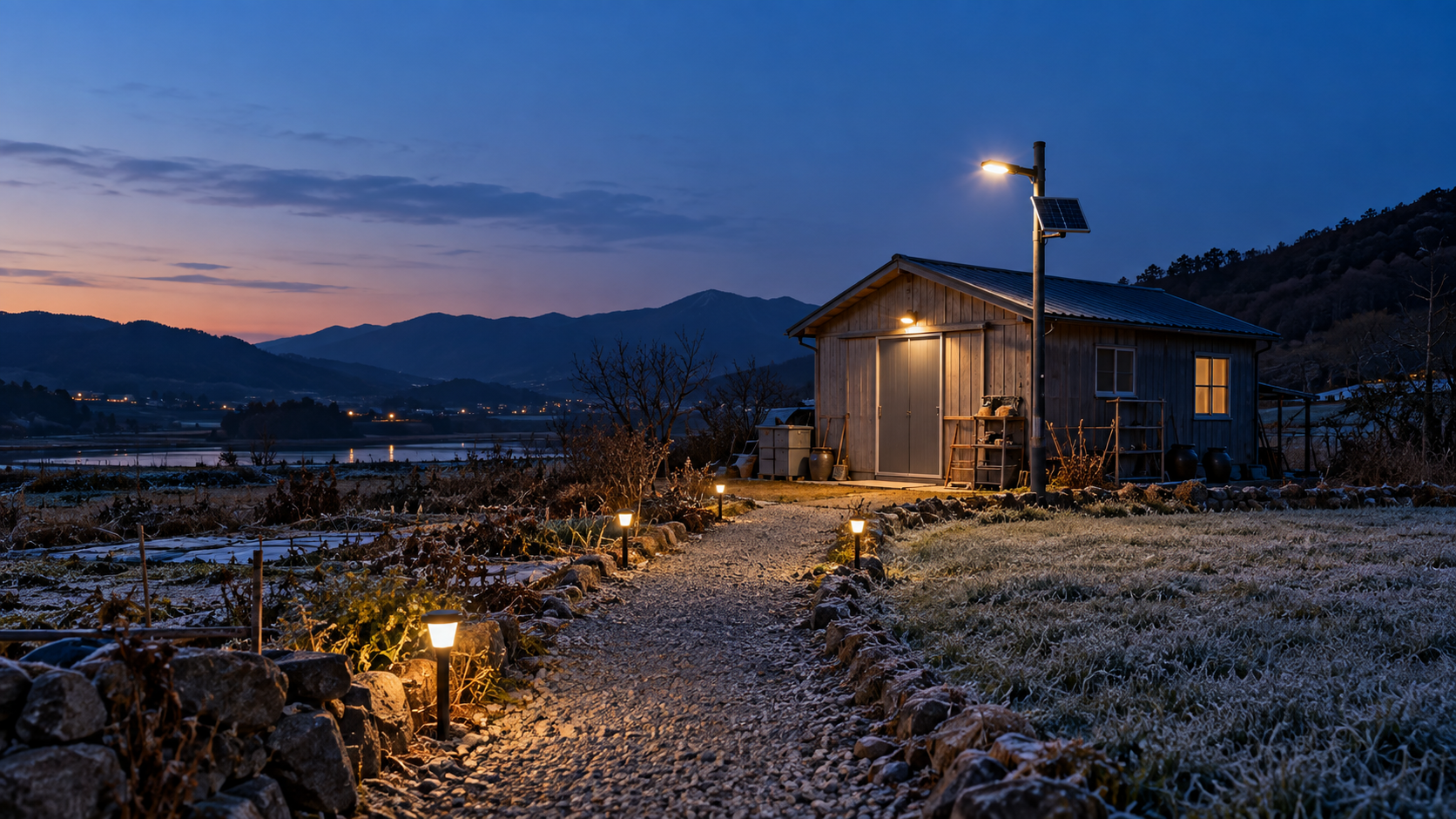
How long solar garden lights, solar street lights, and solar motion lights stay on in a Korean winter, calculated by panel size. January solar hours are 44% of April. How to choose integrated vs split-panel, motion vs always-on, battery and IP rating.
A solar garden light bought in summer stays on all night. The trouble comes in December and January: short days, a low sun, and snow on the panel. A light that goes dark at 8 p.m. leaves the farm shed path and storage door unlit in exactly the darkest season.
Bottom line: In 2020, average daily solar generation hours in Korea were 2.26 in January, 44% of April’s 5.08. To stay lit in winter, look at panel size and battery capacity rather than the “W” number in the product name, and use motion-sensing lights for paths and doors. Under shaded eaves, choose a split model with the panel mounted in the sun.
1. Why lights die early in winter
| Month | Avg daily solar hours (2020) | vs April |
|---|---|---|
| January | 2.26 | 44% |
| March | 4.41 | 87% |
| April | 5.08 | – |
| June | 3.88 | 76% |
| July | 2.82 | 56% |
Figures are from a report based on Korea’s Electric Power Statistics Information System. Winter also has the longest nights, over 14 hours around the solstice, so less energy has to cover more hours.
2. Estimate winter run time from panel size
Daily charge ≈ panel W × solar hours × 0.75 (losses).
| Panel | January charge | April charge | 3 W lamp, January | 5 W lamp, January |
|---|---|---|---|---|
| 5 W | about 8 Wh | about 19 Wh | about 2.8 h | about 1.7 h |
| 10 W | about 17 Wh | about 38 Wh | about 5.7 h | about 3.4 h |
| 20 W | about 34 Wh | about 76 Wh | about 11.3 h | about 6.8 h |
By this math, a 10 W panel’s about 17 Wh of January charge would run a true 400 W lamp for under three minutes, so “100 W” or “400 W” in product names cannot be taken at face value. Compare panel size and battery capacity (mAh or Wh) on the spec sheet.
3. Motion vs always-on
Motion lights stay off until something moves, so the same battery lasts far longer, which suits shed doors and storage areas. “Always-on plus motion” street lights glow dimly and brighten when someone passes, which suits driveways. Small stake lights for marking a path can be always-on, but expect them to fade early in winter.
4. Integrated vs split panel
Integrated units are easy to mount but need sun where the lamp goes. Split units connect a separate panel by cable, so the panel can go on a sunny pole or roof while the lamp hangs under the eaves. Because the winter sun is low, pick a panel spot that is not shaded at midday in midwinter.
5. Battery and waterproofing
- Look for a stated capacity (mAh or Wh) and a replaceable battery.
- Lithium batteries charge poorly below freezing; low-temperature protection helps.
- Choose IP65 or higher (dust-tight and resistant to water jets).
- Tilt panels slightly so snow slides off, and brush off heavy snow.
References
- Energy Economy News, seasonal generation hours of renewables (February 3, 2021; 2020 monthly averages from the Electric Power Statistics Information System).
- IEC 60529 ingress protection (IP code).
- IMUN.FARM, farm shed off-grid solar cost (25% loss assumption, cold-weather battery cautions).
- Actual run time depends on panel orientation, shading, weather, battery condition, and product specs.