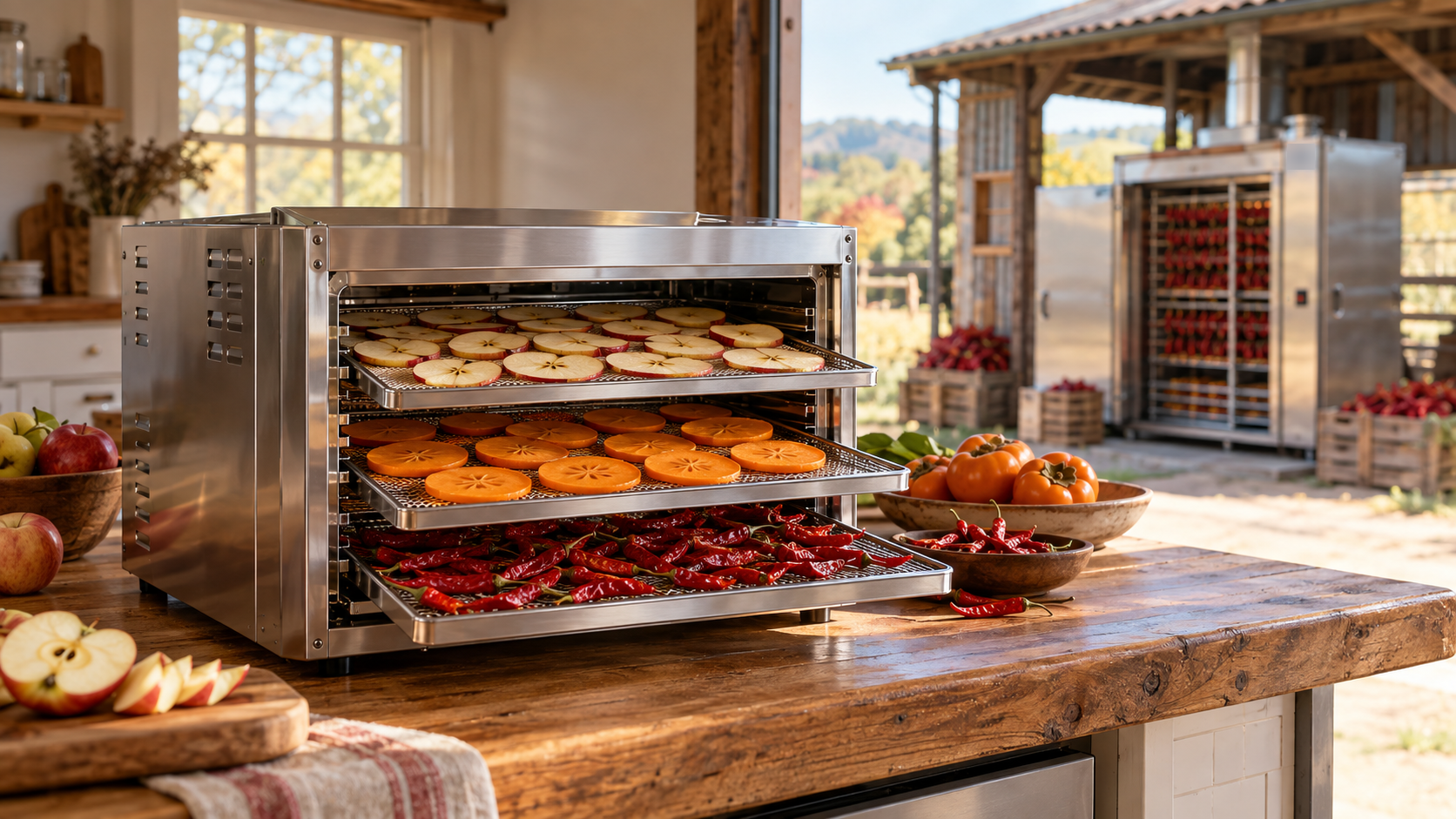
What to check when buying a food dehydrator (trays, wattage, temperature range, material), how to estimate electricity cost in Korea, drying settings for chili peppers, persimmons, apples and mushrooms, the RDA hygienic pepper-drying standard, and when growers need a farm pepper dryer.
Autumn brings a pile of things to dry at once: chili peppers from the garden, persimmons, shiitake, leftover apples. Food dehydrators range from small home units to farm hot-air dryers costing several hundred thousand won. The right one depends on what and how much you dry.
Bottom line: for occasional snacks, a 5–6 tray home dehydrator is enough. For regular drying or several kilograms of peppers, look at stainless 10-tray-plus units, and for 50–100 or more pepper plants, a dedicated pepper dryer. Check trays, wattage, temperature range and material. Dry peppers at 65°C for at least 6 hours, then 55°C, as the Rural Development Administration recommends.
1. What to check.
Trays and tray size. Food must lie in a single layer, so total tray area sets capacity. Stacked units are cheap but dry unevenly; rear-fan cabinet units dry evenly and suit frequent use.
Wattage and electricity cost. Watts × hours gives kWh. At KEPCO’s second residential tier (KRW 214.6/kWh), a 500 W unit running 10 hours costs about KRW 1,070 in energy charges. The tiers are KRW 120.0 up to 200 kWh, 214.6 for 201–400 kWh and 307.3 above 400 kWh (outside July–August). Heaters cycle, so real use is often lower, but a 40-hour pepper run adds up.
Temperature and timer. Hygienic pepper drying needs 65°C. Check the maximum temperature and whether the timer runs 48 hours or continuously.
Material. Stainless trays tolerate long, hot runs and clean easily but cost more. If you choose plastic, look for food-grade, BPA-free labeling.
2. Why peppers start at 65°C.
The RDA says hot-air drying at 50–55°C for two to three days does little to reduce bacteria. Drying at 65°C for at least 6 hours, then 55°C for 36 hours, cuts bacteria by over 99% while keeping a good color; 70°C for 42 hours reaches 99.99%.
3. For growers.
Farm pepper dryers circulate hot air and are rated by plant count or by geun (600 g). Small units are electric; larger ones often burn kerosene. Roughly: a garden of 20–30 plants can use a 10-tray dehydrator in batches, 50–100 plants suit a home pepper dryer of about 8 trays, and hundreds of plants need a farm unit. Sun drying saves fuel and can fetch more, but wet spells bring mold and bleached pods; some growers pre-dry by machine and finish in the sun.
References
- Rural Development Administration, Nongsaro: hygienic pepper drying (65°C 6 h then 55°C 36 h; 70°C 42 h).
- KEPCO residential low-voltage energy charges (KRW 120.0 / 214.6 / 307.3 per kWh).
- Product specifications from seller pages, checked October 6, 2026.