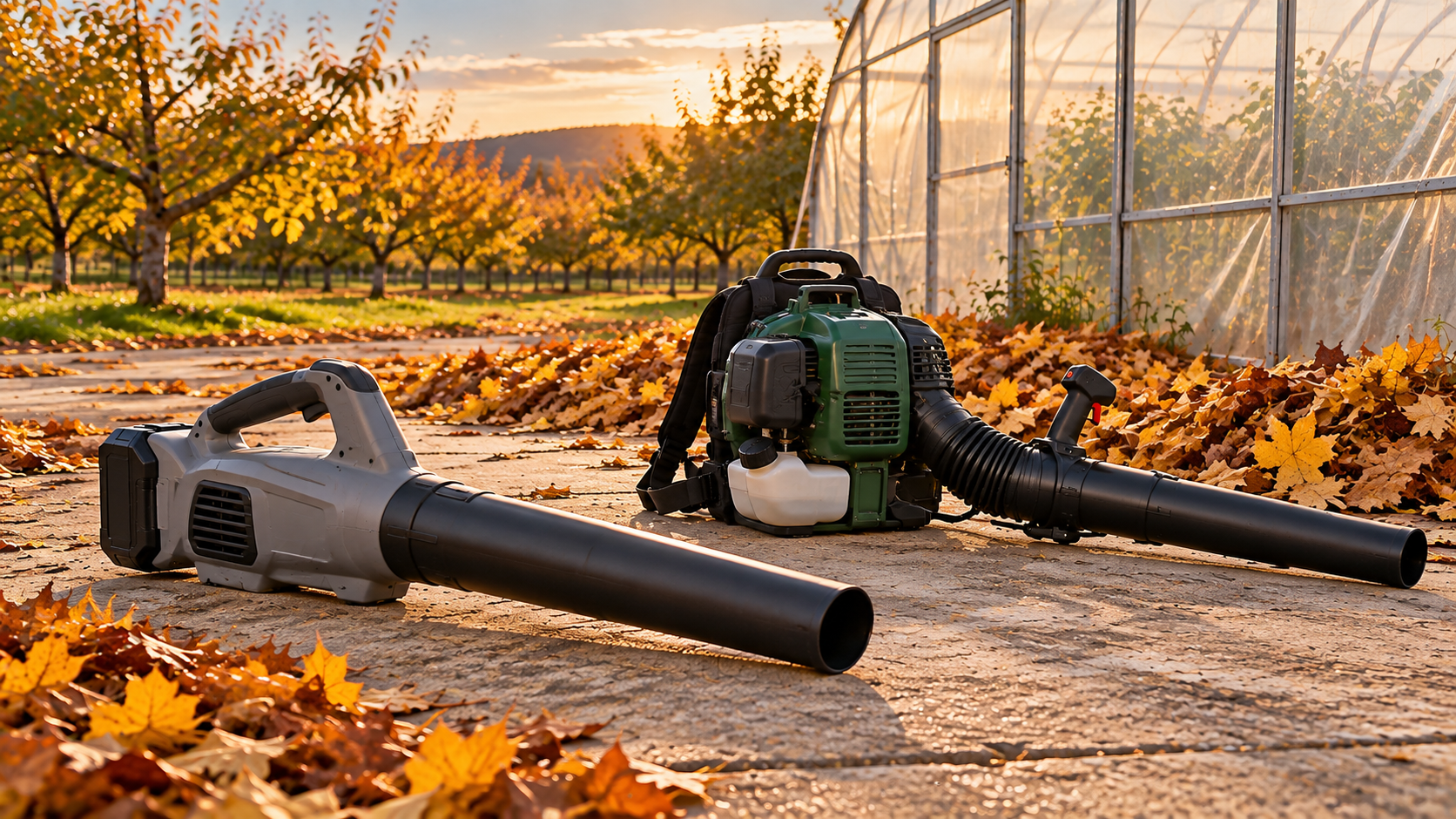
How to choose between a cordless leaf blower and a backpack engine blower by the area you clear: air speed vs air volume, sharing 18V/36V batteries with other tools, 2-stroke vs 4-stroke fuel, storage, and safety.
Leaves fall all at once from late October through November. A small yard takes a broom; a farm shed driveway, greenhouse perimeter, and orchard rows take a day. Leaves in a greenhouse drainage ditch overflow in the next rain, and leaves caught under the film hold moisture all winter.
Bottom line: For a yard or shed driveway, a cordless blower is enough; for orchards or several greenhouses at once, a backpack engine blower fits better. Buying a cordless body that shares batteries with your existing sprayer or trimmer cuts the cost sharply. For engines, first check whether it is 2-stroke (premixed fuel) or 4-stroke (gasoline with separate oil). Compare both air speed and air volume.
1. Cordless or engine?
| Item | Cordless (18V/36V) | Backpack engine |
|---|---|---|
| Best for | Yard, driveway, deck, shed floor | Orchard rows, many greenhouses |
| Run time | Battery capacity; spares extend it | As long as you refuel |
| Carrying | Handheld | Worn on the back |
| Noise, fumes | Low, no exhaust | Loud, exhaust |
| Upkeep | Charging and battery storage | Fuel, spark plug, air filter |
If you can finish in 20–30 minutes, cordless is easier: no pull-start, less noise near neighbors. Half a day of clearing usually outlasts several batteries.
2. Air speed and air volume are different
Air speed (m/s or km/h) matters for wet or stuck leaves and debris in cracks. Air volume (m³/min) matters for pushing a pile of dry leaves. Many listings advertise only speed; a high-speed, low-volume blower blasts a narrow spot but moves piles poorly. Divide km/h by 3.6 to get m/s.
3. Cordless: start with the battery
Much of a cordless blower’s price is the battery and charger. If you already own a cordless sprayer, trimmer, or pruner, buy the same brand and voltage as a bare tool. If this is your first, pick one battery platform for the tools you will add later. 18V is light and usually enough for yards; 36V (including two 18V packs) blows harder but is heavier and drains faster. Batteries also drain faster in the cold.
4. Engine: 2-stroke or 4-stroke
2-stroke engines run on gasoline premixed with 2-stroke oil, often the same mix as a brush cutter; follow the manual’s ratio and store the mix in its own can. 4-stroke engines take plain gasoline with oil in a separate sump; heavier and usually pricier, but no mixing. If storing for over a month, drain fuel as the manual directs.
5. Farm uses and cautions
- Clear greenhouse drainage ditches before rain.
- Work orchard rows with the wind at your back, pushing leaves to one end.
- Blow only light, dry snow off greenhouses; wet snow and ice will not move.
- Wear eye and ear protection, and never aim at people, cars, or windows. Keep the nozzle off the greenhouse film.
References
- IMUN.FARM, cordless sprayer and trimmer battery guide.
- Manufacturer manuals (2-stroke mix ratios, fuel storage, protective equipment).
- Actual performance and run time vary by model, battery capacity, leaf condition, and weather.