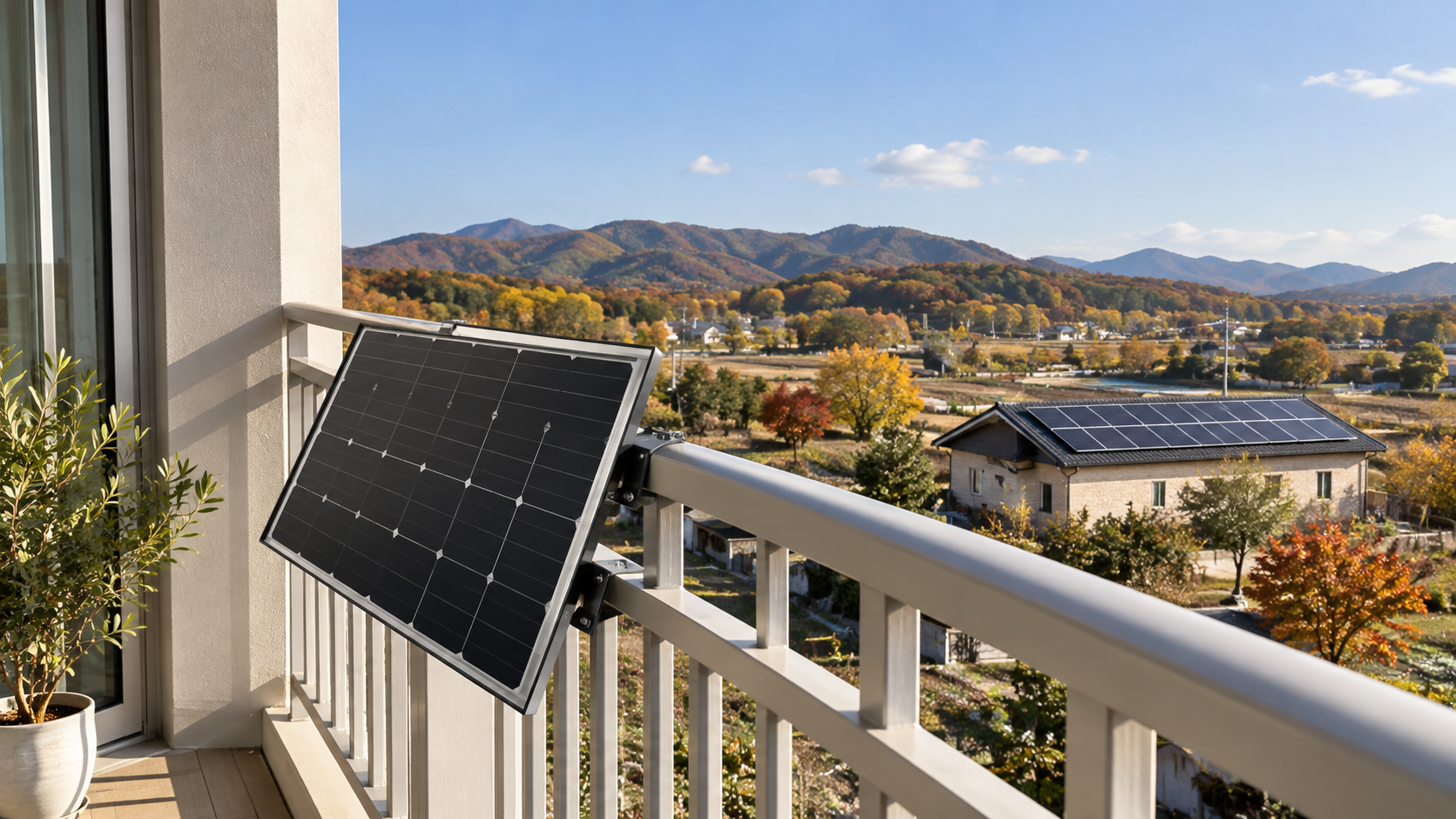
Korea 2026 home solar costs from the official notices. A 500 W apartment balcony panel costs about KRW 1 million, and national plus local subsidies cut the owner share to around KRW 200,000, with installation in October–December. Detached-house 3 kW systems are capped at KRW 4.541 million with a KRW 1.65 million national subsidy. Savings, payback and off-grid farm sheds.
“How much would one panel on the balcony cut my electricity bill?” The question is back this autumn. In July 2026 the government opened a new balcony solar program, and in September it let local governments approve applications on a rolling basis. Buying a panel yourself and installing one through the program are very different in cost and rules.
Bottom line: A 500 W balcony panel costs about KRW 1 million installed; with national and local subsidies the owner pays around KRW 200,000. Local governments are recruiting now, and installation runs October–December. Detached-house 3 kW systems get KRW 1.65 million in national subsidy under a KRW 4.541 million total cap, but the 2026 intake closed on a single first-come day, April 15. A 500 W panel produces at most about 640 kWh a year, saving roughly KRW 130,000.
1. Balcony solar (2026 national program)
| Item | Seoul | Outside Seoul |
|---|---|---|
| Capacity | Up to 500 W per household | Up to 500 W per household |
| Install cost | About KRW 1 million (500 W) | About KRW 1 million (500 W) |
| National aid | KRW 600 per W (300,000) | KRW 800 per W (400,000) |
| Share rules | National ≤30%, local ≥50% | National ≤40%, local ≥40% |
| Owner share | Around KRW 200,000 (computed) | Around KRW 200,000 (computed) |
| Installation | October–December | October–December |
Source: Ministry of Climate, Energy and Environment notices No. 2026-692 (July 13) and No. 2026-866 (September 10). Seoul’s Gwanak-gu, for example, covers KRW 800,000 of a KRW 1 million 500 W install for 20 households (deadline October 26). The national budget is KRW 37.5 billion for 100,000 households. Households that received a mini-solar subsidy before are excluded. Apply at your city, county or district office.
2. Rules for apartments
- Submit a consent form stamped by the apartment management office.
- Fasten to at least four points on the upper and lower rails with spring washers and lock nuts, plus stainless bands.
- Plug-in connection only, with a KS-certified microinverter.
- Shading disputes with the unit below are not mediated and can cancel the subsidy.
3. Savings from 500 W
Gwanak-gu puts 500 W output at up to about 639 kWh a year, roughly 53 kWh a month. At KEPCO residential low-voltage rates (non-summer): KRW 120.0/kWh tier saves about KRW 6,400 a month, the 214.6 tier about 11,400, and the 307.3 tier about 16,300. These figures exclude VAT, fund charges, climate and fuel-cost adjustments, and assume all output is used at home. With a KRW 200,000 share, payback is about a year and a half; paying the full KRW 1 million takes more than seven years.
4. Detached-house 3 kW (2026 housing program)
Notice No. 2026-236 (March 17) sets KRW 550,000 per kW of national subsidy (KRW 1.65 million for 3 kW; 632,000 per kW on islands) and a total cost cap of KRW 4.541 million including VAT. Low-carbon modules with at least 17.5% efficiency are required. Owner share is set by contract; the cap minus national aid is at most about KRW 2.89 million before any local top-up. The 2026 intake was a one-day first-come window on April 15.
Using the same output ratio, 3 kW makes about 320 kWh a month. A household using 450 kWh would pay energy charges on only 130 kWh after net metering; energy plus basic charges fall from about KRW 89,600 to 22,900, saving about KRW 800,000 a year, for a payback of roughly four years. Whether surplus carries over to the next month was not confirmed in KEPCO’s documents, so it is not counted.
5. Farm sheds go off-grid
Both programs target homes on residential KEPCO contracts, so a farm shed (20 m² or less, not for living) is unlikely to qualify. For sheds without grid power, see our farm-shed off-grid solar cost guide. Panel types and lifespans are covered in our January post, Solar Panel Research 2026.
References
- Ministry of Climate, Energy and Environment notices No. 2026-692 and No. 2026-866, 2026 household (balcony) solar program.
- Ministry of Climate, Energy and Environment notice No. 2026-236, 2026 renewable energy housing support program.
- Korea Energy Agency, New and Renewable Energy Center, participating company notices.
- KEPCO residential low-voltage tariff and net metering pages.
- September 2026 press reports on Gwanak-gu and Gangnam-gu balcony solar recruitment.
- Ministry of Agriculture, Food and Rural Affairs, farm shed and rural stay shelter standards.
- Savings are simplified estimates; actual output depends on orientation, shading and weather.