A practical 2026 cost guide for Korean multi-span greenhouses, breaking down frame, PO film, vents, thermal curtains, irrigation, and smart-farm automation.
The first greenhouse quote often feels confusing. One contractor may talk about 200,000 KRW per pyeong. Another may go above 500,000 KRW. Add automatic vents, thermal curtains, irrigation, heating, fertigation, and smart-farm controls, and the total cost for the same 1,000 pyeong can differ by several hundred million KRW.
That is why “cost per pyeong” is dangerous when used as one number. A quote for frame only is not the same as a quote including film, gutters, vents, curtains, irrigation, wiring, and controls.
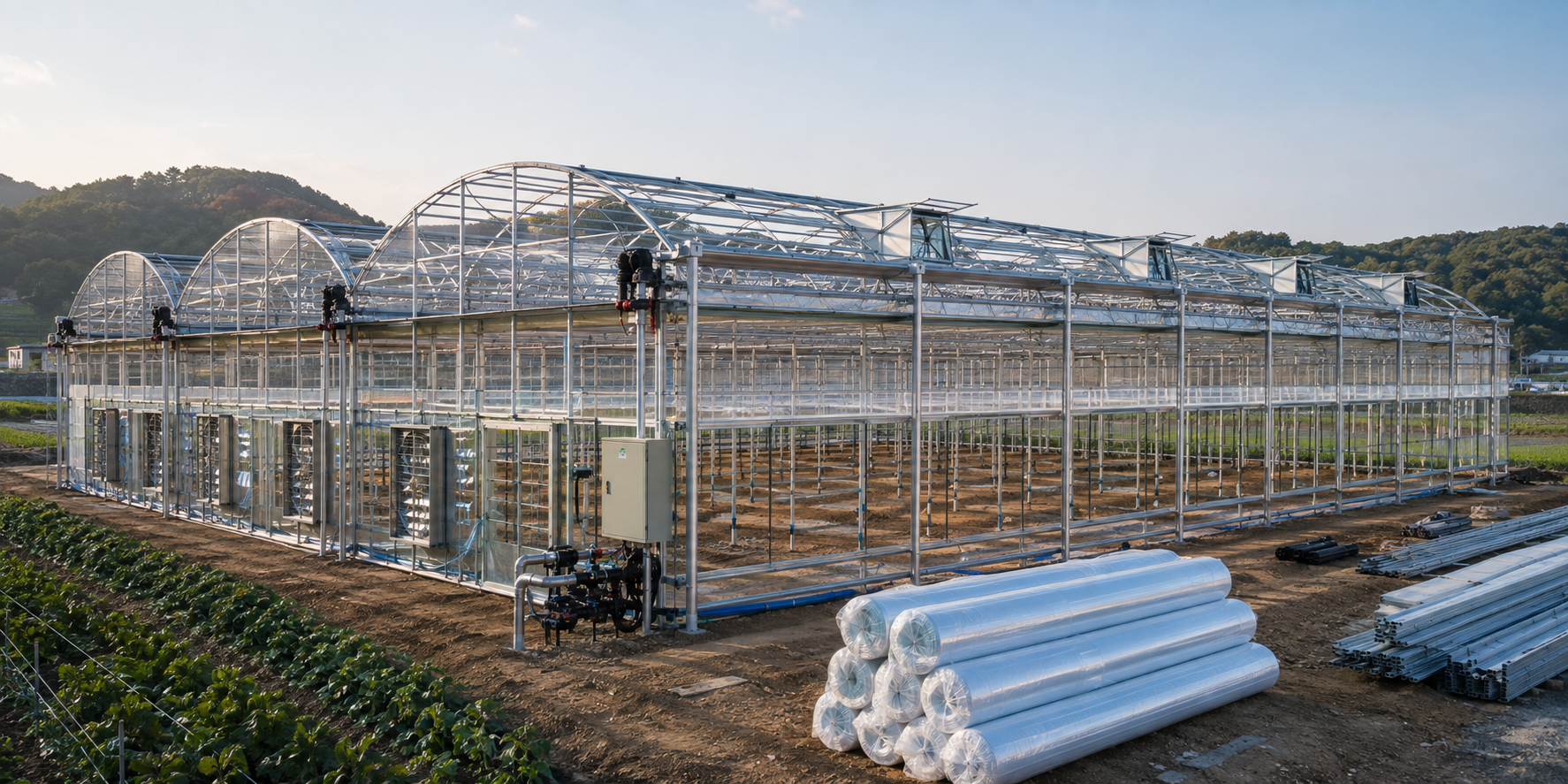
Short answer: start with 180,000 to 450,000 KRW per pyeong for practical multi-span greenhouses
For 2026 planning, a practical Korean multi-span greenhouse often starts around 180,000 to 450,000 KRW per pyeong. The lower end usually means frame, PO film, gutters, and basic vent automation. The higher end includes double covering, thermal curtains, irrigation, ventilation, wiring, and more complete internal facilities.
With smart-farm controls, fertigation, heating, cooling, dehumidification, and sensors, the planning range can move to 450,000 to 750,000 KRW per pyeong or more. Glasshouses and high-spec controlled-environment greenhouses are a different class.
| Type | Cost per pyeong | Total for 1,000 pyeong |
|---|---|---|
| Basic single-span greenhouse | 80,000 to 150,000 KRW | 80 million to 150 million KRW |
| Basic multi-span frame + PO + vents | 180,000 to 280,000 KRW | 180 million to 280 million KRW |
| Multi-span with curtains and irrigation | 280,000 to 450,000 KRW | 280 million to 450 million KRW |
| Semi-automated smart-farm type | 450,000 to 750,000 KRW | 450 million to 750 million KRW |
| High-spec glass or advanced greenhouse | Over 1 million KRW | Over 1 billion KRW |
Use this table as a quote-reading baseline, not a fixed price list. Actual cost depends on region, material grade, foundation, civil works, electric service, crop, and subsidy-program requirements.
Why the same greenhouse can have very different prices
A multi-span greenhouse is not just several plastic houses attached together. Roof valleys, gutters, drainage, side vents, roof vents, thermal systems, air movement, and work paths all interact. As the area increases, small specification differences become large total-cost differences.
The major cost drivers are below.
- Pipe diameter and thickness.
- Column and rafter spacing.
- Foundation method.
- PO film grade and thickness.
- Gutters and drainage.
- Number of side and roof vent motors.
- Double film, horizontal curtains, or multi-layer thermal curtains.
- Irrigation, fertigation, heating, fans, and dehumidification.
- Smart-farm sensors, control panels, and remote monitoring.
Do not compare only the total price. Compare what is included.
Frame cost: check pipe specification first
The frame is the skeleton of the greenhouse. If it is weak, snow, wind, and typhoons become serious risks. Very low quotes often hide differences in pipe grade, pipe thickness, column spacing, foundation, and reinforcement.
Basic multi-span quotes often mention pipe columns around Ø48mm, rafters around Ø32mm, horizontal members, gutters, PO film, and automatic vent motors. The numbers alone are not enough. Thickness, spacing, and connection details matter.
| Item | What to check |
|---|---|
| Columns | Diameter, thickness, spacing, galvanizing |
| Rafters | Diameter, spacing, connection method |
| Foundation | Ground anchor, drilled fixing, or concrete foundation |
| Gutters | Material and drainage path |
| Reinforcement | Snow and wind reinforcement for the region |
Retrofitting the frame later is difficult. Do not save too much on the skeleton.
Film and thermal systems: PO film alone is only half the story
A plastic greenhouse is not just one layer of film. Depending on the crop, it may need double film, horizontal curtains, multi-layer thermal curtains, water curtains, and shade. Strawberries, tomatoes, and paprika require more serious winter temperature management than simple low-cost greens.
Thermal equipment raises the initial cost but can reduce heating cost. It should be evaluated as an energy-saving investment, not just an extra expense. Korean extension materials on protected horticulture often discuss thermal curtains, ventilation, dehumidification, and water-curtain systems as energy-saving tools.
Check these items.
- PO film thickness and replacement cycle.
- Single or double covering.
- Horizontal curtain or multi-layer thermal curtain.
- Airtightness of side and roof vents.
- Heating-cost reduction for winter crops.
Automation: vent motors alone are not a smart farm
In greenhouse quotes, automation often begins with side and roof vent motors. But a real automated facility can include irrigation, fertigation, temperature and humidity sensors, CO₂ control, fans, control panels, and remote monitoring.
Think in three layers.
| Layer | Components | Cost impact |
|---|---|---|
| Basic automation | Side and roof vent motors, timers | Low |
| Crop automation | Irrigation, fertigation, sensors, ventilation fans | Medium |
| Smart-farm controls | Integrated control panel, remote monitoring, data logging, alerts | High |
You do not need the highest specification from day one. But electrical routing, control-panel location, sensor points, and irrigation lines should be considered during the first design. Adding them later is messy and costly.
600 pyeong and 1,000 pyeong examples
Many farmers compare around 600 to 1,000 pyeong. The rough total-cost picture is below.
| Specification | 600 pyeong | 1,000 pyeong |
|---|---|---|
| Basic multi-span frame + PO + vents | 108 million to 168 million KRW | 180 million to 280 million KRW |
| With thermal curtains and irrigation | 168 million to 270 million KRW | 280 million to 450 million KRW |
| Semi-automated smart-farm type | 270 million to 450 million KRW | 450 million to 750 million KRW |
Civil work, access roads, drainage, electric service, agricultural water, heaters, fertigation equipment, work rooms, and cold storage may not be included. A cheap quote can become expensive when missing items appear later.
Crop choice changes the specification
Never quote a greenhouse before deciding the crop. Lettuce, strawberries, tomatoes, and paprika require different height, ventilation, insulation, irrigation, and work paths.
| Crop | Important specification | Caution |
|---|---|---|
| Leafy greens | Ventilation, shade, irrigation | Low unit price makes overinvestment risky |
| Strawberries | Raised beds, insulation, irrigation, work paths | Initial cost and labor flow matter |
| Tomatoes | Height, training system, ventilation, fertigation | Greenhouse height and durability matter |
| Paprika | High-spec environmental control | Basic greenhouses may be insufficient |
| Seedlings | Temperature uniformity, insulation, ventilation | Uniformity creates value |
Cost per pyeong means little until the crop is defined.
Questions to ask contractors
Ask specific questions before comparing numbers.
- What are the pipe diameter, thickness, and spacing?
- What foundation method is included?
- What snow and wind standards are assumed?
- What PO film grade and thickness are included?
- Are gutters and drainage included?
- How many side and roof vent motors are included?
- Are double film, horizontal curtains, or thermal curtains included?
- Are irrigation, fertigation, electric works, and control panels included?
- Are civil works, access roads, electric service, and agricultural water excluded?
- What is the warranty and repair policy after typhoon or heavy snow damage?
- Does the quote match subsidy-program specifications if subsidies are used?
If the answers are vague, the quote is not necessarily cheap. It may just be incomplete.
Subsidy projects require extra caution
If a greenhouse is built under a subsidy program, do not look only at the farmer’s own-payment amount. Check total project cost, standard unit price, subsidy ratio, settlement documents, and post-management obligations.
Subsidies also require documentation. Quotes, tax invoices, before-and-after photos, material specifications, contracts, and completion checks must match. Lowering the specification too far can create settlement or post-management problems.
Conclusion
A multi-span greenhouse cost cannot be reduced to one number. For 2026 planning, first think of 180,000 to 280,000 KRW per pyeong for a basic multi-span structure, 280,000 to 450,000 KRW with thermal and irrigation systems, and 450,000 to 750,000 KRW for a basic smart-farm type.
The real issue is not the headline price. It is what is included: frame, film, thermal systems, vents, irrigation, electrical work, civil work, drainage, and service support.
A cheap quote feels good. An incomplete quote is dangerous. A greenhouse is a long-term production asset, so block future cost holes before signing.
References
- Nongsaro, protected horticulture and greenhouse energy-saving materials.
- Rural Development Administration, winter agricultural facility disaster prevention and energy-saving guidance.
- Korean search-result quote cases for 2026 basic multi-span greenhouse construction, including 1,000 pyeong 1-2W five-span examples with Ø48mm and Ø32mm pipe frame, PO film, automatic vents, and double thermal curtains.
- Korean search-result cases for basic plastic greenhouse installation, commonly showing 80,000 to 150,000 KRW per pyeong for basic single-span-type construction.
- The cost ranges in this article are planning estimates based on public quote snippets and common protected-horticulture cost structures. Actual quotes vary by region, materials, crop, civil works, electrical service, and subsidy standards.