A practical guide to smart aquafarm ornamental fish production: startup equipment, monthly electricity cost, sales channels, permits, and risks.
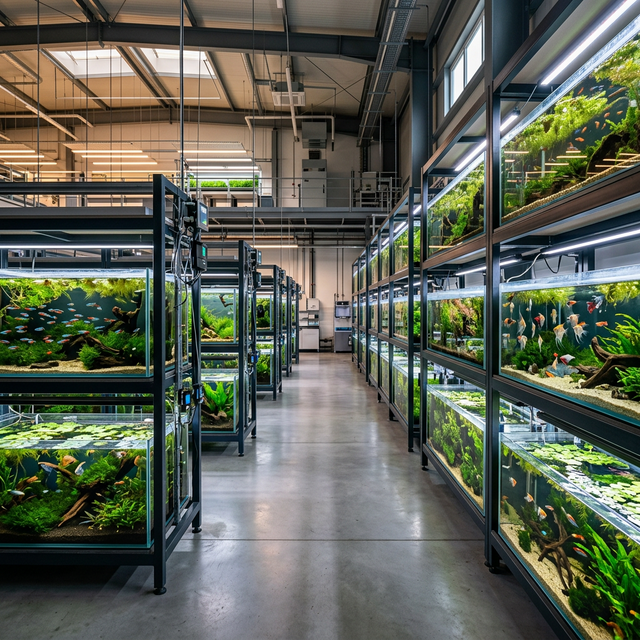
People who search for rare tropical fish often have a specific idea in mind. Could a spare room, a small shed, or a container be turned into an automated fish room? Add sensors, automatic feeders, heaters, cameras, and maybe the fish will breed while the system does the work.
It looks attractive from the outside. The tanks are bright. The plants are green. The fish seem to multiply on their own.
The business reality is more stubborn. A smart aquafarm for ornamental fish is closer to an automated hobby business than a magic income machine. Before buying sensors, you need to decide which species to raise, how much electricity the room will consume, and where the fish will actually be sold.
The short answer
A smart aquafarm for ornamental fish can work as a small side business. It is risky if a beginner expects full-time income from day one.
The first target should not be monthly net profit of 3 million KRW. The first target should be stable survival and repeatable breeding. Ornamental fish are not sold by the kilogram. They are sold by individual fish, pairs, lines, color, pattern, and trust. That creates high value per unit, but one water-quality failure can wipe out inventory overnight.
Ornamental fish are a recognized industry in Korean law
Korea has a specific law for the ornamental fish industry: the Act on the Promotion and Support of the Ornamental Fish Industry. The law defines ornamental fish as aquatic organisms such as tropical fish, koi, and goldfish that can be kept in a certain space for viewing and enjoyment. It also includes breeding, production, distribution, sales, import and export, exhibitions, and experience programs in the ornamental fish industry.
A person who wants to run an ornamental fish aquaculture business must meet facility standards set by the Ministry of Oceans and Fisheries and report the facility to the local government. The reporting period is generally valid for five years. The law also includes grounds for startup support, facility modernization support, and support for expanding sales channels.
That does not mean every small hobby tank is a regulated farm. Scale matters. Once production, repeat sales, and a dedicated facility are involved, the operator should check local reporting requirements, alien species rules, wastewater, electrical safety, and shipping rules.
Startup equipment cost: three levels
Do not start with a large smart-farm quote. In ornamental fish, operating skill comes before equipment. It is safer to think in three levels.
| Level | Setup | Rough startup cost | Best fit |
|---|---|---|---|
| Test setup | 4 to 8 small tanks, basic filters, heaters, lights, thermometers | 1 million to 3 million KRW | Testing species and buyer response |
| Side-business setup | 10 to 30 rack tanks, central air, spare heaters, basic sensors, automatic feeders | 5 million to 15 million KRW | Evening and weekend management with online sales |
| Small farm setup | 10 to 20 pyeong dedicated room, recirculating filtration, backup power, cameras, water sensors, packing area | 20 million to 50 million KRW or more | Almost a full business, not just a hobby |
The word “smart” can be misleading. Sensors and apps are useful, but they do not save fish by themselves. Backup air pumps, UPS power, alarms, quarantine tanks, and simple emergency routines are often more important than a beautiful dashboard.
Survival equipment comes before fancy automation.
Monthly electricity cost depends on heaters and lights
Electricity is one of the main fixed costs. Tropical fish need stable water temperature. In winter, a shed or container can become expensive because heaters run for long hours.
Here is a simple example. The actual electricity bill depends on contract type, season, total usage, basic charges, and local conditions. The table is only a planning estimate.
| Equipment | Quantity | Assumption | Monthly use example |
|---|---|---|---|
| 100W tank heaters | 20 | 8 hours per day on average | About 480kWh |
| 20W LED lights | 20 | 10 hours per day | About 120kWh |
| Air and circulation pumps | One system | 24-hour operation | About 40kWh to 100kWh |
| Cooling, heating, dehumidifying | Depends on room | Strong seasonal impact | Must be calculated separately |
Even a small rack system can reach around 600kWh per month. At 150 KRW per kWh, that is about 90,000 KRW. At 250 KRW per kWh, it is about 150,000 KRW. Basic charges, winter heating, summer cooling, and dehumidification can push it higher.
The key is not simply reducing the number of heaters. The key is insulation. Stabilizing the room temperature can be safer and cheaper than running many individual tank heaters in a cold space.
What should you raise?
Beginners should not start with expensive rare fish. High prices usually come with a reason. The fish may be fragile, hard to breed, difficult to grade, or limited to a small buyer group.
Think in three groups.
1. Fast-turnover small tropical fish
Guppies, platies, mollies, and some corydoras are easier to breed and sell. They are useful for learning. The problem is competition and low unit price. Common fish alone rarely leave enough margin after packing, shipping, feed, and losses.
2. Premium lines and selective breeding
Color, pattern, fin shape, body shape, and stable bloodlines create price differences. Even within the same species, a trusted breeding line can sell at a higher price. This takes time. You need to watch several generations and select carefully. It is closer to seed selection in farming than simple pet keeping.
3. Aquatic plants and setup packages
Aquatic plants can sometimes be easier to ship than live fish. They also work well in bundles: beginner planted-tank kits, shrimp-tank packages, or curated aquascape sets. A customer often wants “plant this and the tank will look right,” not just one random plant.
Sales channels must come before production
The most common failure is raising fish well and then having nowhere to sell them. Live inventory cannot sit forever. It eats feed, needs water changes, takes space, and can die.
| Channel | Strength | Weakness |
|---|---|---|
| Local aquarium shops and wholesalers | Can move volume at once | Lower price and strict quality standards |
| Direct online sales | Higher margin and brand building | Photos, customer service, packing, and DOA claims are hard |
| Hobby communities and social media | Trust can lead to reservations | Requires steady content and reputation management |
| Experience and education programs | Smart-farm systems are easy to show | Needs space, safety planning, and program operation |
Relying only on direct online sales is risky. Relying only on wholesalers keeps margins low. A realistic mix is: sell premium fish direct, move common fish through shops or wholesalers, and use the smart-farm system for education or experience programs when the facility is suitable.
Which smart equipment should come first?
A smart aquafarm does not need expensive sensors on every tank. Separate equipment that protects profit from equipment that simply feels advanced.
Install these first.
- Power outage alarm and backup power.
- Water temperature alarm.
- Central air system and spare air pump.
- Leak detector.
- Room camera.
- Automatic feeder only if travel or absence is common.
Install these later.
- pH, DO, ORP, and EC sensors.
- Automatic water-change system.
- Integrated dashboard.
- Remote data logging for every tank.
Those tools are useful, but they do not create profit immediately. First build a system that does not collapse. Then collect data.
A simple profit example
The table below is a side-business example. Real profit depends heavily on species, mortality, average selling price, electricity rate, packing loss, feed, and refunds.
| Item | Conservative | Middle | Aggressive |
|---|---|---|---|
| Fish sold per month | 100 | 250 | 500 |
| Average selling price | 3,000 KRW | 5,000 KRW | 8,000 KRW |
| Monthly revenue | 300,000 KRW | 1,250,000 KRW | 4,000,000 KRW |
| Feed, supplies, packing | 100,000 KRW | 250,000 KRW | 600,000 KRW |
| Electricity and water | 100,000 KRW | 200,000 KRW | 400,000 KRW |
| Mortality, returns, discounts | 50,000 KRW | 150,000 KRW | 500,000 KRW |
| Estimated net profit | 50,000 KRW | 650,000 KRW | 2,500,000 KRW |
The point is not that these numbers are guaranteed. The structure matters. Profit comes when average price and monthly sales volume rise together. Electricity savings alone will not make the business work. Species selection and sales channels do most of the work.
Bad ways to start
These starting patterns are dangerous.
- Buying expensive rare fish after watching only videos.
- Installing 50 tanks first and looking for buyers later.
- Spending money on automation but skipping quarantine tanks.
- Starting in a cold container without winter electricity calculations.
- Ignoring alien species rules and release-prevention duties.
Ornamental fish look beautiful, but this is still a live-inventory business. A sick fish is not a product. It is a risk.
A practical 3-month start plan
Start small for the first three months.
- Limit the target species to two or three.
- Check local shop prices and online selling prices first.
- Buy and raise the species for at least two months.
- Record breeding, mortality, feed amount, and water-change cycles.
- Use a power meter to calculate real electricity use.
- Test shipping and packaging.
- Decide how product photos and sales descriptions will look.
- Prepare quarantine tanks and backup power before scaling.
- If the operation becomes a business, check facility standards and reporting requirements with the local government.
Skipping these steps creates a room full of equipment but no reliable product.
Who should and should not try this
This business fits someone who can check tanks every day, keep records, take decent photos, and respond to online customers. It also helps if the person already enjoys fishkeeping.
It does not fit someone who has little experience with live animals, leaves home often, or thinks automation will replace management. A smart farm does not remove the operator. It helps the operator make fewer mistakes.
Conclusion
Raising ornamental fish in a smart aquafarm can become a real side business. Rare tropical fish, premium aquatic plants, direct online sales, and education programs can create a small but meaningful income stream.
The order matters. Check sales channels before equipment. Check insulation before electricity bills. Check survival rate before rare species.
The business starts not with a shiny tank, but with the habit of checking water temperature, feeding, and fish condition at the same time every day.
References
- Korean Law Information Center, Act on the Promotion and Support of the Ornamental Fish Industry.
- Ministry of Oceans and Fisheries, Aquaculture Industry Division, competent authority listed for the law.
- Act on the Promotion and Support of the Ornamental Fish Industry, Article 2 definitions of ornamental fish, industry, and ornamental fish aquaculture.
- Same Act, Articles 10 to 12 on startup support, facility modernization support, and reporting of ornamental fish aquaculture.
- Same Act, Article 19 on support for equipment, facilities, and sales-channel expansion.
- IMUN.FARM internal articles on smart farms, aquaponics, and farm electricity-cost planning.