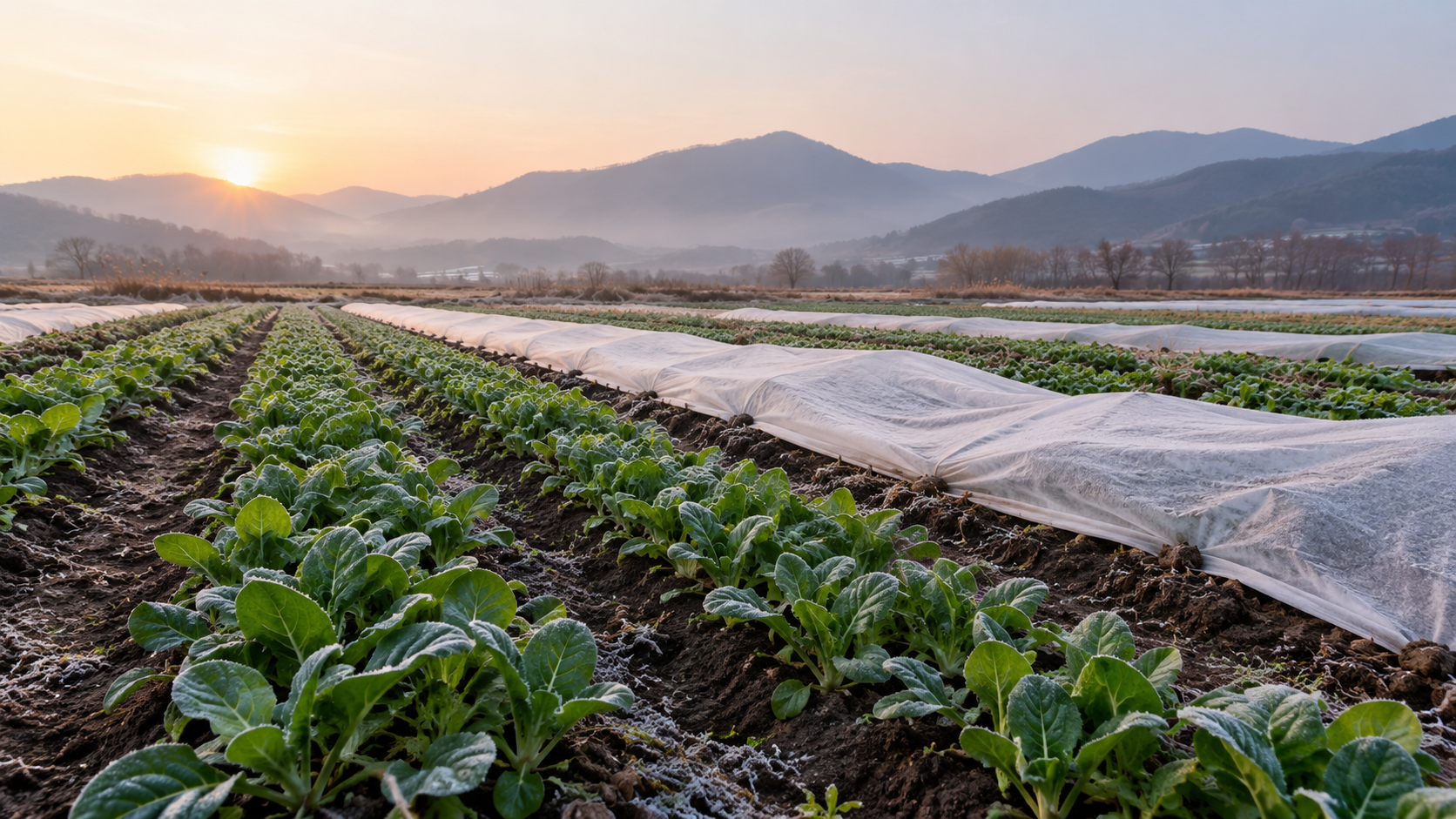
When to sow overwintering spinach in Korea, how to prepare soil pH and fertilizer, seeding rates, winter row cover and drainage, and why winter spinach prices have been rising.
Winter spinach grown in cold fields is sweet, which is why Pohangcho, Seomcho and Namhae spinach sell at a premium every winter. But the season is decided now, at October sowing, not in winter.
Sow too early and plants grow leggy and lose sweetness before winter. Sow too late and seedlings meet the cold too young and freeze.
Bottom line: in southern Korea, sow upland fields around late September and post-rice paddies around mid-October. After October 20, germination and winter survival drop sharply. Lime two weeks before sowing to reach about pH 6.5, and protect plants with drainage and covers in winter.
1. When to sow
RDA’s Nongsaro lists autumn spinach sowing in September–October, harvesting from October to March, with 45–100+ days of growth.
| Region / case | Sowing | Source |
|---|---|---|
| Namhae, upland | around September 25 | Namhae Agricultural Technology Center |
| Namhae, after rice | around October 15 | Namhae Agricultural Technology Center |
| Pohangcho | from mid-September | Nongmin Shinmun |
| Sinan Seomcho | September sowing, December–late March harvest | Newscj |
Namhae’s extension center warns that sowing after October 20 lowers germination and exposes young seedlings to freeze damage. Central regions get cold sooner, so sow earlier there and check local guidance.
2. Split sowing
Namhae recommends dividing the field into three blocks sown one week apart so harvests spread out. Prices peak from late December to late January before Lunar New Year, and autumn spinach takes 50–60 days to harvest, so count back from that window.
3. Choose Asian-type varieties
Spinach bolts as days lengthen. Asian types form flower buds at 12–13 hours of daylight, Western types at 14–16 hours, so autumn sowing uses Asian types. Pohangcho and Seomcho are Asian types.
4. Soil: lime and pH first
Spinach is sensitive to acid soil. Nongsaro gives pH 6.0–7.0; Jeju’s extension service advises 6.5–7.0; Namhae recommends 6.5–7.5 and notes growth is severely suppressed at pH 5.5. Apply lime two weeks before compost and fertilizer to avoid ammonia injury.
| Input | Per 10a (about 1,000㎡) | Note |
|---|---|---|
| Compost | 1,500kg | fully matured only |
| Lime | 200kg | two weeks before sowing |
| Nitrogen | 25.0kg | 10.0 base + 15.0 top-dressing |
| Phosphate | 5.9kg | base |
| Potash | 11.9kg | includes one top-dressing |
Immature compost is a main cause of yellowing disease.
5. Sowing method and rates
Broadcast or drill. Nongsaro uses 1m or 2m beds with 15–20cm sowing bands; cover drilled seed with 1.5–1.8cm of soil.
- Seed rate: 6–7L of processed round seed or 15–18L of prickly seed per 10a.
- Germination: optimum 15–20℃; above 30℃ germination falls below 50%, and below 4℃ germination and growth suffer.
- Water: irrigate before sowing; soaking seed for 24 hours evens germination.
6. Winter row cover
Spinach tolerates around -10℃, but young plants, windy fields and long cold spells still cause leaf damage. Row cover or film reduces wind and frost injury.
Official spinach guides give no temperature trigger, so practical rules are:
- Cover before the first hard freeze. Frozen leaves do not recover.
- Pin densely and bury the edges against wind.
- Ventilate on warm days to avoid humidity and disease.
- Remove in early spring. RDA’s rule for garlic and onion is to remove covers once lows no longer fall below about -7 to -8℃ and long cold spells are over.
Drainage matters even more. Namhae identifies excess moisture as the main cause of yellowing disease and recommends drainage ditches at least 25cm deep.
7. Harvest and prices
Autumn-sown spinach can be harvested after 50–60 days; overwintered spinach is cut from December to March. A January 2026 report put Namhae spinach at 1,945 won/kg in 2023, 3,663 in 2024, 4,239 in 2025 and 4,265 in 2026. Frequent rain in October 2025 delayed sowing and cut shipments 15%. See spinach price trends and /en/prices/spinach/.
FAQ
When should overwintering spinach be sown? Around September 25 for southern upland fields and October 15 after rice, per Namhae guidance. Avoid sowing after October 20.
What pH does spinach need? About 6.5. Growth is severely suppressed at 5.5.
When do row covers go on and come off? On before the first hard freeze; off in early spring once long cold spells end. Ventilate on warm days.
Why does winter spinach turn yellow? Most often yellowing disease from excess moisture. Dig deep drainage and avoid immature compost.
Conclusion
Winter spinach is harvested in winter but won in October. Lime early, choose Asian types, split sowings, stay before October 20, and protect plants with drainage and covers to target the high-price window before Lunar New Year.
References
- RDA Nongsaro, spinach farm work schedule.
- Jeju Special Self-Governing Province Agricultural Research and Extension Services, spinach cultivation.
- Namhae Times, Namhae Agricultural Technology Center guidance, September 2, 2022.
- RDA webzine, spinach management, August 2020.
- Nongmin Shinmun, Pohangcho report (2013); garlic and onion cover removal (February 19, 2026).
- Korea Economic TV, Namhae spinach shipments and prices, January 24, 2026.