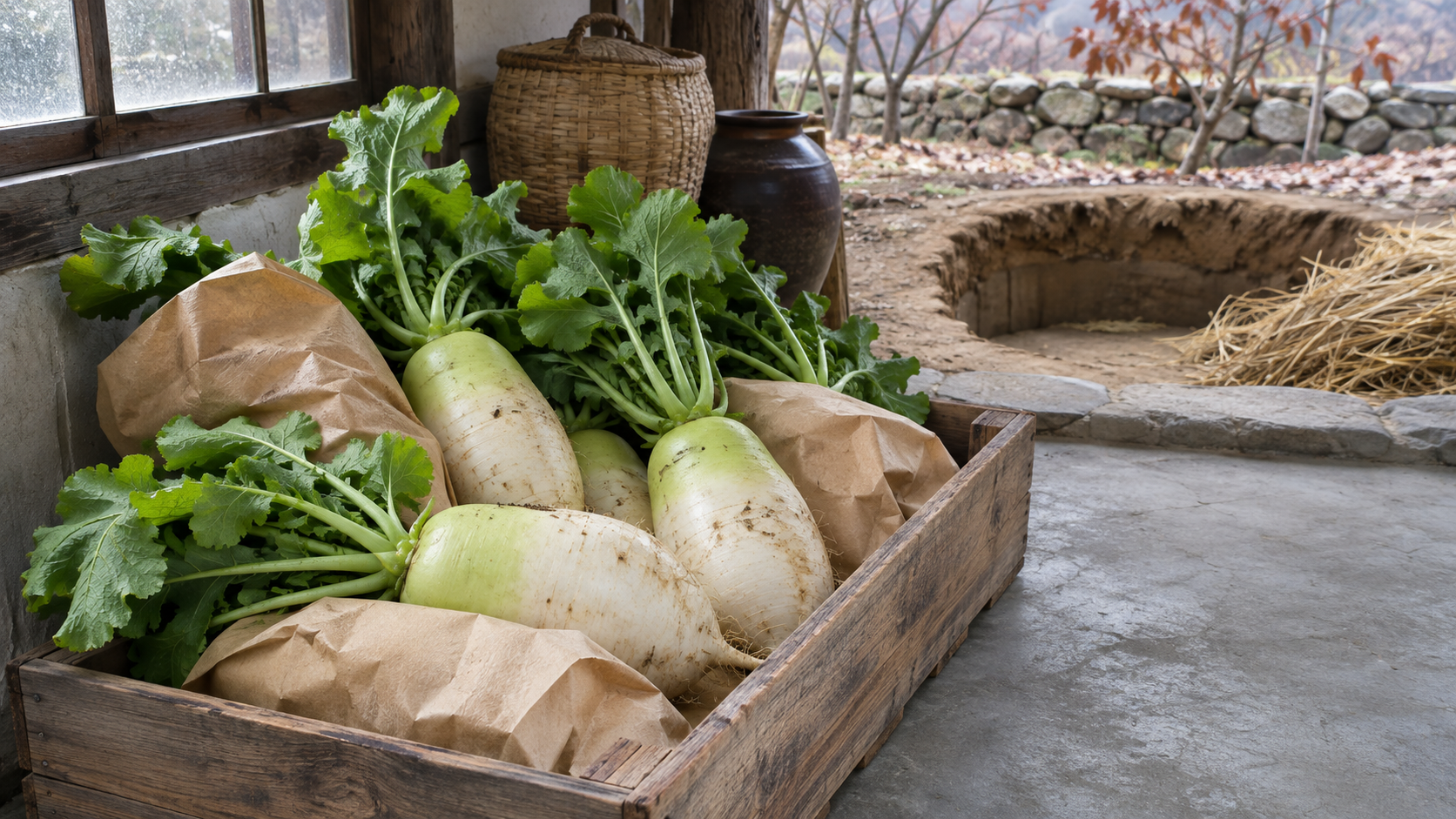
Korean radish (mu) wholesale prices on November 3, 2026 (autumn radish 20kg KRW 12,300, highland radish KRW 15,600 in Seoul, KAMIS), the storage temperature and humidity recommended by the Rural Development Administration, how to keep radish at home, why radish goes pithy, how farmers store radish in a pit, and whether holding stock into December pays.
After kimchi-making season there are always a few radishes left over. Leave them in a corner of the balcony and a week later the inside turns dry and spongy. Radish looks tough, but it dries out, freezes and goes pithy. How you store a 20kg box decides whether it lasts the winter.
Bottom line: keep radish close to 0°C, never frozen, never dry. Nongsaro (Rural Development Administration) recommends 0–4°C and 90–95% humidity and puts the freezing point of radish at about -1.5°C. At home, cut off the leaves the day you buy it, wrap each radish in newspaper and keep it in the vegetable drawer. For large amounts, bury it in a pit, but only once the ground surface starts to freeze. On November 3, 2026, the KAMIS Seoul wholesale price was KRW 12,300 for a 20kg box of autumn radish and KRW 15,600 for highland radish (top grade).
1. What does a 20kg box of radish cost now?
| City | Autumn radish 20kg | Highland radish 20kg | Date |
|---|---|---|---|
| Seoul | KRW 12,300 | KRW 15,600 | Nov 3 |
| Busan | KRW 11,000 | KRW 12,000 | Nov 3 / Nov 2 |
| Daegu | KRW 11,000 | KRW 13,800 | Nov 3 |
| Gwangju | KRW 10,700 | KRW 9,750 | Nov 3 |
| Daejeon | KRW 13,000 | KRW 11,700 | Nov 3 / Oct 30 |
Seoul highland radish was KRW 16,600 from October 27 to November 2 and slipped to KRW 15,600 on November 3. A year earlier (November 3, 2025) it was KRW 13,300. In Busan, autumn radish fell 27% in a week, from KRW 15,000 to KRW 11,000, as harvest volumes rise. Wholesalers describe boxes by count: “10-su” means ten radishes per 20kg (about 2kg each), “12-su” about 1.6kg each. Daily prices are on the radish price page.
2. Storage temperature and humidity
| Source | Temperature | Humidity | Note |
|---|---|---|---|
| Nongsaro, home storage of radish | 0–4°C | 90–95% | freezes at about -1.5°C |
| RDA press release on storage rooms, 2014 | 0°C | – | radish, garlic, onion, carrot |
| Daejeon Agricultural Technology Center | 0–3°C | 90–95% | cold damage below 0°C |
Too warm and radish sprouts and rots. Too dry and it loses water and goes pithy. Below freezing it freezes. A kimchi refrigerator or the vegetable drawer of a normal fridge comes closest at home.
3. Storing radish at home
- Cut off the leaves the day you buy it. Attached leaves keep drawing water out of the root. Dry the leaves as siraegi.
- Brush off soil, do not wash. Washed radish bruises and stays damp. Wash just before use.
- Wrap each radish in newspaper. Nongsaro also recommends wrapping leftover radish in newspaper before refrigerating.
- Cover loosely with a plastic bag so the fridge fan does not dry it, leaving the opening slightly open.
Without fridge space, a winter balcony works as long as it does not freeze; Nongsaro says to wrap radish in newspaper there and watch out for frost. Cut radish keeps only a few days wrapped in the fridge. For longer, cut it into soup-sized pieces and freeze it; frozen radish turns soft and suits soups and braises, not fresh salads. We found no official figure for freezer life, so we do not give one.
4. Why radish goes pithy
Pithiness is when part of the tissue dies, loses its contents and turns cotton-like, according to Nongsaro. It varies by variety; firm-fleshed varieties such as Taebaek store better, and early varieties should be harvested on time. When buying, choose radish that feels heavy for its size. Once pithy, it cannot be reversed, so use it first in soups.
5. For farmers: pit storage
Nongsaro describes the traditional pit method:
- Do not bury right after harvest. The ground is still warm and radish rots or sprouts. Pile it above ground first.
- Dig the pit once the ground surface starts to freeze. For large amounts, 60cm wide and 75cm deep, any length.
- Put the radish in and cover lightly with soil.
- When that layer freezes, add more. In two or three rounds, build up 40–60cm of soil.
Before harvest, the Daejeon center advises harvesting and storing temporarily if -2°C or lower is forecast, and sending frost-damaged radish to market right away rather than storing it.
6. For farmers: does holding radish into December pay?
KAMIS monthly averages for top-grade autumn radish (20kg, Seoul):
| Year | November | December | Change |
|---|---|---|---|
| 2020 | KRW 10,924 | KRW 8,600 | -21% |
| 2021 | KRW 12,555 | KRW 12,371 | -1% |
| 2022 | KRW 15,009 | KRW 10,220 | -32% |
| 2023 | KRW 9,731 | KRW 9,370 | -4% |
| 2024 | KRW 26,343 | KRW 28,609 | +9% |
| 2025 | KRW 17,667 | KRW 17,613 | 0% |
December beat November in only one of six years. November, with kimchi demand, is usually the best month for autumn radish, and from December Jeju winter radish competes. Storage is better seen as a way to spread out sales without losses than as a bet on higher prices, keeping in mind weight loss and pithy roots lowering the grade.
7. Checklist
- Nov 3 Seoul wholesale: autumn radish 20kg KRW 12,300, highland KRW 15,600 (KAMIS, top grade).
- Store at 0–4°C, 90–95% humidity; radish freezes at about -1.5°C.
- Cut leaves on day one, do not wash, wrap in newspaper, vegetable drawer.
- Pit storage once the ground surface freezes: 60cm wide, 75cm deep, 40–60cm of soil in 2–3 rounds.
- Ship frost-damaged radish immediately.
References
- Nongsaro (RDA), Radish: home storage methods: nongsaro.go.kr
- RDA press release on storage room conditions, September 30, 2014: rda.go.kr
- Daejeon Agricultural Technology Center, crop care for cold waves, November 27, 2012: daejeon.go.kr
- Hankyung, radish box counts (“10-su”, “12-su”), July 31, 2025: hankyung.com
- aT KAMIS wholesale prices (autumn and highland radish 20kg, top grade, five cities), survey date November 3, 2026; monthly averages 2020–2026.