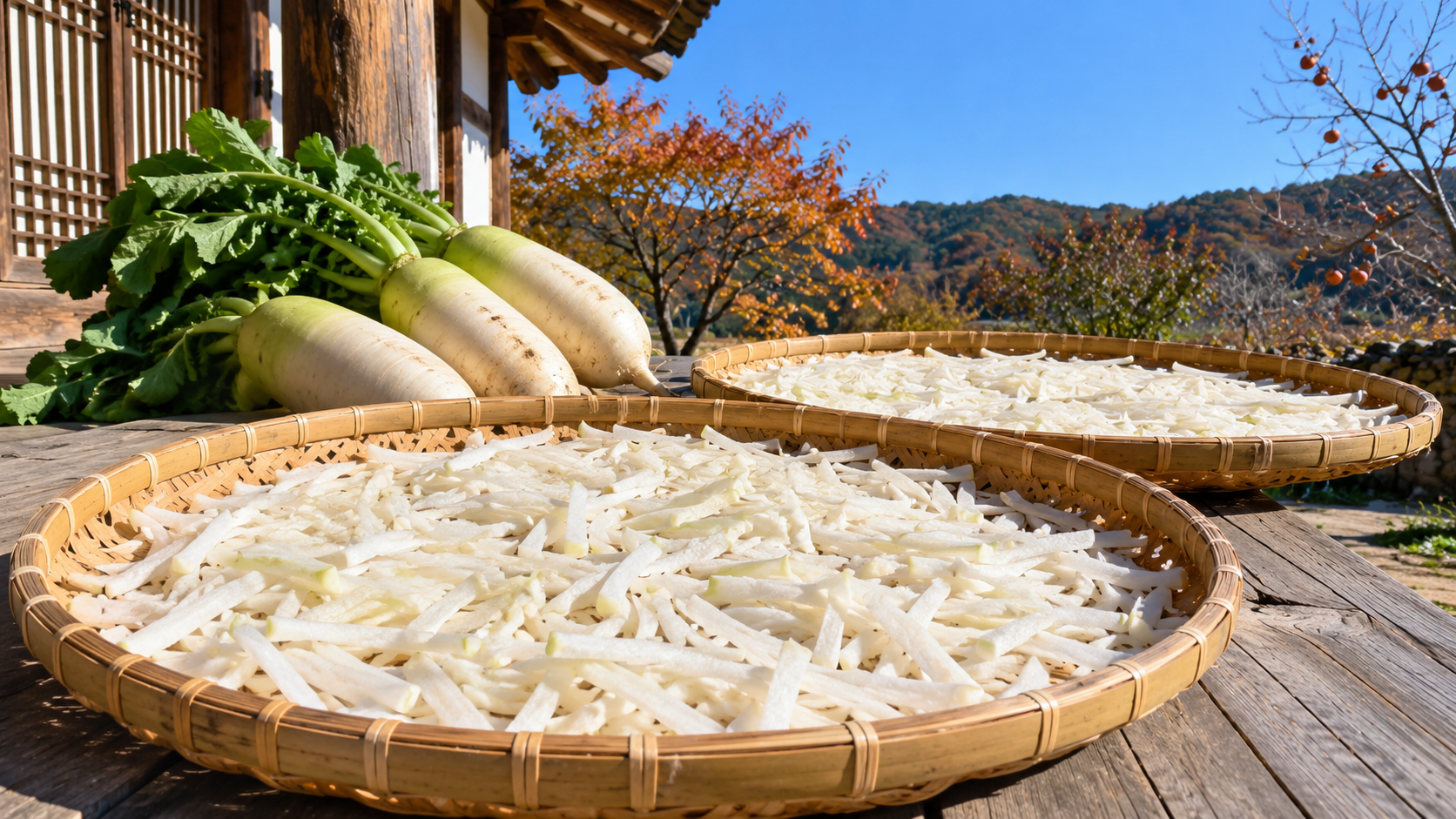
How to make Korean dried radish strips (mumallaengi): cutting thickness, sun versus dehydrator drying, the yield calculated from the Korean Food Composition Table (93.8% vs 14.5% moisture), an RDA drying study, storage, how to soak for muchim, plus November 5, 2026 KAMIS wholesale radish prices.
Radish is at its cheapest during kimchi season. On November 5, 2026, autumn radish (top grade, 20kg) sold for KRW 12,300 wholesale in Seoul — about KRW 620 per kg. Drying a box of radish now stocks the pantry with mumallaengi, the chewy dried radish strips used in Korean side dishes all winter.
Bottom line: cut radish into finger-width sticks and dry them in sun and wind until they snap. Based on moisture values in the Korean Food Composition Table, 20kg of fresh radish yields about 1.4–1.5kg of dried radish. Fresh radish is 93.8% water; finished mumallaengi is 14.5%. The weight drops below a tenth, while calcium, potassium and fiber concentrate.
Earlier records: dried radish greens in Making Siraegi 2026, whole-radish winter storage in Radish Storage 2026, radish water kimchi in Dongchimi 2026. Daily prices are on the radish price page.
1. Radish prices now
KAMIS wholesale, November 5, 2026, autumn radish top grade 20kg: Seoul KRW 12,300, Busan 11,000, Daegu 11,000, Gwangju 10,700, Daejeon 12,000. Any firm radish without internal pithiness works — including leftover kimchi radishes with minor surface blemishes.
2. How much dried radish you get
The Korean Food Composition Table (DB 10.4, 2026) lists fresh Korean radish at 93.8g water per 100g and dried radish at 14.5g. The 6.2% solids become dried strips at 14.5% moisture, so the yield is about 7%: 20kg of fresh radish gives roughly 1.4–1.5kg of mumallaengi; one 1.5kg radish gives about 100g. In exchange, 100g of dried radish carries 326mg calcium, 3,489mg potassium and 23.7g dietary fiber.
3. Cutting and drying
An RDA-affiliated study (Korean Journal of Food and Cookery Science, 2015) compared 3.5mm and 7.0mm cuts dried naturally versus hot-air drying at 45°C: hot-air drying browned less. Thinner cuts dry faster but break easily; thicker cuts keep more chew after soaking. Home cooks usually cut sticks about half a finger thick.
Sun-drying: spread the sticks on bamboo trays or a hanging mesh dryer without overlap, turn once or twice a day, bring them in at night. There is no fixed number of days — judge by state, not the calendar: they are done when they snap instead of bending. A food dehydrator is the fallback for wet weather and keeps the color whiter; home units draw around 250W, so even 10 hours uses only 2.5kWh.
4. Storage and soaking
Fully dried strips keep well if moisture is kept out: portion into zipper bags or airtight containers and store cool or frozen. For muchim (seasoned salad), soak briefly in lukewarm water just until the core softens — oversoaking washes out sweetness and texture — then squeeze and dress with gochugaru, soy sauce or fish sauce, garlic, rice syrup and sesame.
5. For growers
Radishes that missed the grading box are worth drying: at KRW 500–600 per kg wholesale, converting culls into a storable product cuts waste, and dried radish is light enough for parcel direct sales. Plan around the 7% yield and your cutting labor before committing volume. Compare wholesale returns in our market sales calculator.
References
- KAMIS, autumn radish wholesale prices, surveyed November 5, 2026
- Rural Development Administration, Korean Food Composition Table DB 10.4 (2026)
- Korean Journal of Food and Cookery Science (2015), quality characteristics of dried radish strips under different drying conditions
- Site records: Making Siraegi 2026, Radish Storage 2026