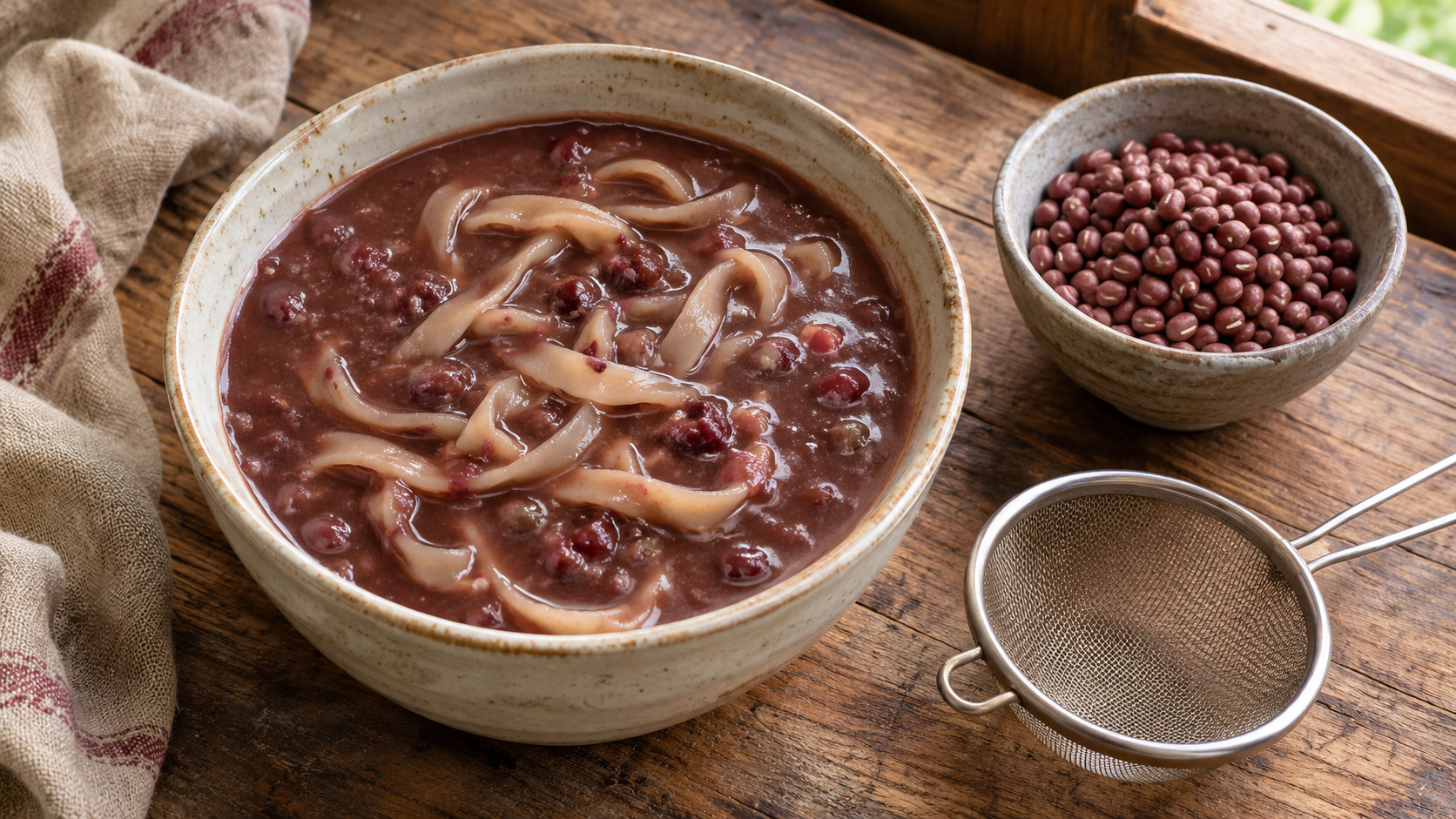
How to make pat-kalguksu (knife-cut noodles in red bean soup) at home using a recipe sourced from the Rural Development Administration: 5 cups red beans, 2 cups flour, 15 cups water. Soaking, discarding the first water, straining a smooth bean broth, regional seasoning, varieties, and KAMIS red bean wholesale prices on November 4, 2026.
When the cold wind starts, queues form outside market stalls selling pat-kalguksu, knife-cut wheat noodles simmered in thick red bean soup. Making it at home raises two questions: how many beans to use, and how to get a smooth broth without bits of skin.
Bottom line: the recipe published by the Korean Food Promotion Institute from RDA material uses 5 cups red beans, 2 cups flour and 15 cups water. Discard the first boiling water, simmer the beans in 15 cups of fresh water until very soft, then press through a sieve and discard the skins. Knead the noodles from 2 cups flour and 1 cup of the bean cooking water. At 180g per cup, 5 cups is about 900g, nearly a whole 1kg bag. On November 4, 2026, domestic red beans (top grade, 40kg) sold for KRW 724,000 wholesale in Seoul, or KRW 18,100 per kg (KAMIS).
1. The recipe
| Ingredient | Amount | Weight |
|---|---|---|
| Red beans | 5 cups | about 900g (180g per cup) |
| Flour | 2 cups | not given |
| Water | 15 cups | for simmering the beans |
| Salt and sugar | a little | to season at the end |
The recipe does not state servings. Keep the ratio and scale down: 500g of beans (about 2.8 cups) takes roughly 1.1 cups of flour and 8.3 cups of water.
2. Soaking and the first water
The recipe gives no soaking time; Nongsaro’s red bean recipes say to soak “for half a day or more.” Discarding the first water reduces the bitter taste of saponins and keeps the colour bright (Food Information Nuri). RDA’s Green Magazine (February 2025) notes the red colour is anthocyanin and the water is not toxic, so this is a matter of taste.
3. A smooth bean broth
Cool the cooked beans slightly, press them through a sieve with a ladle, rinsing with a little cooking water, and discard the skins. Blending first speeds this up.
4. Noodles
Knead flour, salt and 1 cup of bean cooking water, roll thin, roll up and cut. Cooking times are not given in the recipe; noodles are done when they float and turn translucent. Stir constantly, as bean broth catches on the bottom.
5. Sugar or salt
Nongsaro (2013) notes that Jeolla cooks season pat-kalguksu mostly with sugar and Gyeongsang cooks with salt. RDA (2022) recommends the ‘Geomguseul’ variety for its sweetness in red bean lattes and kalguksu.
6. Prices, November 4, 2026
| City | Domestic red beans 40kg | Per kg | A year earlier |
|---|---|---|---|
| Seoul | KRW 724,000 | KRW 18,100 | KRW 820,000 |
| Busan | KRW 668,000 | KRW 16,700 | KRW 777,000 |
| Daegu | KRW 731,000 | KRW 18,275 | KRW 851,000 |
| Gwangju | KRW 500,000 | KRW 12,500 | KRW 646,000 |
| Daejeon | KRW 585,000 | KRW 14,625 | KRW 770,000 |
The five-city average of KRW 641,600 is 17.0% lower than a year earlier. Imported red beans averaged KRW 260,400 per 40kg, so domestic beans cost about 2.5 times more.
7. For growers
Nongsaro advises harvesting when 70–80% of pods have ripened, in early to mid October in the central-north and mid to late October in the south, then drying for 4–6 days before threshing. Dongji (winter solstice) falls on December 22, 2026. In Seoul, December averages beat November meaningfully only once in six years (2024, +38%); other years ranged from -15% to +3%. Selling small 500g–1kg packs directly before Dongji may earn more per kg than wholesale.
References
- Korean Food Promotion Institute, Hansik Portal, “Rediscovering red beans” (RDA material), November 29, 2021
- Nongsaro RDA Interrobang, noodle map of Korea, August 14, 2013
- RDA press release on red bean varieties and self-sufficiency, May 31, 2022
- RDA Green Magazine, February 2025
- Food Information Nuri, seasonal food: red beans, December 7, 2015
- Nongsaro, red bean work schedule
- aT KAMIS wholesale prices (domestic and imported red beans, 40kg), November 4, 2026; Seoul monthly averages 2020–2025