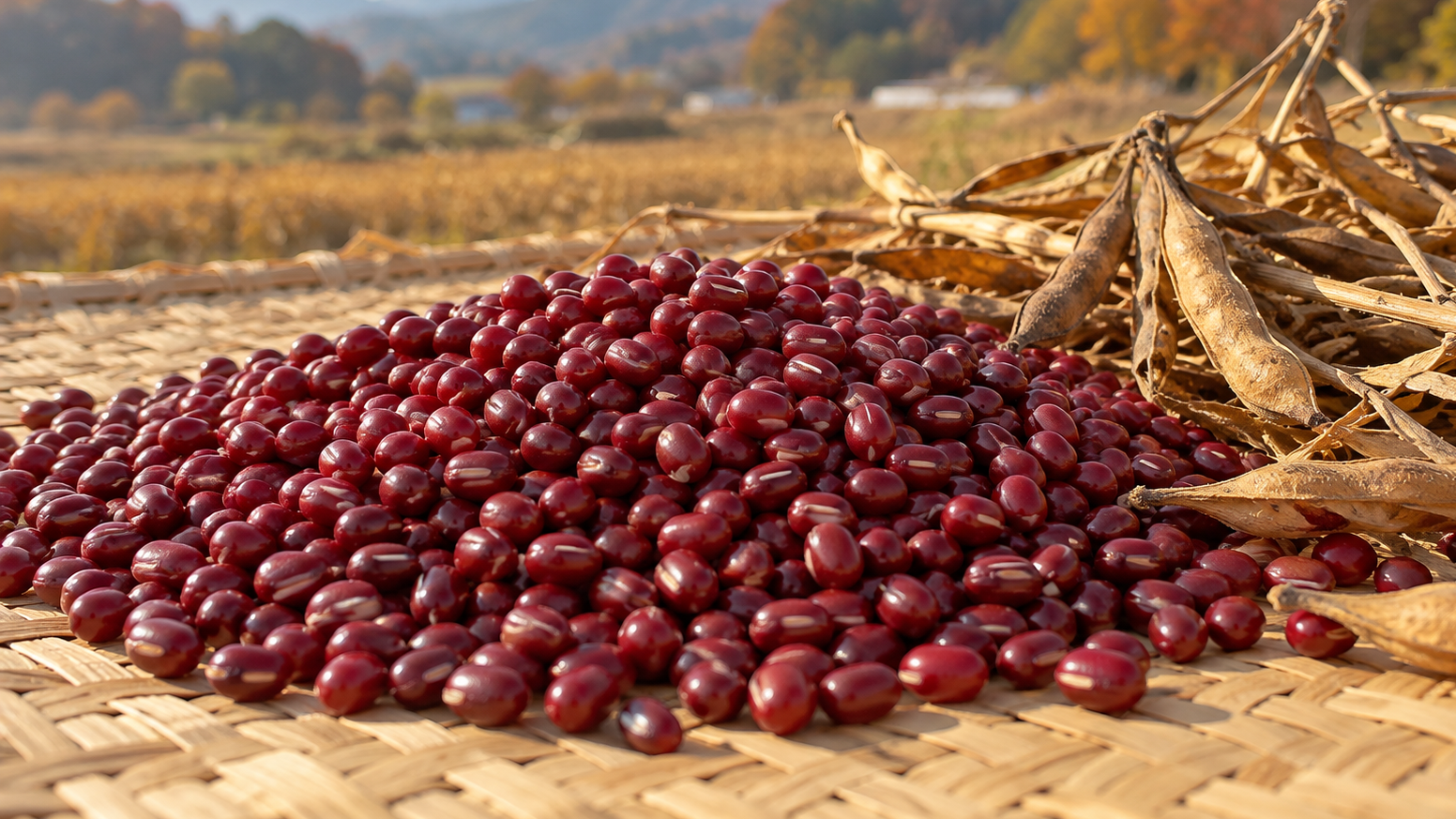
As of the October 1, 2026 KAMIS survey: domestic and imported red bean (adzuki) 40 kg wholesale prices, ten years of harvest-season moves, and how to decide between selling and storing new-crop beans.
When red bean pods start turning brown, growers start doing the math. Can they get KRW 800,000 per 40 kg again like last year, or will new-crop beans pull the price down. The short answer: domestic red bean prices have come off last year’s peak, but they are still far above where they sat only a few years ago.
Bottom line: as of the October 1, 2026 KAMIS survey, domestic top-grade red beans sold for KRW 724,000 per 40 kg in Seoul. That is 11.7% below a year earlier (KRW 820,000) but about 1.8 times the 2016–2024 October average of roughly KRW 400,000. Imported red beans (standard grade, KRW 267,000) cost 2.7 times less. Over the past ten years, harvest season did not reliably bring lower prices.
Try it yourself: the produce market sales calculator compares what you keep in Seoul, Busan, Daegu, Gwangju and Daejeon at today’s prices.
1. Where the price stands.
| Point in time | Domestic, top grade, 40 kg | Imported, standard grade, 40 kg |
|---|---|---|
| October 1 (survey date) | KRW 724,000 | KRW 267,000 |
| September 1 | KRW 724,000 | KRW 267,000 |
| July 1 | KRW 744,000 | KRW 267,000 |
| One year earlier (2025-10-01) | KRW 820,000 | KRW 269,000 |
| Per kg (October 1) | about KRW 18,100 | about KRW 6,675 |
Red bean prices move in steps, not daily swings. Seoul held at KRW 744,000 through August, stepped down to 724,000 on September 1, and has not moved since. Imported beans barely moved all year. Daily data are on /prices/red-bean/ and /prices/red-bean-red/.
2. Why prices got so high.
From 2018 to 2024, Seoul’s October average stayed between about KRW 360,000 and 460,000. It jumped to KRW 778,800 in December 2024 and reached 830,000 in July and August 2025.
According to Joongboo Ilbo (December 21, 2025), the 2024 crop was cut sharply by a summer heat wave, and in 2025 heat and heavy rain brought disease that reduced output again. The same report put the 2025 average wholesale price at KRW 774,763 per 40 kg, 47.39% above the 2024 average. Planted area has also been shrinking, from 5,893 ha in 2019 to 3,690 ha in 2023, with output falling from 7,102 t to 5,256 t. With such a thin production base, one poor season moves prices a lot.
3. Regional gaps.
| City | Domestic, 40 kg | Imported, 40 kg |
|---|---|---|
| Daegu | KRW 761,000 | KRW 308,000 |
| Seoul | KRW 724,000 | KRW 267,000 |
| Busan | KRW 670,000 | KRW 260,000 |
| Gwangju | KRW 590,000 | KRW 253,000 |
| Daejeon | KRW 585,000 | KRW 228,000 |
Three cities have stepped down by KRW 20,000 since September: Seoul on September 1, Daejeon on September 8 and Gwangju on October 1. Busan and Daegu have not moved yet. Whether they follow is the first signal to watch as new-crop beans arrive.
4. Does harvest season bring lower prices.
| Year | Oct average | Dec average | Oct → Dec |
|---|---|---|---|
| 2016 | 220,400 | 474,048 | up 115% |
| 2017 | 507,500 | 345,263 | down 32% |
| 2018 | 360,000 | 481,526 | up 34% |
| 2019 | 395,286 | 373,000 | down 6% |
| 2020 | 400,000 | 480,000 | up 20% |
| 2021 | 458,368 | 365,091 | down 20% |
| 2022 | 375,368 | 355,429 | down 5% |
| 2023 | 440,000 | 450,947 | up 2% |
| 2024 | 460,000 | 778,800 | up 69% |
| 2025 | 820,000 | 788,000 | down 4% |
In ten years, prices rose sharply after harvest four times and fell sharply twice; the rest moved about 5% or less. The size of the crop, not the calendar, sets the harvest-season price.
5. What to watch for the 2026 crop.
As of October 1 we could not find an official nationwide assessment of the 2026 red bean crop, so we do not put a number on the outlook. Watch whether the KRW 20,000 step-downs spread to Busan and Daegu, what local buyers offer compared with last year, and December demand around the winter solstice (dongji, December 22), when red bean porridge is traditional. Even so, December wholesale prices have not always risen. If 2026 is a normal crop, prices are likely to settle somewhere between today’s KRW 724,000 and the pre-spike mid-400,000s.
6. Sell now or store.
Well-dried red beans keep for months, but two risks matter: mold if stored damp, and bean weevils if stored warm. Thresh on a tarp or net rather than bare ground, sieve out dust and broken pods, dry until a bean cracks cleanly when bitten, and store sealed in a cool place. A practical split is to sell half of well-dried beans at current levels and hold the rest for November–December prices and direct winter sales.
Domestic and imported beans largely serve different buyers. Processors use imported beans; domestic beans are supported by consumers who care about origin, rice-cake and porridge shops that label Korean beans, and direct sales. Domestic growers get the domestic premium only with even size, no insect damage, and a clear origin and crop year.
Related harvest-season posts: peanut prices 2026 and perilla seed prices 2026.
7. Conclusion.
As of the October 1, 2026 KAMIS survey, domestic red beans sell for KRW 724,000 per 40 kg in Seoul, below last year’s peak but still about 1.8 times the pre-spike level. The 2026 crop will decide where prices go, and history shows harvest season can push prices either way. Selling in portions is the safer approach this year.
References
- aT KAMIS, wholesale intermediary prices: red bean, domestic top grade 40 kg and imported standard grade 40 kg, as of October 1, 2026 (data.go.kr API).
- aT KAMIS, monthly wholesale averages, domestic red bean, Seoul, 2015–2026.
- Joongboo Ilbo, report on domestic red bean prices ahead of the winter solstice, December 21, 2025.
- IMUN.FARM
/prices/red-bean/and/prices/red-bean-red/price pages. - Actual prices vary by dryness, bean size, foreign matter, insect damage, crop year, buyer and terms.