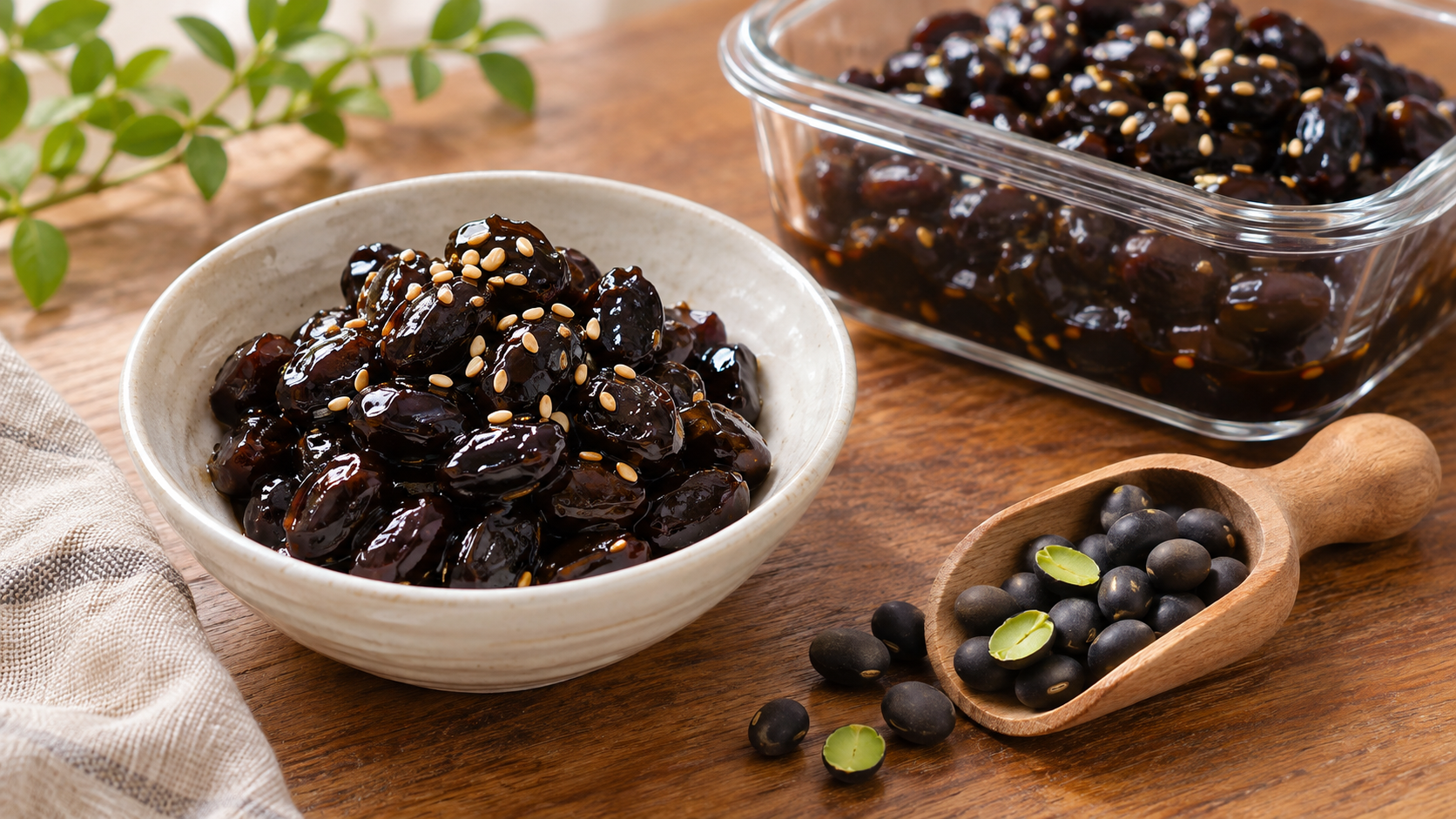
How to make kongjaban, Korean soy-braised black soybeans, using only what official sources confirm: the Encyclopedia of Korean Culture method (half water, half soy sauce, sugar once the beans wrinkle), a 1991 study on why the beans turn hard, seoritae nutrition from the national food composition table, and domestic seoritae prices on November 12, 2026.
When the new seoritae crop arrives, Korean kitchens braise some of it in soy sauce. The complaint afterwards is always the same: a day later the beans are as hard as pebbles.
Bottom line: kongjaban hardens because it is boiled for a long time after the soy sauce and sugar go in. In a 1991 study in the Korean Journal of Food Science and Technology, soaking made the dish softer, while longer heating after adding sugar and soy sauce made it markedly harder. So soak well and keep the seasoned stage short. The Encyclopedia of Korean Culture says to braise in half water and half soy sauce and add sugar once the beans wrinkle. On November 12, 2026 domestic seoritae sold for KRW 9,900–13,980 per kg on Coupang.
Earlier records: Seoritae Harvest Time and Price 2026, Small Black Soybeans 2026.
1. What kongjaban is
The Encyclopedia of Korean Culture defines it as beans braised in soy sauce: black soybeans are simmered in equal parts water and soy sauce, and sugar, oil, green onion and ginger are added when the beans wrinkle. It gives no quantities or times.
We could not find a government or public-institution recipe with spoon measures for soy sauce, sugar or syrup. The Nongsaro entry called kongjaban is a different dish from North Gyeongsang: boiled beans coated in glutinous rice paste, dried and fried at 170℃. This post therefore gives the confirmed order and principle, not invented amounts.
2. Why the beans turn hard
The abstract of the 1991 paper confirms three things:
- Soaking lowers the hardness of the finished dish.
- The longer the heating after sugar and soy sauce are added, the harder it becomes.
- More sugar makes it slightly harder.
The common explanation is osmosis, but the abstract does not say so; we report only the result.
3. Order of work for soft beans
- Wash and soak the beans well.
- Simmer in half water, half soy sauce.
- Add sugar only when the beans wrinkle.
- After the sugar, do not boil for long.
- Finish with a little oil, as the encyclopedia describes.
For chewy, firm kongjaban do the opposite. We found no official soaking time. A 1990 abstract shows black soybeans absorb water faster than other varieties and that final weight gain falls above 40℃, which suggests cool or lukewarm water rather than hot.
4. Nutrition
National Standard Food Composition Table (RDA), seoritae per 100 g:
| Dried | Boiled | |
|---|---|---|
| Energy | 401 kcal | 184 kcal |
| Protein | 38.02 g | 17.93 g |
| Water | 10.5 g | 61 g |
| Dietary fibre | 21.3 g | – |
Three hundred grams of dry seoritae carries about 114 g of protein and 1,200 kcal before seasoning (our calculation).
5. Price
Seoritae is not in the KAMIS wholesale survey. On November 12, 2026 domestic seoritae labelled 1 kg sold for KRW 9,900–13,980 on Coupang (three Rocket-delivery listings). For comparison, domestic white soybeans were KRW 227,000 per 40 kg wholesale in Seoul on November 11, about KRW 5,680 per kg, almost unchanged from a year earlier.
6. Storage and selling
We found no official refrigerator life specific to kongjaban; the food safety portal gives 0–10℃ for chilled storage. For growers, small packs labelled by use, such as 300 g for kongjaban, with the crop year printed clearly, are easier for buyers to choose. Selling the cooked dish is processing and may require a business notification.
References
- Encyclopedia of Korean Culture, Kongjaban
- Korean Journal of Food Science and Technology (1991), physical and sensory characteristics of kongjaban under different cooking conditions (abstract)
- Korean Journal of Food Science and Technology (1990), soybean soaking study (abstract)
- RDA National Standard Food Composition Table: seoritae, dried and boiled
- RDA Nongsaro: black soybeans (food of the month), kongjaban (North Gyeongsang local food)
- KAMIS wholesale price for domestic white soybeans (surveyed November 11, 2026)
- Coupang listings for domestic seoritae 1 kg (searched November 12, 2026)