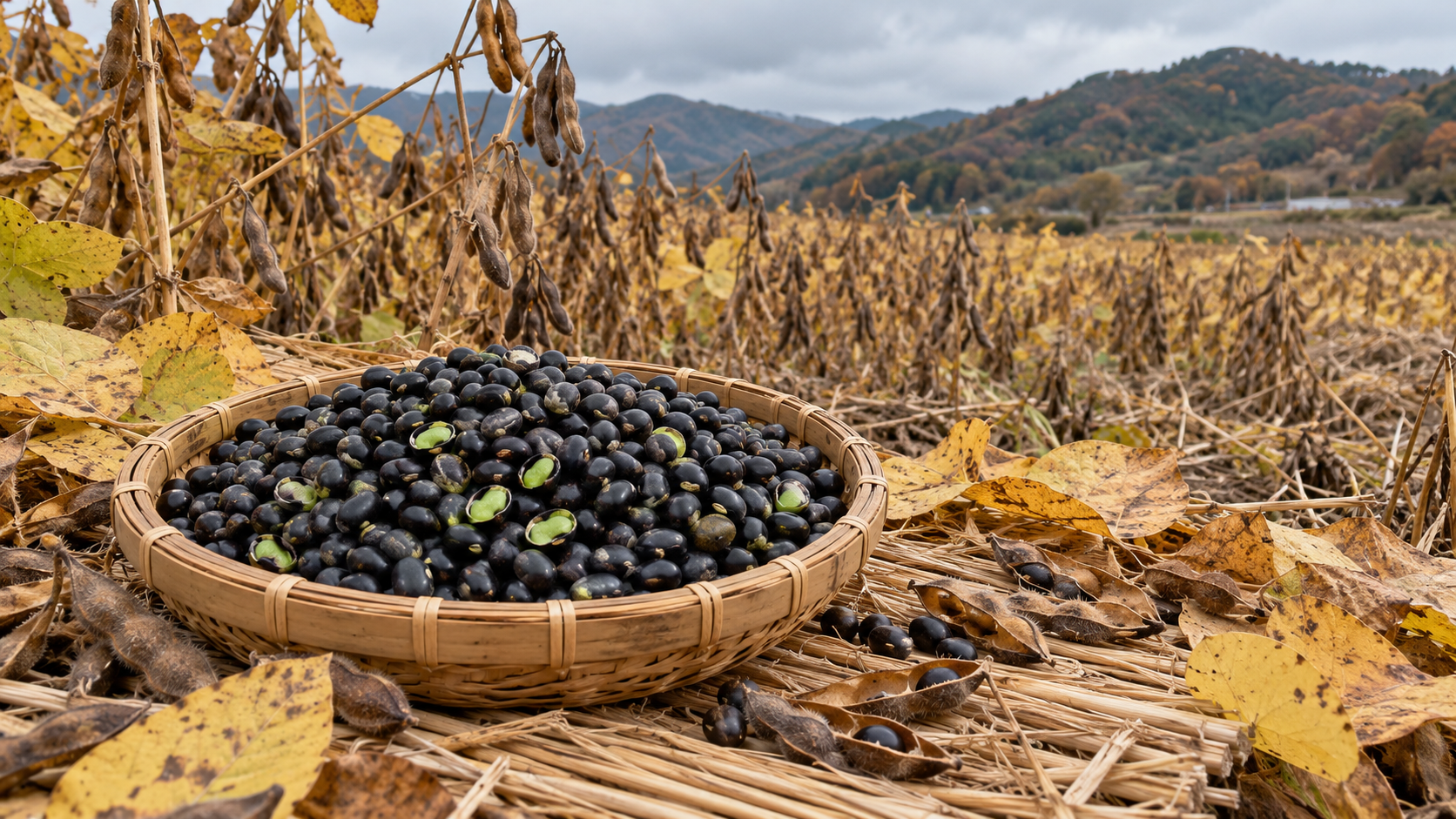
When to harvest seoritae (green-kernel black soybean) by RDA criteria, how to thresh and dry it, what domestic seoritae cost online on October 9, 2026, how to tell domestic from imported black beans, and where growers can sell.
Seoritae means roughly “frost bean”: it is harvested around the first frost. In mid-October, when soybean leaves start to yellow, growers count the days to cutting, and households that make soy milk start looking for new-crop beans.
Bottom line: Harvest seoritae 7–14 days after the leaves have dropped and most pods have turned their mature color. Waiting longer means pods shatter and beans fall. On October 9, 2026, domestic seoritae sold online for about KRW 9,000–16,000 per kilogram, and most of what is on sale is the 2025 crop. New-crop beans arrive after the late-October harvest, drying and sorting.
1. What is seoritae?
According to the KAMIS food archive (RDA source), seoritae is harvested around Sanggang, the late-October solar term. The skin is black and the kernel is green, so it is also called “sokcheong.” Heuktae is a black bean with a yellow kernel, and seomoktae is the small “mouse-eye” bean. The RDA variety Cheongja 5 lodges and shatters less than landrace seoritae, can be machine-harvested, and yields 343 kg per 10 a versus about 200 kg. Its area grew from 314 ha in 2020 to 3,703 ha in 2026.
2. When to harvest
Landrace seoritae is sown before mid-May (Chungnam ARES) and usually harvested from late October into November. RDA’s October 2026 guidance for soybeans:
- Maturity: leaves yellow and drop, and 95% or more of pods across the field show the variety’s mature color.
- Harvest window: about 7–14 days after maturity, when pod moisture is 15–18%.
- Field check: shake the pods lightly and listen for beans rattling.
RDA’s 2022 guidance put the timing at “all leaves dropped, stems brown and 80–90% of pods brown.” Shattering losses were 0.1% at the right time, 5.0% when 20 days late and 9.4% when 40 days late. Gyeonggi ARES notes that seoritae shatters easily when harvest is delayed.
3. Threshing and drying
| Step | Guideline | Source |
|---|---|---|
| Field drying | 2–3 days in sun after cutting | RDA (2022) |
| Threshing | At 13–15% moisture, thresher 300–400 rpm | RDA (2026), Gyeonggi |
| Dryer | Slowly at 30°C or less; 30–35°C for food, 25–30°C seed | RDA (2022, 2019) |
| Storage moisture | About 14% (about 12% for seed) | RDA (2022), Gyeonggi |
4. What does 1 kg cost?
Seoritae is not a KAMIS survey item; KAMIS covers only white soybeans. We checked Coupang on October 9, 2026.
| Product | Size | Oct 9 price | Per kg |
|---|---|---|---|
| Sillim Nonghyup domestic seoritae (2025) | 1 kg | KRW 15,980 | KRW 15,980 |
| Deojoun domestic seoritae | 1 kg | KRW 10,790 | KRW 10,790 |
| Nonghyup Daehan Mingok seoritae | 1 kg | KRW 8,980 | KRW 8,980 |
| Hyundai Nongsan domestic seoritae | 2 kg | KRW 16,300 | KRW 8,150 |
| Hankki Nongsan domestic seoritae | 2 kg | KRW 15,900 | KRW 7,950 |
For reference, domestic white soybeans (top grade, 40 kg) averaged KRW 228,600 at wholesale across five cities on October 8, about KRW 5,700 per kilogram (/prices/soybean/). Check the production year on the listing; most current stock is from 2025.
The KAMIS archive says domestic beans are larger with few damaged beans and a grey hilum with a clear brown line; imported beans are smaller, with damaged beans and a faint line. Visual checks have limits, so buy from sellers with clear origin information.
5. Buying for soy milk, and storage
RDA’s webzine suggests grinding soaked beans with water or milk for soy milk or noodle soup. There is no official bean-to-water ratio, so weigh the dry beans you use per batch and multiply by the per-kilogram price. Store dry beans in a cool, ventilated place at 18–22°C for about three months; RDA advises against kimchi refrigerators because of moisture. Freeze leftover soaked beans in an airtight container.
6. Where growers can sell
Without a KAMIS wholesale price, growers can use two references: white-soybean wholesale (about KRW 5,700 per kg) and online domestic seoritae (KRW 8,000–16,000 per kg). Direct-sale prices fall between them. Sell only after drying to about 14% moisture; under-dried beans mold in storage. Legal wholesale consignment fees for grains, including soybeans, are capped at 2%.
7. Checklist
- Harvest 7–14 days after maturity; shake pods and listen.
- Twenty days late raises shattering loss to 5%.
- Thresh at 13–15% moisture; store at about 14%.
- Domestic seoritae online: KRW 9,000–16,000 per kg; 2 kg packs about KRW 8,000 per kg.
- Most current stock is the 2025 crop; check the year.
References
- RDA soybean harvest guidance (October 7, 2026, reported by Dailian); RDA press releases of October 12, 2022 and October 11, 2019.
- Gyeonggi ARES soybean harvest guidance (Aju News, October 1, 2023).
- Nongsaro farm technology: sowing time and spacing for late-maturing black soybeans (Chungnam ARES, 2004).
- RDA Green Magazine (June 2022): Cheongja 5, storage and use; Dailian (June 22, 2026) on Cheongja 5 area.
- KAMIS food archive “Black bean.”
- aT KAMIS wholesale prices: white soybean domestic top grade 40 kg, five cities, October 8, 2026.
- Online prices: Coupang product pages, checked October 9, 2026.