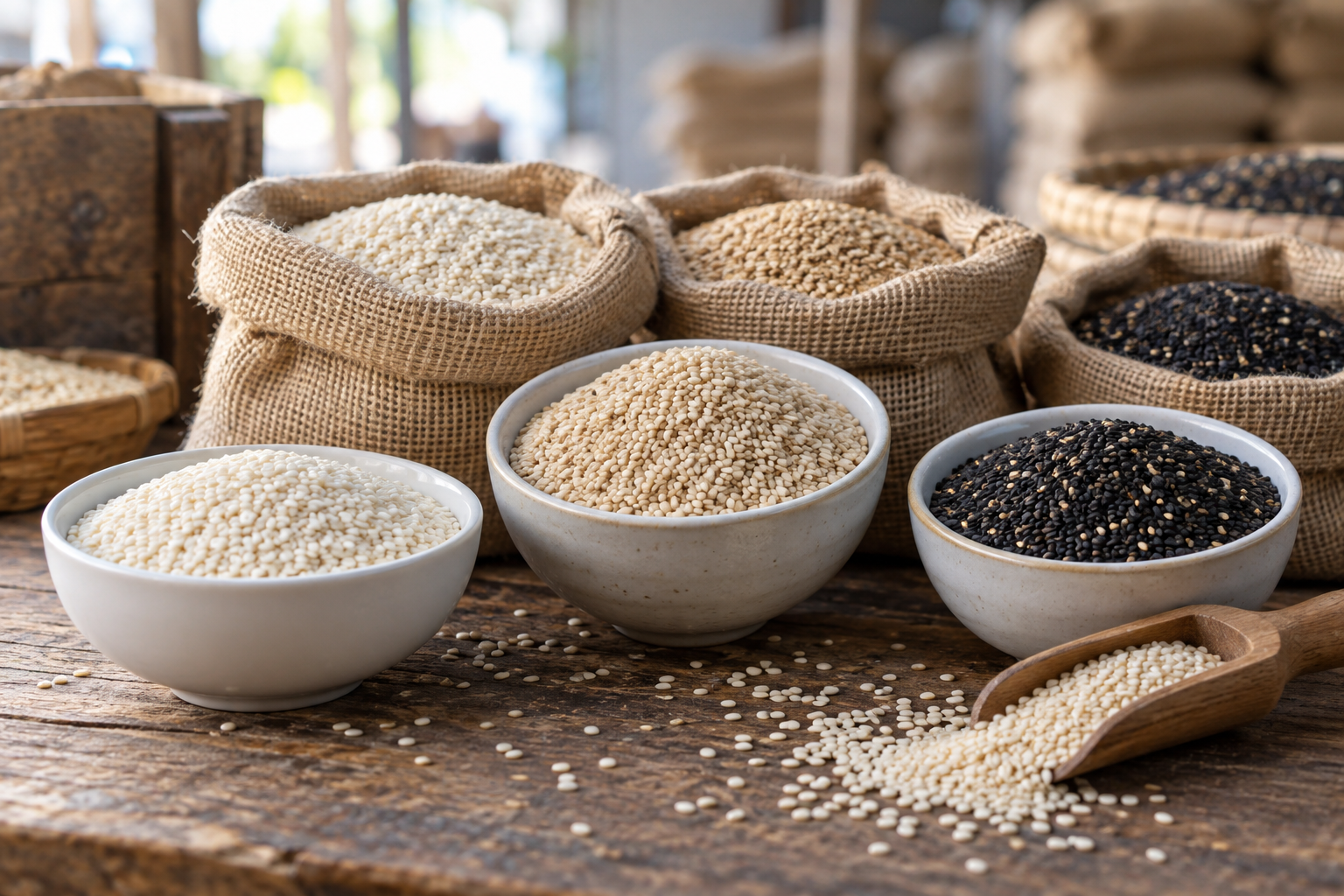
A practical guide to domestic Korean sesame prices and imported 30 kg wholesale prices from China and India.
Sesame prices are confusing because domestic and imported sesame do not belong to the same market. Domestic white sesame, Chinese sesame, and Indian sesame may all use a 30 kg unit, but buyers treat them differently.
Bottom line: do not read sesame prices from the domestic number alone. Imported 30 kg wholesale prices show the substitute pressure that affects domestic sesame.
1. Why domestic and imported sesame must be separated.
Sesame is used for roasting, oil, restaurants, and processing. Domestic sesame earns a higher price because of aroma, origin trust, and local demand. Imported sesame sets the reference price for large-volume buyers.
That means domestic sesame farmers still need to watch imported 30 kg prices. If imported sesame gets too cheap, some buyers shift away from domestic lots. If imported prices hold firm, domestic sesame has more room to defend its price.
2. The 30 kg unit makes the spread visible.
KAMIS wholesale data separates domestic white sesame, Chinese sesame, and Indian sesame in 30 kg units. The unit is easy to compare, but the products are not identical.
On IMUN.FARM, check these pages together.
- Domestic white sesame:
/prices/sesame/ - Indian sesame:
/prices/sesame-india/ - Chinese sesame:
/prices/sesame-china/
The spread between these pages gives a quick view of the domestic premium. Actual transactions still depend on origin, moisture, cleaning quality, aroma, and buyer terms.
3. What domestic sesame farmers should watch.
Domestic sesame has a strong story: aroma and trust. But the market is cold. If the price gap becomes too wide, some buyers move to imported sesame.
Track three numbers.
| Price to check | Meaning | Use |
|---|---|---|
| Domestic white 30 kg | Domestic baseline | Compare direct and wholesale sales |
| Chinese 30 kg | Large-buyer reference | Pressure on domestic ceiling |
| Indian 30 kg | Low-price import reference | Processing substitute pressure |
When selling domestic sesame, the question is not only how expensive it is. The question is why this lot deserves the price. Clean sorting, stable roasting quality, and origin trust matter.
4. What buyers of imported sesame should watch.
Imported sesame buyers often focus on price. That is natural, but Indian and Chinese sesame may differ in aroma, color, grain condition, and processing fit.
A restaurant or processor may save money on the purchase price and lose it in flavor. If roasted aroma is weak, the customer notices before the spreadsheet does.
5. Sell now or store.
Sesame does not collapse as quickly as spinach, but it is still sensitive to moisture and insects. Poor storage damages aroma and color.
Selling now makes sense when:
- drying is uncertain;
- cleaning is incomplete;
- imported sesame prices are falling;
- cash flow is tight;
- a reliable buyer is ready.
Storage can work when:
- drying and cleaning are good;
- moisture and insects can be controlled;
- regular domestic-sesame buyers exist;
- imported prices are not collapsing;
- lot quality is consistent.
A small seed can carry a large storage mistake. If the smell changes, a good price board does not help.
Farm checklist.
- Compare domestic, Chinese, and Indian 30 kg prices together.
- Do not mix cleaned and uncleaned lots.
- Include freight and return risk in direct-sale prices.
- Separate roasting-use and oil-use explanations.
- Do not wait if moisture smell appears.
- Check
/prices/sesame/,/prices/sesame-india/, and/prices/sesame-china/together.
References
- aT KAMIS agricultural price OpenAPI, specialty-crop sesame 30 kg wholesale query structure.
- IMUN.FARM
/prices/sesame/,/prices/sesame-india/, and/prices/sesame-china/price pages. - Actual sesame prices can vary by origin, grade, moisture, cleaning quality, aroma, and buyer.