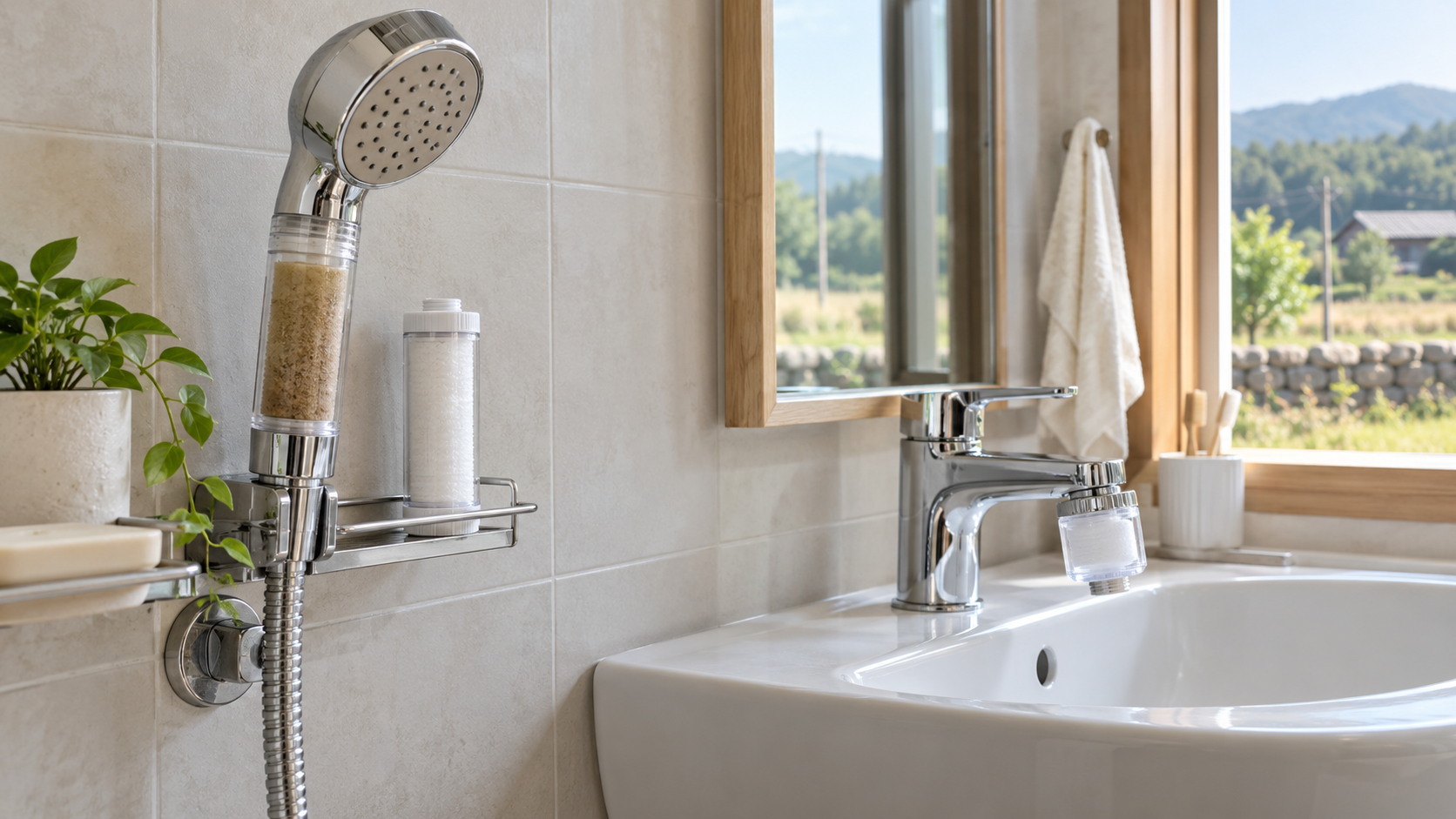
What shower and faucet filters do and do not remove, based on the Korea Consumer Agency test of 20 filter shower heads (7 below 80% chlorine removal), rust from galvanized pipes in pre-April 1994 buildings, groundwater testing intervals, and how to set a replacement cycle and yearly filter cost.
People who install a filter shower head in a country house are often surprised when the white cartridge turns yellow within a week. It is common with well water or old pipes, but changing filters more often is not the whole answer.
Bottom line: Shower and faucet filters catch visible debris such as rust particles. They do not make water safe to drink. In a 2021 Korea Consumer Agency test, 7 of 20 filter shower heads removed less than 80% of residual chlorine. If a filter browns in days, check the water and the pipes first. Galvanized steel supply pipes in buildings from before April 1994 are a leading cause of rusty water, and some local governments subsidize replacement. Groundwater used for drinking is tested every 2 years, non-drinking use every 3 years.
Earlier record: preventing frozen pipes in farm sheds and country houses.
1. Why filters discolor quickly
Two usual causes: rust from old galvanized pipes (Seoul treats buildings built before April 1994 with galvanized supply pipes as eligible for replacement support), and dissolved substances in groundwater, which differ by well and can only be known through a water test.
2. What filters do and do not do
The Korea Consumer Agency tested 20 bathroom filter shower heads sold online in November 2021, using water purifier test methods with 80% residual chlorine removal as the pass mark. Seven failed; six of those had no test report, and all 20 advertised chlorine removal, some claiming 100%. The agency noted the products were not subject to KC certification and had no performance standard. For well water, expect a filter to catch visible particles, not to purify water for drinking.
3. Shower, washbasin and kitchen faucet filters
All work the same way. Faucet filters fit on the tap outlet, so check the thread type and adapters. A shower filter alone leaves the washbasin and kitchen water unchanged.
4. When to replace
No law or agency test sets an interval. Follow the manual and replace when the cartridge clearly changes color, when water pressure drops, or when the stated period ends. Check weekly at first to learn your home’s cycle: every 2 weeks means 26 cartridges a year per tap, monthly 12, every 2 months 6, every 3 months 4. If a filter browns within 2 weeks, fixing the water source is cheaper than buying filters.
5. For homes on well water
Korea’s Groundwater Act requires periodic testing for drinking and certain other uses; city guidance puts it at once every 2 years for drinking and every 3 years for non-drinking household use. Find your latest result, check building age and pipe material if tap water is rusty, ask the local water office about pipe replacement support, and solve drinking water with equipment matched to the test result.
References
- Korea Consumer Agency, filter shower head residual chlorine test, November 30, 2021 (as reported by Medigate News).
- Seoul Metropolitan Government, old indoor water pipe replacement support.
- Enforcement Decree of the Groundwater Act, Art. 29; Enforcement Rule, Art. 38.
- Gimhae City and Incheon City groundwater testing guidance.
- Naver Search Ad keyword tool, October 30, 2026.