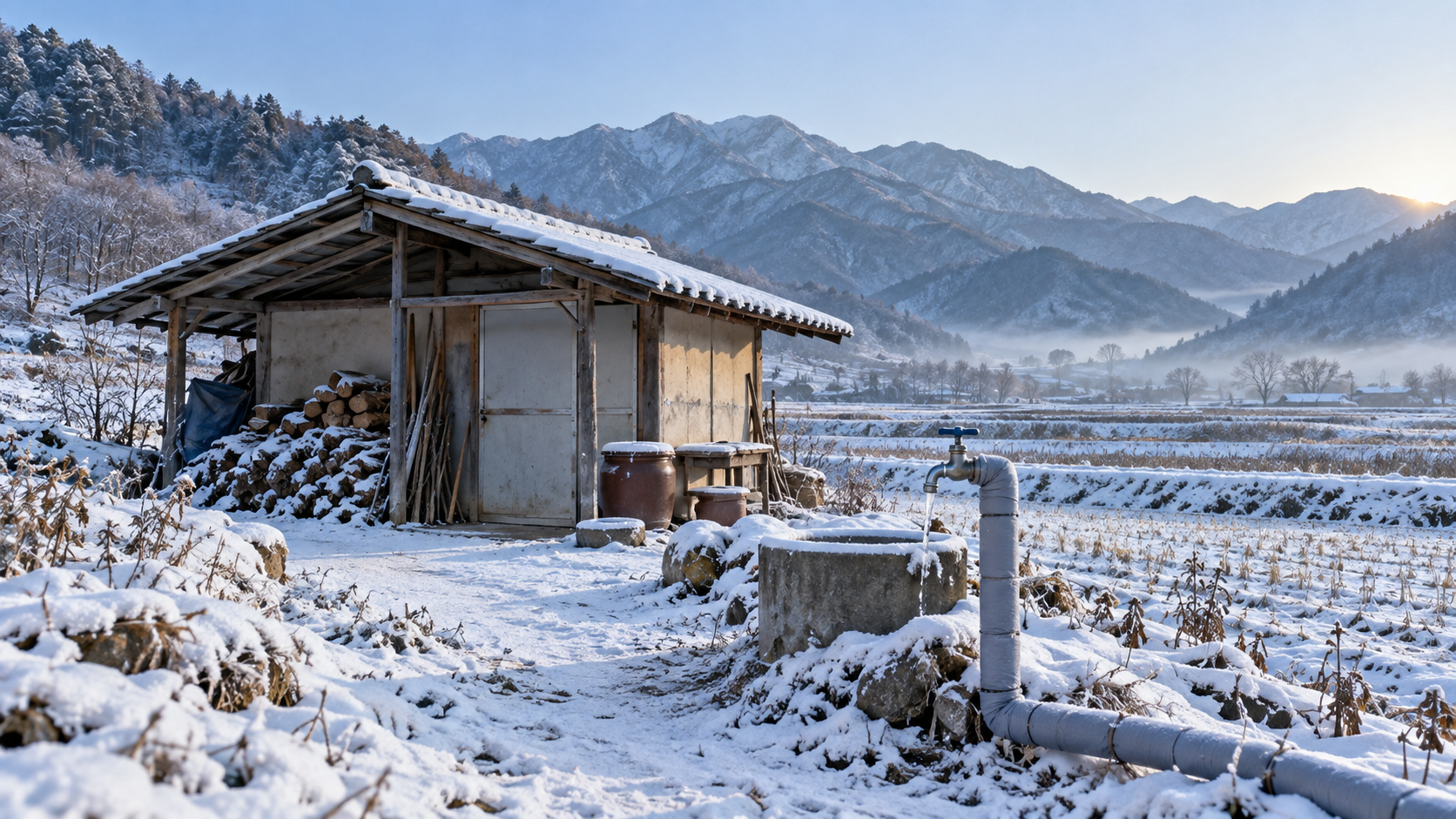
Weekend farm sheds and country houses are prone to frozen pipes. Seoul’s freeze warning levels and prevention tips, how to drain pipes before leaving for winter, safe heat cable installation and how to thaw a frozen pipe.
A winter weekend: you open the farm shed, turn the tap, and nothing comes out. The meter glass is cracked or a pipe in the wall has burst. Apartments share heat with neighbours; a shed empty all week sits below freezing every night.
Bottom line: Seoul found that 80% of frozen water meters last winter came down to poor insulation. If a shed stays empty all winter, draining the pipes is the surest fix. If people come and go, insulate exposed pipes and use certified (KC) heat cable wound two to three finger-widths apart, never overlapped. In a cold snap, let water trickle so a paper cup fills in 33–45 seconds.
1. When the risk starts.
Seoul’s waterworks issues four freeze warning levels by daily low:
| Level | Daily low |
|---|---|
| Watch | above −5°C |
| Caution | −5°C to −10°C |
| Warning | −10°C to −15°C, two days or more |
| Severe | below −15°C, two days or more |
Sheds in valleys often run several degrees colder than the city; prepare one level higher than the forecast suggests.
2. Why sheds and country houses are vulnerable.
Pipes sit full and still for days, many pipes are exposed, heating is off when nobody is there, and repairs are hard to arrange at weekends. So the first rule is to leave no water to freeze.
3. Draining before winter.
- Close the main valve (or switch off the well pump).
- Open the lowest tap first, then the higher ones to let air in.
- Drain water heaters, boilers and pumps following the manufacturer’s manual.
- Flush the toilet and sponge out what remains in the tank.
- On return, reopen the valve and run taps until the air is out.
Draining needs no power, which suits sheds running on small solar systems; see small solar for a farm shed.
4. If people come and go: insulation and heat cable.
Wrap every exposed pipe and joint with insulation. Seoul recommends filling the meter box with old clothes or insulation and covering the lid with plastic; replace anything that gets wet.
Heat cable is convenient but can start fires if misused:
- Use KC-certified cable.
- Wind it two to three adult finger-widths apart, never overlapped. In a broadcast test, evenly spaced cable stayed around 30°C while tightly overlapped cable rose more than 10°C quickly and passed 50°C.
- Cover the cable with insulation.
- Check it every year and replace cracked or scorched cable; keep plugs free of dust.
A built-in thermostat switches the cable on only when it is cold.
5. In a cold snap, let water trickle.
When nobody is using water at night or while out, let a tap run so a disposable cup fills in about 45 seconds (0°C to −10°C) or 33 seconds (−10°C to −15°C), per Seoul’s guidance.
6. If it has frozen.
Leave the tap open, wrap the frozen part in warm wet towels or use a hair dryer from a distance. Never pour water hotter than 50°C or use a flame. If the meter or pipe has burst, close the main valve and call the local waterworks (in Seoul, 02-120).
References
- Seoul Metropolitan Government, “80% of meter freezes due to poor insulation: three ways to prevent them.”
- Seoul Waterworks Authority, four-level freeze warning system.
- SBS News, “Heat cable wound tightly is a fire risk,” January 14, 2014.
- Pipe layout and drain procedures vary by site and manufacturer.