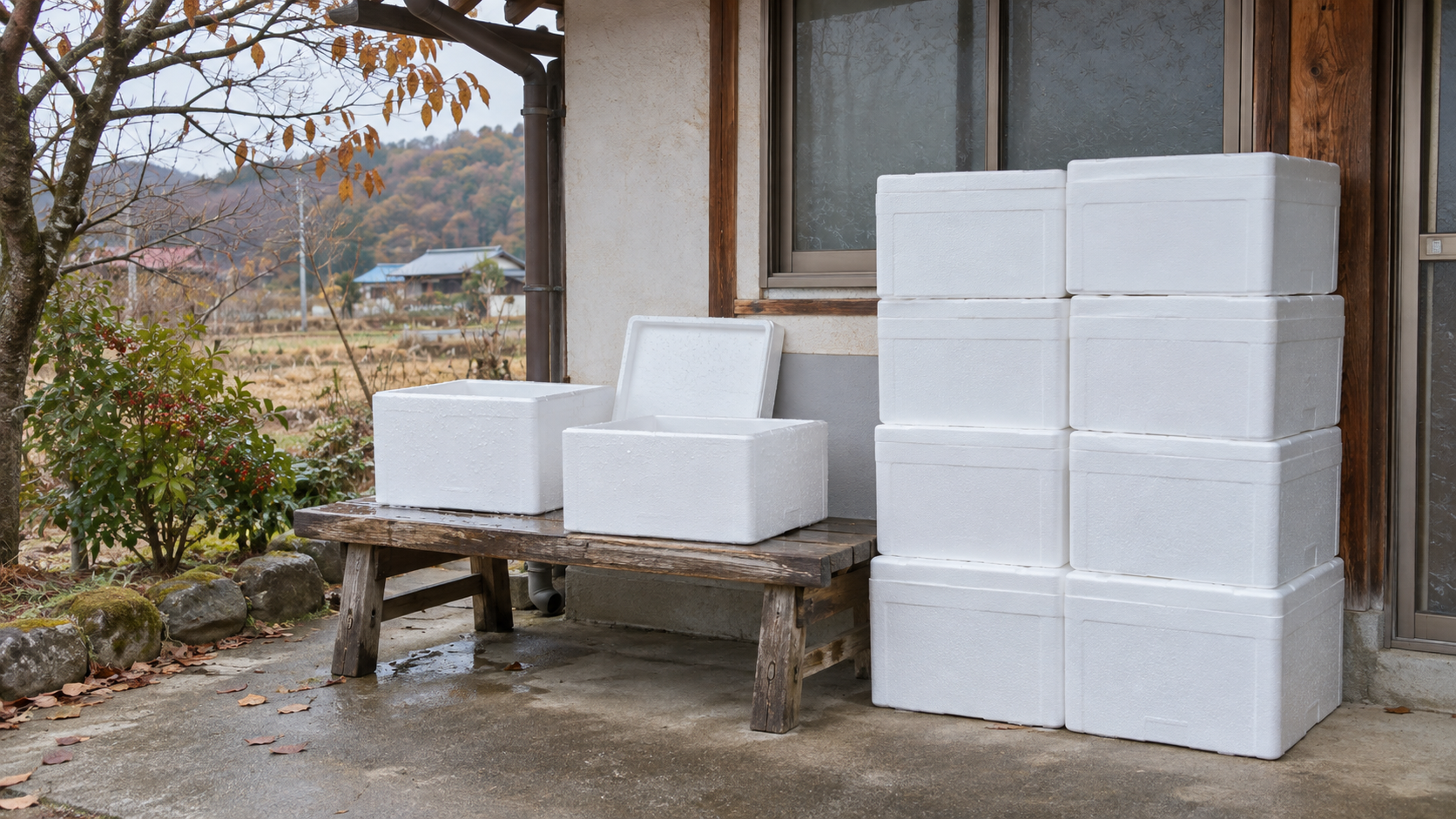
How to put out the styrofoam boxes that pile up after kimjang, based on the Ministry of Environment sorting rules and the 2026 separate-disposal app Q&A: removing tape, waybills and stickers, boxes stained with kimchi brine, colored styrofoam, fruit nets and tray liners, cup noodle containers, building insulation, insulated delivery boxes, how to find your local collection day, and ways to reuse clean boxes.
When kimjang is over, styrofoam boxes stack up on the porch: the box the salted cabbage came in, the one for chili powder and salted shrimp, the spare ones left after sending kimchi to the children. Then the questions start. Does the tape have to come off? What about a box soaked with kimchi brine? Can colored styrofoam go in with the white? Boxes put out the wrong way are often simply left behind by the collectors.
Bottom line: Remove all tape, waybills and stickers, empty and rinse the box, then put it out separately as styrofoam. If food or brine stains will not wash out, break the box up and put it in a volume-rate (paid) garbage bag. Styrofoam that is laminated or glued to another material, building insulation, and fruit nets do not go out as styrofoam. Collection days and places differ by municipality, so check your local rules on the national waste-sorting site (wasteguide.or.kr).
Related: how to ship kimchi in styrofoam boxes and what Korea Post charges is covered in Shipping Kimchi in Styrofoam Boxes 2026.
1. The basic steps
The Ministry of Environment sorting rules for styrofoam (expanded polystyrene) say to empty the contents and rinse off foreign matter, and to remove labels and any other materials before putting it out. Packaging boxes for agricultural, fishery and livestock products are named specifically, which covers almost every kimjang box.
- Empty it. Take out plastic bags, ice packs, newspaper and cabbage leaves.
- Peel off the tape. Strip the vinyl tape around the lid completely.
- Remove the waybill and stickers. The paper waybill is a different material, and it carries your name and address, so tear it up separately.
- Rinse and dry if it has brine or water on it.
- Put it out with other styrofoam, stacked or tied together.
2. Brine-stained and fish boxes
If rinsing gets it clean, it is ordinary styrofoam. If food is soaked in and cannot be removed, the ministry rules send it to a volume-rate garbage bag or other method set by local ordinance, and a government briefing advised breaking heavily soiled styrofoam into pieces for the garbage bag. We found no official text specific to kimchi smell, so the practical test is simply whether water gets it clean.
3. Colored and coated styrofoam
Sources differ slightly here. The 2026 Q&A for the government’s separate-disposal app says styrofoam containers can go out with white styrofoam regardless of color or pattern, while a 2021 government briefing advised keeping colored cup noodle containers apart. The 2026 Q&A is the most recent source we found, but it also notes that details can vary by municipality.
What is clear: styrofoam that is coated with or glued to another material goes to the garbage bag or bulky-waste route under local rules.
4. Quick reference
| Item | Where it goes |
|---|---|
| Clean produce or fish styrofoam box | Styrofoam |
| Box with stains that will not wash out | Garbage bag (broken up) |
| Laminated or glued styrofoam | Garbage bag etc. (local rules) |
| Styrofoam tray liner under apples | Styrofoam (same material) |
| Foam fruit net | Garbage bag (PE, different material) |
| Meat or fruit tray | Styrofoam after cleaning |
| Cup noodle container | Rinse, then styrofoam |
| Foam board (woodrock) | Garbage bag or bulky waste |
| Building insulation styrofoam | Bulky waste |
| Insulated box with foil or plastic lining | Garbage bag (Seoul standard) |
| Appliance packing foam | Return to the seller where possible |
We found no official styrofoam-section guidance on ice packs, so take them out and handle them by your local rules rather than leaving them in the box.
5. Finding your collection day
National rules set the principles, but days, places and item details are set by local ordinance. The government’s waste-sorting website (wasteguide.or.kr), opened on September 5, 2025, shows your district’s rules and drop-off points based on location and covers 730 items. The separate-disposal app, your county office website, or the village head and township office are the other places to ask. Rural villages often have their own collection days. Do not burn styrofoam at a farm shed: burning household waste outside approved facilities is prohibited under the Wastes Control Act.
6. Reusing clean boxes
We could not find official RDA guidance on using styrofoam boxes for garden warming or vegetable storage, so we only list uses already covered on this site: shipping kimchi or sweet potatoes again, keeping newspaper-wrapped radishes on a cold balcony from freezing (Radish Storage 2026), and making a winter shelter for stray cats (Stray Cat Winter Shelter). Keep two or three clean boxes, not a whole stack.
7. For farms shipping direct
Put the waybill on an outer bag or carton rather than the styrofoam itself, tape only around the lid, and double-bag kimchi so brine does not soak into the foam. A clean box on arrival is a box that gets recycled.
References
- Seoul Metropolitan Government, Separate Disposal Guidelines with the Ministry of Environment sorting rules for expanded polystyrene and the Seoul standard, page updated August 6, 2025.
- Korea.kr policy briefing (Ministry of Environment), styrofoam disposal guidance, April 9, 2018.
- Korea.kr policy briefing, confusing styrofoam items (fruit liners, fruit nets, cup noodle containers), July 7, 2021.
- Korea.kr policy briefing, launch of the national waste-sorting website (wasteguide.or.kr), September 5, 2025.
- Korea Waste Association, 2026 Separate-Disposal App Q&A 100 Cases.
- Wastes Control Act, Article 8 (ban on burning waste outside approved facilities).