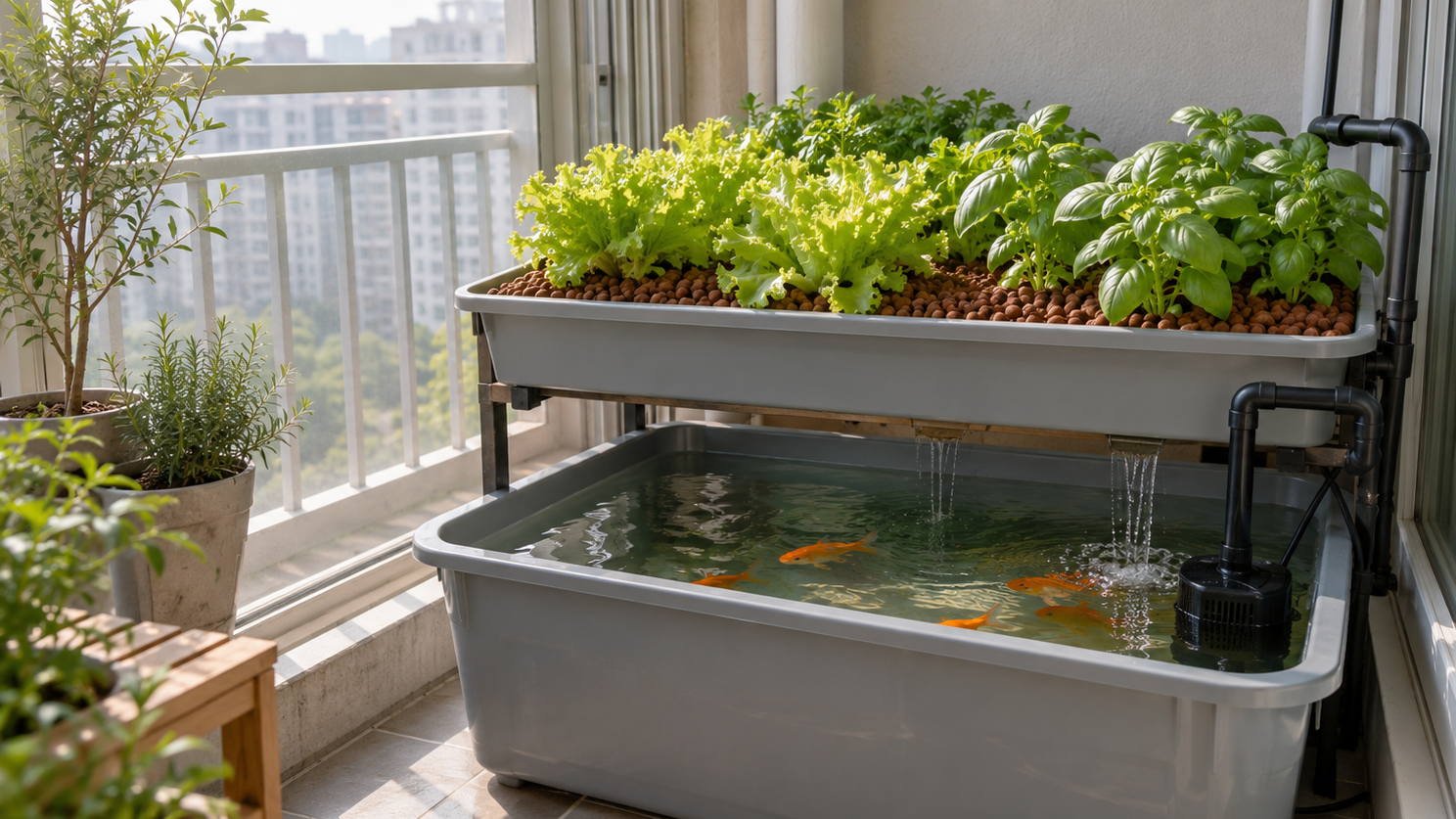
Every part you need for a 100L home aquaponics system, with real Korean prices, fish load and grow bed sizing from FAO guidance, pump flow, media choice, power use and assembly steps.
Aquaponics videos make it look simple: put a vegetable bed over a fish tank and pump water between them. Then you start shopping and the questions pile up. How big a tank? How many watts of pump? How much clay media? How many fish?
This guide fills the cart for one 100L fish tank on a balcony, with what to buy, what it costs in Korea and how to assemble it. Sizing follows the FAO small-scale aquaponics manual.
Bottom line: keep fish under 1kg in a 100L tank, build a 0.3–0.5㎡ grow bed 15–20cm deep, and pick a pump that turns the tank over once or twice an hour. Parts start at about 230,000 won on a sunny balcony, or about 340,000 won with a grow light and timer.
1. What 100L can support
The most common DIY mistake is overstocking. FAO puts maximum density at 20kg of fish per 1,000L, and advises halving it to 1kg per 100L for tanks under 500L. FAO also advises against growing food fish in tanks that small, so balcony systems suit ornamental fish such as goldfish or guppies plus leafy greens and herbs.
Grow area follows feed. FAO uses 40–50g of feed per ㎡ per day for leafy greens and 50–80g for fruiting crops.
| Total fish weight | Daily feed (1–2% of body weight) | Leafy green area |
|---|---|---|
| 0.5kg | 5–10g | about 0.1–0.25㎡ |
| 1kg | 10–20g | about 0.2–0.5㎡ |
A 100L tank matches 0.3–0.5㎡ of grow bed. Start with about 0.5kg of fish and increase as water stabilizes.
2. Parts list and real prices
Coupang prices on October 1, 2026; they change often.
| Part | Role | Spec | Example price |
|---|---|---|---|
| Storage box tank | fish tank | about 100L, sturdy plastic | 55,900 won (two 120L boxes, tank and bed) |
| Grow bed | plant bed | similar volume, 15–20cm media | one of the two boxes above |
| Expanded clay | grow media | fill to bed depth | 68,000 won per 40L; two bags 136,000 won |
| Submersible pump | lifts water to bed | 100–200L/h or more | 14,380 won (20W) |
| Hose | pump to bed | match pump outlet | 4,300 won (+3,000 shipping) |
| Air pump | oxygen, outage backup | quiet, 2 outlets | 7,500 won |
| Ceramic rings | bacteria habitat | 1L | 12,900 won |
| Water test kit | pH, ammonia | multi-parameter | see product box |
| Plant LED | shaded balcony or indoors | bar type for greens | 69,800 won |
| Timer outlet | automatic lighting | programmable | 27,400 won |
| Heater (winter) | tropical fish | auto thermostat | 6,400 won (100W) |
| Net pots | hold seedlings (optional) | hydroponic | 14,900 won (50) |
Shelving is assumed to be on hand. A sunny south-facing balcony can skip the LED and timer, saving close to 100,000 won; goldfish at room temperature need no heater.
3. Grow bed: 1:1 with the tank, depth by crop
Oklahoma State University Extension recommends a 1:1 ratio of media bed volume to fish tank volume for basic flood-and-drain systems. FAO recommends 15–20cm depth for leafy greens and 30cm for fruiting crops. A 0.5㎡ bed at 20cm is exactly 100L.
If you use a deep storage box as the bed, fill only 15–20cm of media and give it a flat, solid base. Media adds up: a 0.4㎡ bed at 15–20cm needs 60–80L of clay.
4. Choose the pump by flow, not watts
FAO advises circulating the full tank volume once per hour at low density, twice at high density, so 100–200L/h for 100L. FAO’s rule of thumb is about 40L per hour per watt, so 3–5W could be enough in theory. Flow drops with lift height, so choose a pump with headroom and throttle it with a valve.
5. Clay pebbles vs gravel; avoid limestone
| Media | Surface area | Pros | Cons |
|---|---|---|---|
| Expanded clay | 250–300㎡/㎥ | light, easy to handle | expensive |
| Volcanic gravel | about 300㎡/㎥ | nearly inert | heavy |
| Limestone | 150–200㎡/㎥ | cheap | raises pH; not recommended |
Aquaponics runs at pH 6–7, and limestone keeps pushing pH up. On a balcony, light expanded clay in 8–20mm size is the safest choice.
6. Seven assembly steps
- Pick the spot. A filled 100L tank weighs over 100kg; choose a solid floor near a drain.
- Fill the tank with dechlorinated water.
- Mount the bed above or beside the tank with a drain back to the tank.
- Rinse and add media to 15–20cm.
- Connect pump and hose. A bell siphon floods and drains automatically but needs tuning; continuous flow is simpler for a first build.
- Add an air stone so oxygen continues if the pump stops.
- Cycle for four weeks before adding fish. See the aquaponics biofilter setup guide.
7. Water quality targets
| Parameter | Target |
|---|---|
| Temperature | 18–30℃ |
| pH | 6–7 |
| Dissolved oxygen | above 5mg/L |
| Ammonia | below 1mg/L |
| Nitrite | below 1mg/L |
A Korean study of home guppy aquaponics suggests 21–25℃ and pH 6.0–7.5 with lettuce, and found its system drifting to pH 7.91, too high for lettuce. Check pH regularly.
8. Monthly power use
| Device | Use | Monthly |
|---|---|---|
| 20W pump | 24 hours | about 14.4kWh |
| 3W air pump | 24 hours | about 2.2kWh |
| 24–36W plant LED | 12 hours | about 8.6–13kWh |
| 100W heater (winter) | as needed | depends on room temperature |
Without the heater, expect about 25–30kWh per month. For income and cost scenarios, see home aquaponics profitability.
FAQ
How many fish go in a 100L aquaponics tank? Count by weight: under 1kg per FAO, starting near 0.5kg.
How much does DIY aquaponics cost? About 230,000 to 340,000 won for the parts in this guide.
How much clay media do I need? Bed area × depth: 60–80L for a 0.4㎡ bed at 15–20cm.
Conclusion
Balcony aquaponics succeeds on ratios, not big equipment: under 1kg of fish per 100L, a 0.3–0.5㎡ bed 15–20cm deep, and a pump turning the tank over once or twice an hour. Cycle the water for four weeks, then add fish slowly. For other fish options, see aquaponics fish recommendations.
References
- FAO, Small-scale aquaponic food production (Fisheries and Aquaculture Technical Paper 589), 2014.
- Oklahoma State University Extension, Aquaponics (HLA-6721).
- Kim and Han, exploratory study on home tropical fish aquaponics using IoT, Journal of the Korea Contents Association 21(4), 2021.
- Coupang prices as of October 1, 2026.