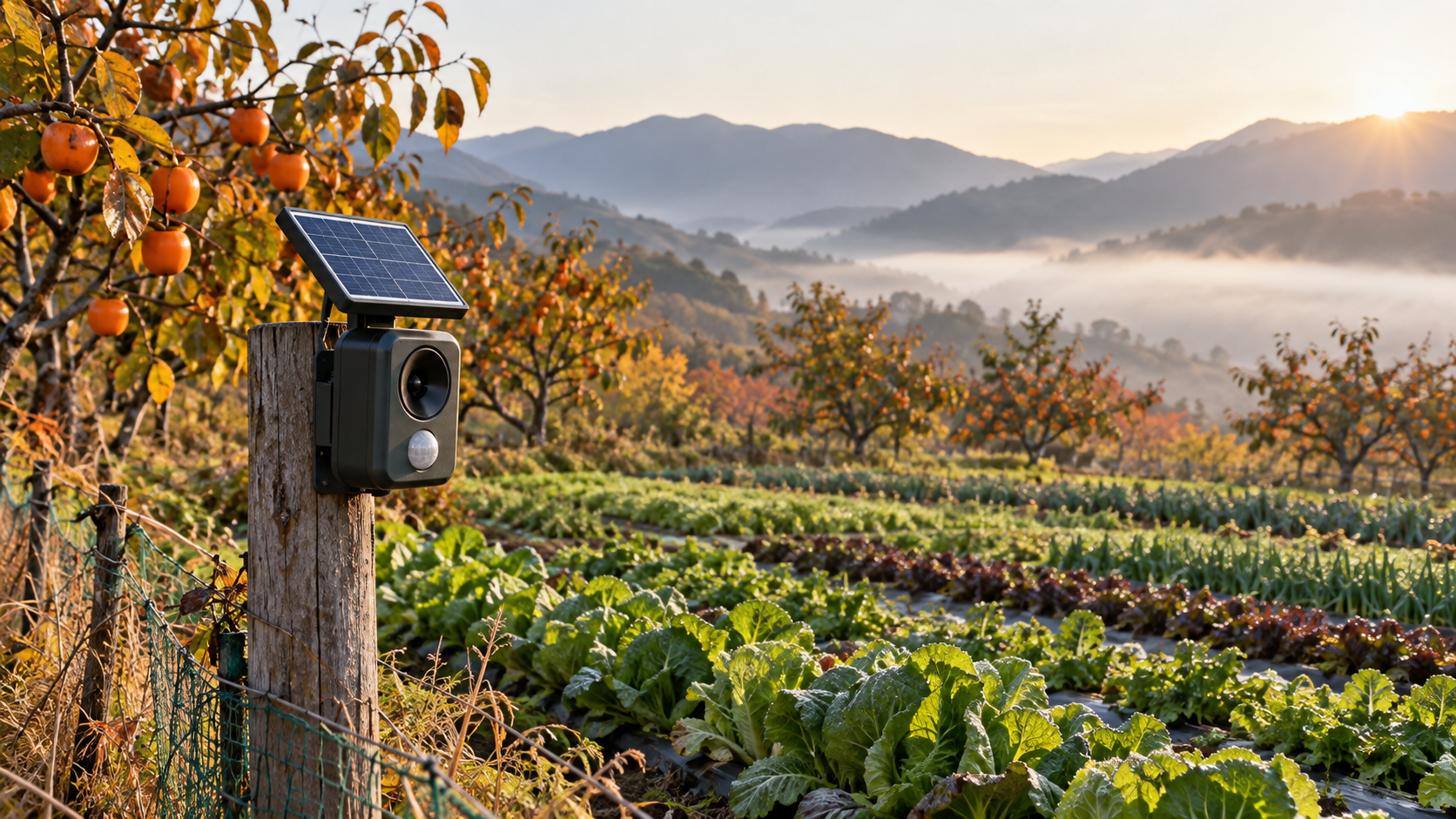
What research says about solar and ultrasonic animal repellers, which methods suit wild boar, water deer and birds such as magpies (fences, bird netting, sound and light devices), and the Korean prevention subsidy and damage compensation rules in the Ministry of Climate, Energy and Environment notice revised in June 2026.
When persimmons turn red, magpies and brown-eared bulbuls arrive first. A sweet potato bed can be ploughed up by wild boar overnight. Will a KRW 20,000–30,000 solar repeller on a stake solve it? This note sticks to published research and Korean law.
Bottom line: A review of frightening devices found ultrasonic devices ineffective at repelling birds and mammals. Sound and light devices are a supplement; fences and bird netting do the real work. Under the Ministry of Climate, Energy and Environment notice, prevention facilities can be subsidised 30% by the state and 30% by local government (up to KRW 10 million per farm, local ordinances may differ), with applications due by March 31 of the year of support. Damage compensation claims must be filed within 5 days.
See also: farm shed solar light buying guide, smart plugs for a farm shed.
1. Types of repeller
Solar is the power source, not the method: a small panel charges by day and a motion sensor triggers sound or light at night.
| Method | How it works | Evidence |
|---|---|---|
| Ultrasonic | High-pitched sound humans can’t hear | Review found it ineffective for birds and mammals |
| Alarm, siren, animal calls | Audible sound | Some protection; Korean law lists sound devices |
| LED strobe | Flashing light at night | No official effect figures found |
| Fences (mesh, net, electric) | Physical barrier | Classified as direct prevention facilities |
| Bird netting | Covers the crop | Listed as a prevention facility in law |
A USDA research review (Gilsdorf et al., 2002) concluded ultrasonic devices do not repel birds or mammals while other devices offer some protection. In a 2024 red deer experiment (Terrade et al.), deer showed no aversion to ultrasound; aversion rose at lower, audible frequencies. We found no Korean official trials on water deer or wild boar.
2. Matching method to animal
| Animal | Damage | First line | Supplement |
|---|---|---|---|
| Wild boar | Night digging, sweet potato, corn | Sturdy or electric fence | Alarm and LED device |
| Water deer | Dawn and night browsing | Tall net or mesh fence | Alarm and LED device |
| Magpie, bulbul, sparrow, crow | Daytime, ripening fruit and beans | Bird netting | Reflective tape, sound |
Electric fences have separate siting, power and warning-sign rules under the Korea Electrical Code. Check with the seller and local office before installing one where people walk.
3. Do solar repellers last through winter?
We found no official winter tests. Winter is the worst case in principle: shorter, lower sun means less charge, longer nights mean more running time, and cold reduces battery performance. Face the panel south, keep it out of shade, aim the sensor at the approach path above crop height, and check it still fires after a few cloudy days. Moving the device now and then and combining it with a fence costs nothing.
4. Prevention subsidy
The legal basis is Article 12 of the Wildlife Protection and Management Act, with details in Notice No. 2026-149 (effective June 30, 2026).
| Item | Notice |
|---|---|
| Facilities | Fences, bird netting, traps; sound devices, intrusion sensors, scarecrows |
| Eligibility | Proven in field trials, or approved by the local head after expert advice |
| Cost split | State 30, local government 30, farmer 40 |
| Cap | Up to KRW 10 million per farm; ordinances may differ |
| Deadline | March 31 of the year of support, to the city or county |
Actual programmes vary. In 2026, Paju was reported to cover 60% of fence costs, and Seogwipo’s second round 80% of nets, bird netting and repellers up to KRW 3 million per farm.
5. Damage compensation
| Item | Notice |
|---|---|
| Deadline | Within 5 days, with the site preserved |
| Cap | Up to KRW 5 million per grower (ordinances may differ) |
| Rate | Up to 80% of assessed damage |
| Not paid | Total assessment under KRW 100,000 |
| Reduction | Up to 50% if paid before and still no prevention facility |
Magpies, jays, bulbuls, sparrows and crows, as well as wild boar and water deer, are designated nuisance wildlife, but catching them still requires a permit from the city or county.
6. Conclusion
A single cheap solar repeller rarely protects a field. Ultrasonic-only devices have weak evidence and sound or light devices are a supplement. Fence against boar and deer, net against birds, apply for support before March 31, and report damage within 5 days.
References
- Wildlife Protection and Management Act, Articles 12 and 23, Enforcement Decree Article 7, Enforcement Rule Annex 3: law.go.kr
- Ministry of Climate, Energy and Environment Notice No. 2026-149 (effective June 30, 2026): law.go.kr
- Gilsdorf, Hygnstrom, VerCauteren (2002), Integrated Pest Management Reviews 7: UNL Digital Commons
- Terrade et al. (2024), Bioacoustics 33(5): bioacoustics.info
- Paju 2026 programme (Kyeonggi Ilbo, February 13, 2026): kyeonggi.com
- Seogwipo 2026 second round (Green News, July 6, 2026): gecpo.org