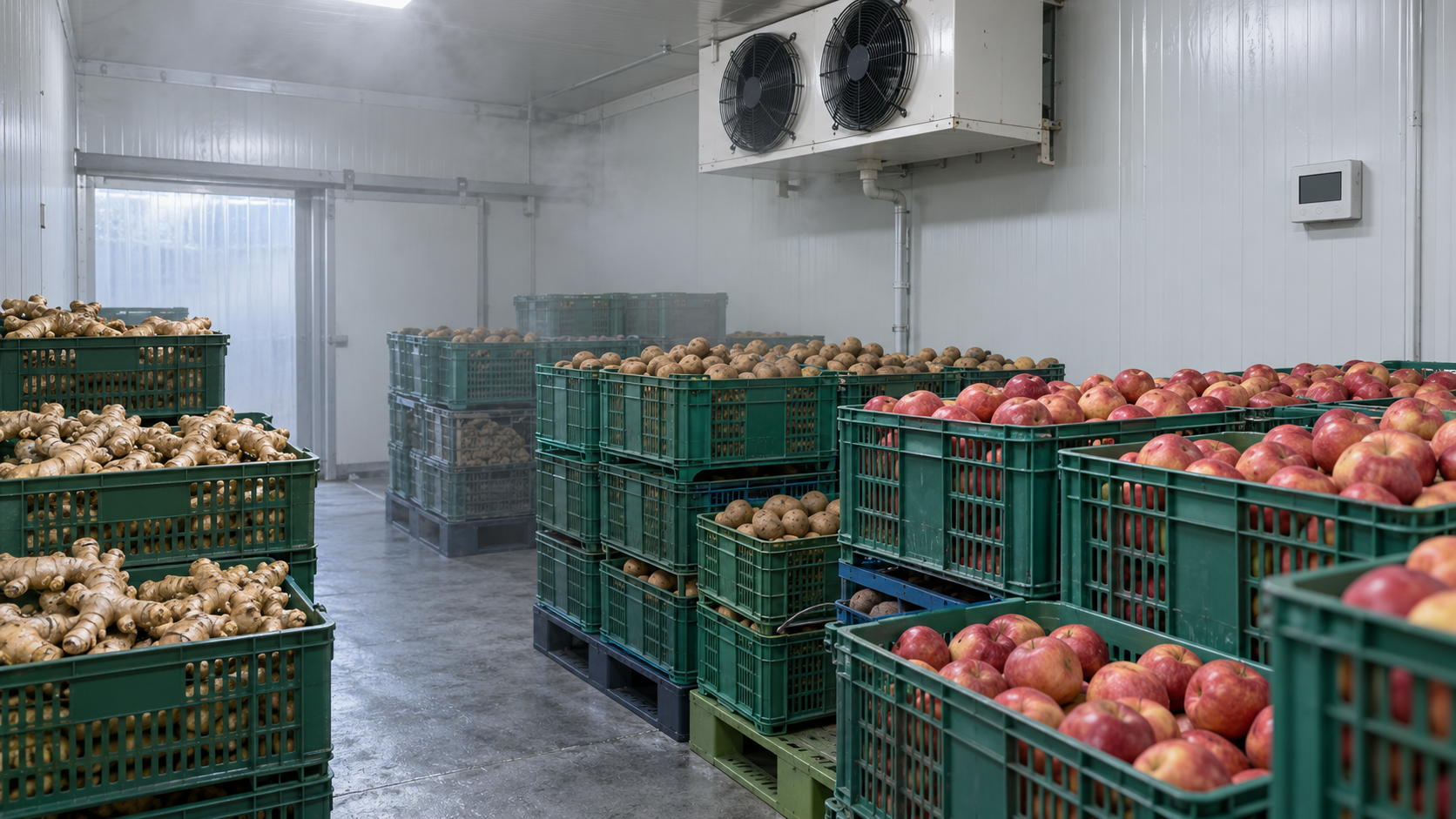
Storage temperature and humidity for apples, pears, persimmons, potatoes, sweet potatoes, ginger, onions, garlic and leafy greens, based on Korean RDA and USDA guidance, plus ethylene mixing rules and condensation control.
Standing in front of a new farm cold room, most growers pause at the controller. Apples go at 0℃, but does ginger? What about potatoes? Can several crops share one room?
Getting this wrong costs more than the installation. Ginger stored near 0℃ starts to rot before winter is over, and sweet potatoes behave the same way. A cold room is not a machine where colder is better. It is a machine for holding each crop at the right temperature.
Bottom line: apples, pears, persimmons, cabbage, radish, carrots and spinach go near 0℃. Sweet potatoes need 12–15℃, ginger about 13℃, and green peppers 7–10℃. Onions and garlic need low humidity, 65–75%. Never store persimmons, carrots or cabbage next to apples and pears.
Try it yourself: the farm cold storage cost calculator turns size and subsidy rate into a build cost range and monthly electricity.
1. Storage temperature and humidity by crop
Korean figures from the Rural Development Administration (RDA) and provincial extension services come first. USDA Agriculture Handbook 66 is used for comparison. Where they disagree, see section 6.
| Crop | Temperature | Relative humidity | Storage life | Main caution |
|---|---|---|---|---|
| Apple (Fuji) | 0℃ ±0.5 | 90–95% | about 4 months (regular air) | high ethylene producer |
| Asian pear (Niitaka) | 0℃ ±0.5 | 90–95% | varies by cultivar | pre-dry before storage; excess humidity darkens skin |
| Persimmon (non-astringent) | 0℃ ±1 | 90–95% | about 3 months | freezes below 0℃; very ethylene-sensitive |
| Grape | around 0℃ | 85–90% | Campbell 4–7 weeks | precool to 5℃ pulp temperature |
| Potato (table) | about 4℃ | 90%+ | long after curing | freezing risk at 0–2℃ |
| Sweet potato | 12–15℃ | 90–95% | up to 1 year | chilling injury below 12℃ |
| Onion | 0–1℃ | 65–75% | 6–9 months | high humidity causes sprouting and rot |
| Garlic | -3℃ to 0℃ | 60–70% | 9+ months | store separately; odor transfers |
| Ginger | about 13℃ | 85–96% | several months | damage below 10℃ |
| Napa cabbage | 0–3℃ | 90–95% | 3–6 months | keep direct cold airflow off |
| Radish | 0℃ | 90–95% | winter radish 2–4 months | no chilling injury |
| Carrot | 0℃ | 95%+ | 7–9 months | ethylene makes it bitter |
| Spinach, leafy greens | 0℃ | 90–95% | about 2 weeks | ethylene-sensitive |
| Green pepper | 7–10℃ | 90–95% | 2–3 weeks | chilling injury below 7℃ |
| Strawberry | 0–4℃ | 90–95% | up to 7 days | a precooling crop, not a storage crop |
These numbers describe the temperature the produce itself should hold, not just the air reading at one sensor. That is why sensor placement in section 7 matters.
2. Crops that belong near 0℃
Apples, pears, persimmons, grapes, cabbage, radish, carrots and spinach last longest as close to 0℃ as possible without freezing. Respiration slows and moisture loss drops.
Apples and pears: RDA’s pear research station uses 0℃ ±0.5 and 90–95% humidity. Niitaka pears should be pre-dried for a few days before storage, because excess humidity causes skin darkening.
Persimmons: 0℃ ±1. Below 0℃ they freeze; above it they soften. Do not leave them at room temperature for more than six days after harvest. They produce little ethylene but are very sensitive to it.
Cabbage, radish, carrots and spinach also sit near 0℃. Keep cabbage out of the direct path of the evaporator fan. Carrots want 95% or higher humidity and turn bitter when exposed to ethylene.
Strawberries are held at 0–4℃ for a week at most, so treat the cold room as a precooler rather than long-term storage.
3. Crops damaged by cold: sweet potato, ginger, green pepper
The most common cold-room mistake is putting these crops near 0℃. They suffer chilling injury: they look fine in storage, then soften and rot within days of removal.
Sweet potatoes: main storage at 12–15℃ and 90–95% humidity. Chilling injury starts below 12℃. Cure them first at 30–33℃ and 90–95% humidity for about four days.
Ginger: RDA uses 13℃ and 96% humidity, with damage below 10℃. USDA uses 12–14℃ and 85–90%. Too dry and it shrivels; condensation on the rhizomes leads to surface mold.
Green peppers: USDA reports chilling injury below 7℃, so 7–10℃ is the safe range. Some Korean guides mention 0–2℃, but that applies to short-term film-packed storage only.
Potatoes sit in the middle. RDA stores table potatoes at about 4℃ and processing potatoes at 7–8℃, after curing at 20℃ and 90% humidity for 10–15 days. Freezing damage is possible at 0–2℃.
4. Crops that need low humidity: onion and garlic
Most crops want 90% humidity or more. Onions and garlic are the opposite: high humidity makes them root, sprout and mold.
Onions are cured at ambient temperature with airflow for 10–15 days. RDA then lowers the temperature to 1℃ ±0.5 over about three months, starting at 65–75% humidity. USDA uses 0℃ and 65–75%.
Garlic: RDA uses -3℃ and 65–70%; USDA uses -1–0℃ and 60–70%. Sprouting is fast between 5℃ and 18℃. Store garlic separately because its odor transfers.
5. Ethylene: crops that must not share a room
Ethylene is a gas released by ripening fruit that speeds aging in nearby produce. RDA warns that ethylene-sensitive crops such as cucumber, watermelon, lettuce, carrots and broccoli lose market quality when stored with high producers like apples, melons and peaches.
| High ethylene producers | Sensitive crops | Result |
|---|---|---|
| Apple, some pears, peach, melon | Persimmon | softens quickly |
| Carrot | turns bitter | |
| Cabbage, lettuce, spinach | yellowing, faster aging | |
| Sweet potato | discoloration |
If you must share a room, group crops with the same temperature and keep producers away from sensitive crops. Ventilate apple and pear rooms once or twice a week for about ten minutes.
6. When sources disagree
- Green pepper: some Korean sources say 0–2℃; USDA says chilling injury below 7℃. Use 7–10℃ for normal storage.
- Garlic: RDA -3℃ versus USDA -1–0℃. Humidity is low in both.
- Onion humidity: RDA allows raising humidity to 80–85% late in storage; USDA keeps 65–75%.
- Potato: RDA about 4℃ for table use; USDA 7–10℃ to limit sugar build-up that darkens fried or baked potatoes. Store warmer if the crop is going to processors.
When there is no single answer, decide by where the crop will be sold and how long it will be held, and record temperatures in your first season.
7. Where to put thermometers
The controller shows one sensor. The door side, the area in front of the evaporator, the back corner and the inside of crates all differ. Use two or three extra thermometers.
- Measure produce temperature as well as air. Pear stores in the US place sensors both in the air and inside fruit.
- Leave 30–50cm between crates and walls so cold air can circulate.
- Leave 60cm to 1m free below the ceiling and fill the room only 70–80%.
- Precool before loading. Field heat can take more than 80% of cooling capacity.
- Manage frost on the evaporator according to the equipment manual.
Frequent door openings also swing temperatures. A strip curtain inside the door helps. Electricity effects are covered in cold storage electricity costs.
8. Preventing condensation at removal
Cold produce moved straight into warm, humid air collects condensation, which USDA notes encourages decay. Cover it with PE film at least 0.15mm thick or warm it gradually, and keep storage humidity at 85–95% with steady air movement.
FAQ
What temperature should a farm cold room be set to? It depends on the crop: near 0℃ for apples, pears, persimmons, cabbage, radish and carrots; about 4℃ for table potatoes; 7–10℃ for green peppers; about 13℃ for ginger; 12–15℃ for sweet potatoes.
Can ginger share a room with apples? No. Apples need 0℃ and ginger about 13℃. Ginger at 0℃ suffers chilling damage.
Why keep onion storage humidity low? High humidity makes onions and garlic root, sprout and mold. Use 65–75%.
How many thermometers do I need? At least two or three: near the door, at the back and at crate height, plus produce temperature if possible.
Conclusion
Cold storage success depends on set points more than on installation cost. Some crops belong at 0℃, others are damaged by cold, and onions and garlic need dry air. Keep ethylene producers away from sensitive crops, and record real temperatures in your first year. For sizes and costs, see cold storage prices 2026.
References
- Rural Development Administration (RDA), press release on storage temperatures and ethylene, September 30, 2014.
- Nongmin Shinmun, RDA Pear Research Institute storage guidance, October 31, 2021.
- RDA Nongsaro, sweet potato farm work schedule (curing and storage).
- RDA, potato storage guidance, June 2, 2014; onion and ginger storage guidance.
- Chungbuk Agricultural Research and Extension Services, napa cabbage storage.
- USDA Agriculture Handbook 66, The Commercial Storage of Fruits, Vegetables, and Florist and Nursery Stocks (2016).
- UC Davis Postharvest Technology Center, Persimmon Produce Facts.
- Actual conditions vary by cultivar, maturity, harvest timing and equipment.