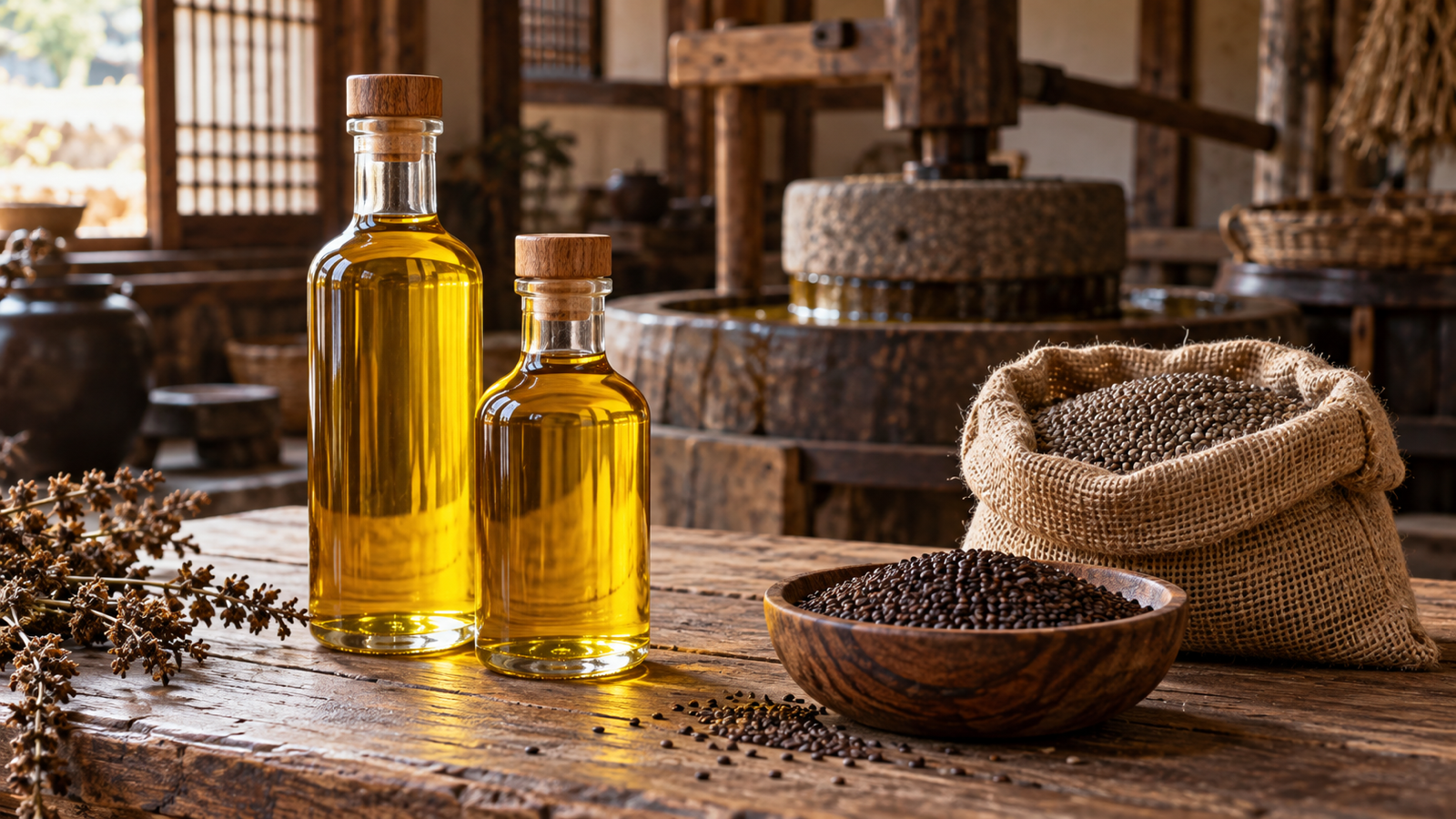
KAMIS data as of October 8, 2026: domestic and imported perilla seed wholesale prices per kilogram, what a 350 ml bottle of Korean perilla oil costs, how to judge pressing at a local mill, raw vs roasted perilla oil, storage, and whether growers should sell seed or oil.
In October, when new-crop perilla seed comes in, sacks line up in front of Korean oil mills. A bottle of domestic perilla oil costs close to KRW 30,000 at the supermarket, so many households would rather buy domestic seed and have it pressed. Farm households face the opposite question: sell the seed as is, or press it and sell oil. Both questions start from the price of the seed.
Bottom line: In the KAMIS survey on October 8, 2026, domestic perilla seed (top grade, 23 kg) averaged KRW 381,800 at wholesale across five cities, about KRW 16,600 per kilogram, 9.5% above a year earlier. Imported perilla seed averaged KRW 299,000 per 45 kg, about KRW 6,640 per kilogram, roughly 40% of domestic. A 350 ml bottle of domestic perilla oil sold online for about KRW 22,000–30,000 on October 9. Perilla oil goes rancid quickly, so keep it refrigerated.
1. What does a bottle of domestic perilla oil cost?
Perilla oil is not a KAMIS survey item, so we checked four online sellers on October 9, 2026.
| Seller and product | Size | List price | Oct 9 price | Per ml |
|---|---|---|---|---|
| Coupang, Daejeon Gireumjip domestic oil | 350 ml | KRW 31,500 | KRW 29,450 | KRW 84 |
| Coupang, Harini Mill raw perilla oil | 350 ml | KRW 29,000 | KRW 22,650 | KRW 65 |
| Oasis Market domestic perilla oil | 350 ml | KRW 27,000 | KRW 25,900 | KRW 74 |
| Gangwon The Mall domestic oil, gift wrap | 350 ml | – | KRW 28,500 | KRW 81 |
At list price, 350 ml runs KRW 27,000–31,500. Per milliliter, the range is KRW 65–84. Check that the page states the origin of the seed, not just “perilla oil.”
2. What does the seed cost?
| City | Domestic top grade 23 kg (Oct 8) | Per kg | Oct 1, 2025 |
|---|---|---|---|
| Daegu | KRW 397,000 | KRW 17,261 | KRW 355,000 |
| Gwangju | KRW 382,000 | KRW 16,609 | KRW 346,000 |
| Busan | KRW 380,000 | KRW 16,522 | KRW 337,000 |
| Daejeon | KRW 376,000 | KRW 16,348 | KRW 365,000 |
| Seoul | KRW 374,000 | KRW 16,261 | KRW 340,000 |
Gwangju rose 7.3% in one week (KRW 356,000 on October 1); the other four cities were unchanged. Seoul has stayed at KRW 374,000 since July. Imported perilla seed (45 kg) averaged KRW 299,000, up 18.3% from KRW 252,800 a year earlier, but per kilogram domestic is still 2.5 times the imported price. Daily prices: /prices/perilla-seed/ and /prices/perilla-seed-imported/.
3. Is pressing at a mill worth it?
There is no official standard for how many milliliters of oil 1 kg of perilla seed yields. Variety, roasting temperature and time, pressing method and moisture all change the yield, and research shows yield rises with roasting temperature and time. So we do not claim “1 kg makes N bottles.”
Work backward instead. If store-bought domestic oil costs KRW 84 per ml and domestic seed costs KRW 16,600 per kg at wholesale, 1 kg must yield about 200 ml just to match the store price on seed cost alone. At KRW 65 per ml, the break-even is about 255 ml. Milling fees, washing fees and bottles push it higher, and consumers pay more than wholesale for seed. Before you hand over seed, ask the mill how many ml per kg it usually gets, whether washing and bottles cost extra, and whether you can choose raw (cold-pressed) or roasted.
4. Raw vs roasted perilla oil
According to the Rural Development Administration (RDA) Nongsaro service, raw perilla oil is pressed from dried seed at low temperature, or after light steaming or roasting. It tastes less nutty and more like the seed itself. Roasted oil is darker and nuttier, but the same source warns that roasting above 200°C for a long time increases benzo(a)pyrene. One study found oil roasted at 190°C for 20 minutes scored best in preference tests.
5. Storage: why refrigerate?
RDA reports that alpha-linolenic acid (omega-3) makes up more than 60% of perilla oil’s fatty acids, compared with 10% or less in soybean oil and under 1% in sesame oil. That makes it oxidize fast. In RDA’s test, acid and peroxide values rose sharply from week 20 at 25°C, while oil kept at 4°C showed almost no change through week 40. Keep it at 0–5°C away from light, and finish an opened bottle within one to two months.
6. Should growers sell seed or oil?
The grower’s reference is the wholesale per-kilogram price, KRW 16,261–17,261 by city on October 8. That is what wholesalers charge, so farm-gate prices are lower. Pressing and selling oil looks more profitable per unit, but subtract milling fees, bottles, boxes, shipping and cold storage. Selling bottled oil may require a food business registration, and origin labeling must be accurate; in August 2025 the national quality agency caught a seller passing off Chinese sesame, red beans, mung beans and perilla as domestic.
Seoul wholesale prices for 2016–2025 show a mild seasonal rise: with the annual average at 100, September is 103.1, October 103.8, November 105.3, December 105.4, and January drops to 96.3. The October average doubled from KRW 180,000 in 2016 to KRW 374,000 in 2026, but the October-to-December gain averages only about 2%, so poor storage can cost more than waiting gains.
7. Checklist
- Domestic perilla seed: KRW 381,800 per 23 kg (about KRW 16,600 per kg), up 9.5% year on year.
- Imported seed: about KRW 6,640 per kg.
- Domestic perilla oil online: KRW 65–84 per ml.
- Ask the mill about yield per kg and extra fees before pressing.
- Refrigerate perilla oil; finish an opened bottle in one to two months.
8. Conclusion
Domestic perilla seed costs almost 10% more than last year, so perilla oil prices are unlikely to fall. Buyers should use KRW 65–84 per ml as a benchmark and check the seed’s origin. Growers should compare seed and oil after all costs, and sell oil only with proper registration and labeling.
References
- aT KAMIS period wholesale prices (data.go.kr API): perilla seed domestic top grade 23 kg, imported 45 kg, five cities, October 2025–October 8, 2026; Seoul monthly averages 2016–2026.
- RDA press release (November 21, 2016) on perilla oil fatty acids and storage temperature.
- RDA Nongsaro “Interrobang” article on edible oils: raw perilla oil, storage, roasting and benzo(a)pyrene.
- Kim In-Hwan et al., Applied Biological Chemistry 39(2), 1996, roasting conditions and perilla oil.
- Herald Economy (August 7, 2025) on origin-labeling violations caught by the national quality agency.
- Online prices: Coupang, Oasis Market and Gangwon The Mall product pages, checked October 9, 2026.