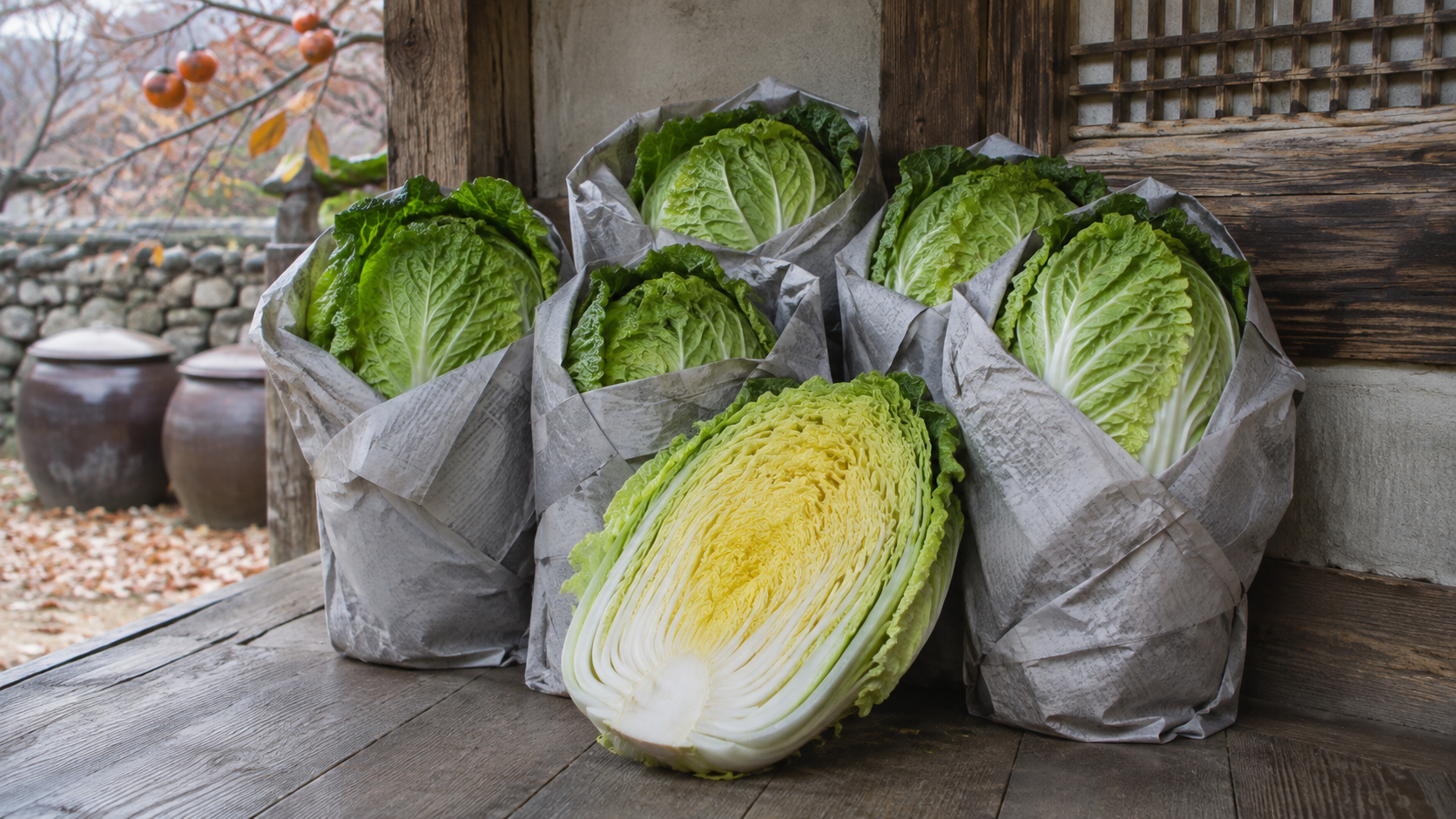
How to store whole napa cabbage and baby napa cabbage after kimchi season: 0–3°C and 90–95% humidity, freeze damage near -8°C, newspaper wrapping, cut cabbage, November 6, 2026 KAMIS prices 39% below last year, and how prices shift from autumn to winter cabbage.
Every kimchi-making weekend leaves two or three cabbages behind, and this year more households bought extra because cabbage is cheap. On November 6, 2026, autumn napa cabbage (top grade, 10kg net of three heads) sold for KRW 9,400 wholesale in Seoul — 39% below KRW 15,300 a year earlier (November 10, 2025).
Bottom line: napa cabbage keeps best at 0–3°C and 90–95% humidity. Wrap whole heads in newspaper, stand them root-end down somewhere cold but frost-free, and refrigerate baby napa or cut cabbage wrapped in film or a bag. Cabbage suffers freeze damage around -8°C, or at -3°C after a sudden drop.
Earlier records: Kimchi-Making Timing 2026, Salting Cabbage 2026, Ugeoji from Outer Leaves 2026, Radish Storage 2026. Daily prices are on the cabbage price page.
1. Prices now
KAMIS wholesale, November 6, 2026, autumn cabbage top grade 10kg (3 heads): Seoul KRW 9,400, Busan 7,000, Daegu 7,230, Gwangju 9,250, Daejeon 7,900. Baby napa cabbage top grade 8kg: Seoul 26,000, Busan 16,000, Daegu 17,000, Gwangju 12,100, Daejeon 16,600. A government supply plan reported on November 3 put this year’s autumn cabbage crop at 1.214 million tons, up 18.5%, while kimchi-making demand is expected to fall 9.1%.
2. Storage conditions
Gimpo’s Agricultural Technology Center gives 0–3°C and 90–95% humidity for stored kimchi cabbage. Seoul’s Agricultural Technology Center warns cabbage freezes at -8°C, or at -3°C when temperatures drop suddenly.
3. Whole heads
Do not wash or trim; the outer leaves protect the head. Wrap each head in newspaper, stand it root-end down in a box, and keep it on an unheated balcony or storeroom near 0°C, covering it or bringing it inside on freezing nights. An empty kimchi-refrigerator vegetable drawer is ideal. Check weekly and peel off yellowing outer leaves, which can be blanched for ugeoji.
4. Baby napa and cut cabbage
Baby napa dries out faster. Keep the outer leaves on, wrap in film or a produce bag, and refrigerate. Cover the cut face of halved cabbage tightly with plastic wrap and use it within days. If you cannot finish it, blanch, squeeze and freeze in portions; raw cabbage turns mushy when thawed.
5. If it freezes
Do not handle frozen leaves; let the cabbage thaw slowly in a cool place, as the Seoul center advises for frozen field cabbage. Remove mushy outer leaves and use the rest quickly in soups.
6. For farmers: from autumn to winter cabbage
Last season, Seoul wholesale autumn cabbage ran KRW 15,300 on November 10, 2025, about 16,000 in late November and 14,200 on December 11. Winter (woldong) cabbage entered the KAMIS survey on December 12 at 13,800 and traded between 11,400 and 12,800 in January and February. Stored autumn cabbage competes with that. A 2022 RDA horticulture study found conventional three-month storage lost 21% to rot and 45% in weight, versus about 10% each with precooling and functional film. For cabbage left in the field, tie the outer leaves only when sub-zero forecasts arrive, using wide soft ties, and add fleece or plastic before a cold snap.
References
- KAMIS, autumn, baby napa and winter cabbage wholesale prices (daily, November 2025 to November 6, 2026)
- Gimpo Agricultural Technology Center, kimchi cabbage harvest and storage guidance (reported November 2022)
- Seoul Agricultural Technology Center, freeze-damage prevention for kimchi vegetables
- MAFRA kimchi-season supply plan as reported November 3, 2026
- RDA National Institute of Horticultural and Herbal Science, cabbage storage study (reported December 20, 2022)