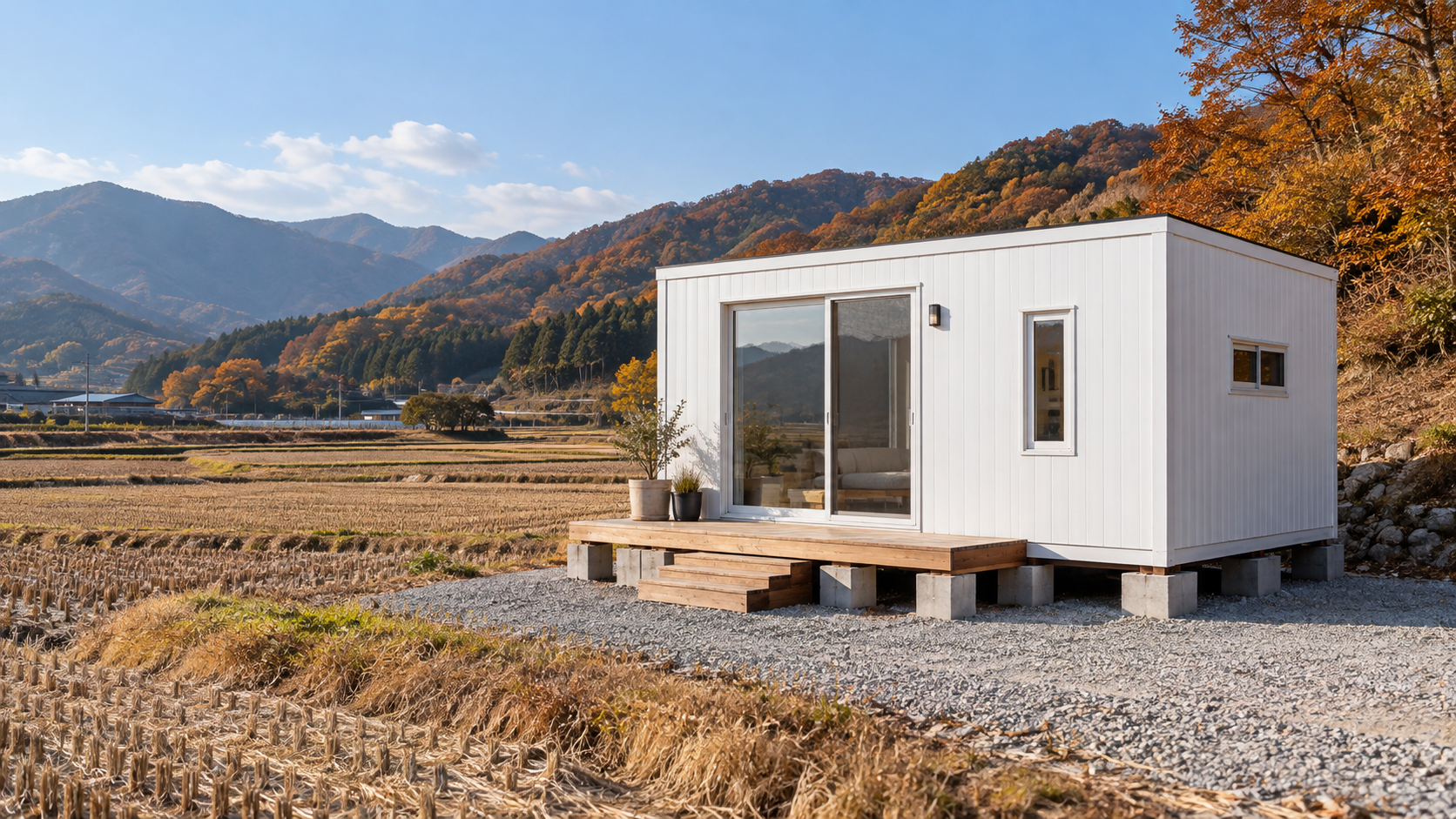
Under Korea's Farmland Act enforcement rules as amended on September 22, 2026: the 20 m² farm hut (nongmak), the 33 m² rural stay shelter, how both differ from a mobile home used as a house, 6-pyeong unit prices, and the costs that sit outside the quote.
Weekend farmers in Korea eventually ask the same question: why not drop a small prefab cabin on the field? Ads promise a “6-pyeong mobile home” for under KRW 10 million. But the same box can be a farm hut, a rural stay shelter or a house, and each comes with different rules on size, sleeping and permits.
Bottom line: a farm hut (nongmak) must be 20 m² or less and cannot be used as a dwelling. To stay overnight, register it as a rural stay shelter (33 m² or less), which needs road access for fire trucks and residential fire equipment. Living in it as a house requires converting the farmland and a building permit or report. As of October 6, 2026, 6-pyeong units on Coupang ranged from about KRW 9.4 million for a steel container hut to about KRW 23.4 million for a modular unit, with transport, foundation, power, water and septic usually extra.
1. Three categories.
| Item | Farm hut | Rural stay shelter | House |
|---|---|---|---|
| Size | 20 m² or less | 33 m² or less | Depends on land use |
| Sleeping | Not as a dwelling | Temporary lodging for farm work | Yes |
| Filing | Temporary building report | Temporary building report | Farmland conversion + building permit |
| Road | No rule | Must face a road usable by fire trucks | Building Act road rules |
The rules come from Articles 3-2 and 3-4 of the Enforcement Rule of the Farmland Act, amended September 22, 2026. Six pyeong is about 19.8 m², just under the hut limit. Ten pyeong is about 33.06 m², slightly over the shelter limit.
2. Farm hut requirements.
Not for residential use; 20 m² or less in floor area (and in building area if eaves project 1 m or more); parking and deck within the ministry’s notified limits; a temporary building report; registration in the farmland ledger; and local building ordinance standards. A separate farm-work toilet may not be installed on a parcel that already has a farm hut or shelter.
3. Rural stay shelter requirements.
33 m² or less (combined with any farm hut on the same parcel); not in disaster-prevention or collapse-risk zones; facing a road usable by fire trucks; a parcel at least twice the combined area of the shelter, deck, parking and external septic tank; a temporary building report and ledger registration; and residential fire equipment. Local ordinances may allow three or more extensions; the ministry said shelters could be used for up to 12 years.
4. Unit prices on October 6, 2026.
| Unit | Price (KRW) |
|---|---|
| 6-pyeong steel container hut (3 m × 6 m) | 9,402,000 |
| 6-pyeong tiny house, basic | 18,000,000 |
| 6-pyeong modular house | 23,386,000 |
| 6-pyeong clay ondol hut | 36,300,000 |
| 6-pyeong system house | 52,000,000 |
Ask separately about transport, crane, foundation, power hookup, water, septic, filing paperwork and decks. Power and water vary the most from site to site. For off-grid power, see our farm shed solar cost guide, and for winter, our frozen pipe prevention guide.
5. Conclusion.
Decide first whether the box will be a farm hut, a shelter or a house; that sets the size limit and the paperwork. File before you install, and check road, power and water before buying land.
References
- Enforcement Rule of the Farmland Act (amended September 22, 2026), Articles 3-2 and 3-4, Korea Law Information Center.
- Ministry of Agriculture, Food and Rural Affairs briefing on the rural stay shelter (korea.kr).
- Coupang listings for “6-pyeong farm hut”, checked October 6, 2026.