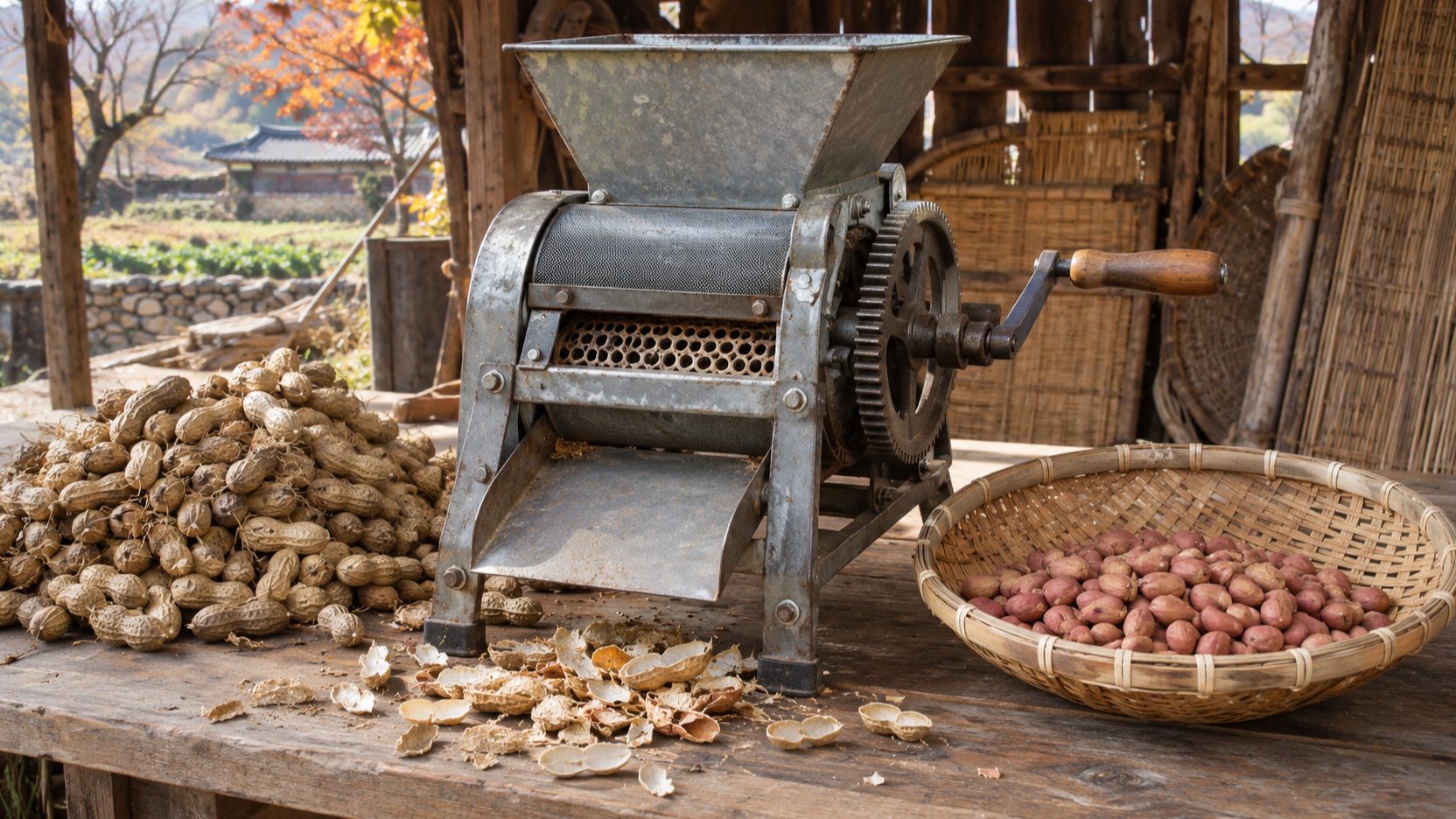
Manual crank, household electric and farm-size peanut shellers compared by Coupang prices on November 3, 2026, the difference between a thresher and a sheller, the Jeju Agricultural Research and Extension Services drying sequence, how much kernel weight 1kg of in-shell peanuts gives, and whether buying in-shell Korean peanuts and shelling them beats buying shelled kernels, with KAMIS wholesale prices from November 2, 2026.
Ten kilograms of fresh in-shell peanuts arrive. The first kilogram gets shelled by hand. After an hour your fingertips hurt and the bowl is barely full. So you search for a peanut sheller, and find the same machine sold as a sheller, thresher, huller or peeler, priced anywhere from about KRW 10,000 to KRW 600,000.
Bottom line: For a few kilograms at home, a KRW 30,000–46,000 manual crank sheller is enough. Household electric models run about KRW 62,000–91,000 and engine-driven farm units about KRW 607,000–620,000. Buying in-shell peanuts and shelling them yourself saves only a few thousand won per kilogram of kernels, so the machine pays off only over tens of kilograms. On November 2, 2026, the KAMIS wholesale price for domestic peanuts (top grade, 30kg) averaged KRW 496,500 across four cities, about KRW 16,550 per kg.
Earlier notes: harvest timing and drying are in Peanut Harvest Timing 2026, roasting and storage in Roasted Peanuts 2026.
1. A thresher and a sheller do different jobs.
After digging, peanuts need two steps. Threshing pulls the pods off the vines. Shelling cracks the pods to release the kernels.
The Jeju Agricultural Research and Extension Services guide gives the order: dry the plants with pods attached for about seven days, strip the pods, then dry them again to 10% moisture or below before storing. A thresher works on dried vines, a sheller on dry pods.
Online listings mix the names to catch more searches. Look at the design, not the title. A hopper plus crank or motor, with kernels and hulls dropping out below, is a sheller. A rotating drum fed whole plants is a thresher.
In a 2017–2018 survey of 52 Korean peanut farms by the National Institute of Crop Science, 42.3% threshed with a machine, 48.1% by hand and 9.6% used both.
2. Types and prices.
Selling prices shown in a Coupang Partners search for “peanut sheller” on November 3, 2026:
| Type | Power | Price range (KRW) |
|---|---|---|
| Manual crank sheller | Hand | 31,000–46,000 |
| Household electric | 220V motor | 62,000–91,000 |
| Rubber-roller / mill type | Motor | 250,000–377,000 |
| Farm engine sheller | Gasoline | 607,000–620,000 |
| Hand nut crackers | Hand | 5,000–10,000 |
Throughput claims in listings are not certified tests and vary with pod dryness and size, so they are left out. Ask whether the gap is adjustable, whether hulls and kernels come out separately, and how many kernels break.
3. How much kernel is in 1kg of in-shell peanuts.
No official Korean shelling ratio by variety was found. USDA’s peanut stocks report converts shelled weight to farmer-stock weight by multiplying by 1.33, which implies roughly 75% kernel by weight. Korean varieties and undried new-crop peanuts may differ, so shell 1kg and weigh it.
4. Is shelling your own cheaper?
Coupang prices on November 3 for items labelled domestic:
| Item | Price (KRW) | Per kg of kernels (75% assumed) |
|---|---|---|
| In-shell peanuts, 1kg | 15,480–19,800 | about 20,600–26,400 |
| In-shell peanuts, 2kg box | 23,650 | about 15,800 |
| Raw shelled kernels, 1kg | 16,500–22,700 | 16,500–22,700 |
Bought by the kilogram, in-shell peanuts cost more per kernel. Only 2kg-plus boxes come close to cheap shelled kernels. The saving is a few thousand won per kilogram at most. Reasons to buy a sheller anyway: freshly shelled kernels keep better, you grow your own, or you save seed. The Jeju guide says seed peanuts should be stored in the shell and shelled just before sowing.
5. Shelling tips.
Dry pods fully (10% moisture or below), sort by size, feed a handful at a time, winnow the hulls with a fan, and discard dark or moldy kernels. Use broken kernels first.
6. For growers.
| City | 30kg wholesale | Per kg | Year earlier | Change |
|---|---|---|---|---|
| Daejeon | 450,000 | 15,000 | 600,000 | –25.0% |
| Seoul | 486,000 | 16,200 | 520,000 | –6.5% |
| Busan | 510,000 | 17,000 | 490,000 | +4.1% |
| Daegu | 540,000 | 18,000 | 600,000 | –10.0% |
The four-city average is 10.1% below the nearest survey a year earlier (October 31, 2025). Sell in-shell when customers boil peanuts (October–November demand), shelled when they roast or cook, ideally shelling to order. Check local machinery rental offices before buying a large unit. Daily prices: peanut prices.
References
- aT KAMIS period wholesale prices (data.go.kr API): domestic peanuts, top grade, 30kg, Seoul, Busan, Daegu, Daejeon, October 31, 2025 and November 2, 2026.
- Jeju Agricultural Research and Extension Services, peanut cultivation guide: agri.jeju.go.kr
- Bae et al., survey of peanut farming practices (National Institute of Crop Science): koreascience.kr
- USDA NASS, Peanut Stocks and Processing, August 2026: esmis.nal.usda.gov
- Coupang Partners product search prices, checked November 3, 2026.