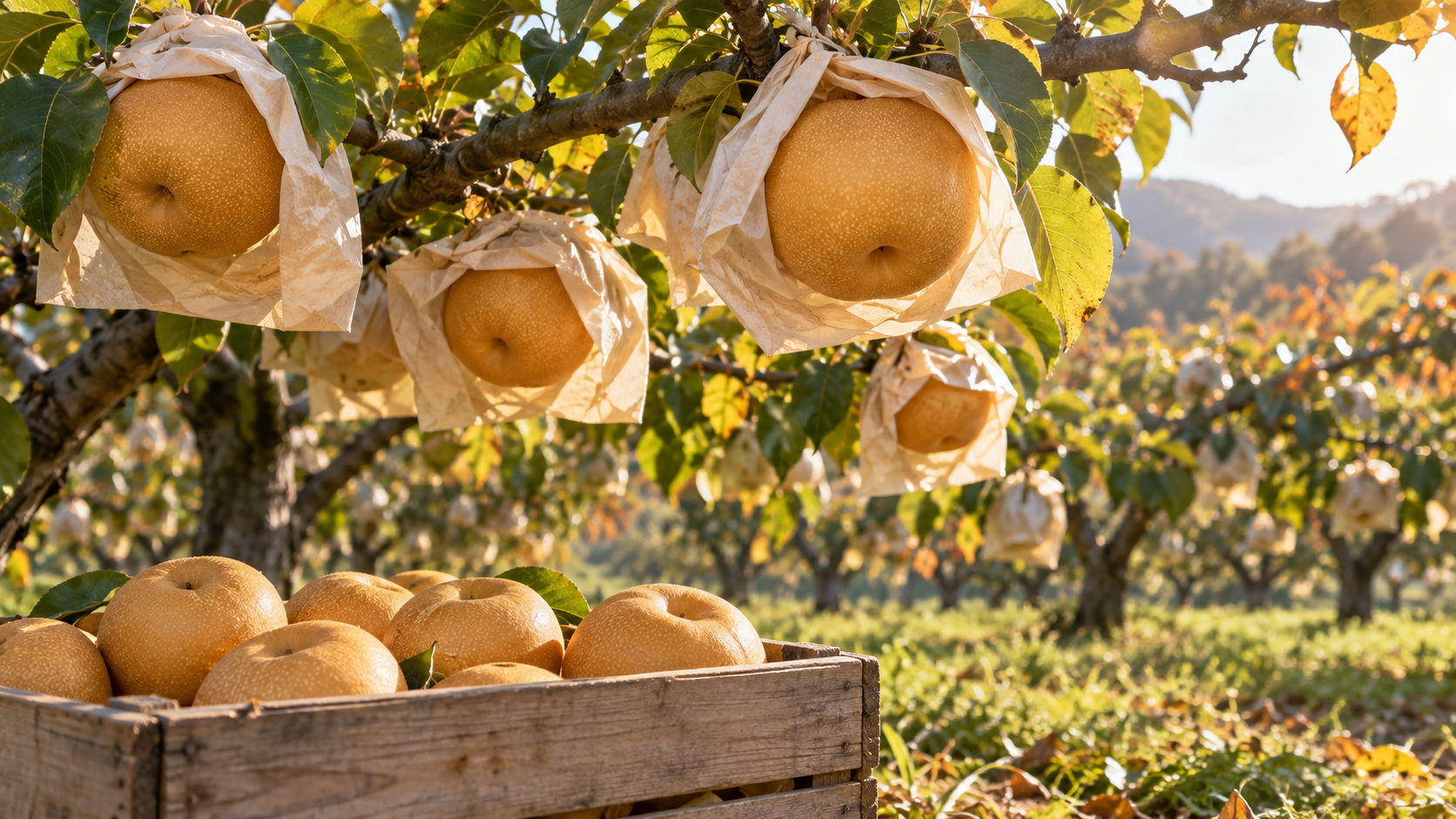
As of the October 2, 2026 KAMIS survey: wholesale price of Shingo pears per 15 kg box, the 7.5 kg and per-kg equivalents, the post-Chuseok drop, the cheapest month by 10-year average, how to pick and store pears, and when growers should sell from cold storage.
After Chuseok, Korean pear prices start to slide. Buyers who paid gift-box prices a few weeks ago and growers deciding when to pull pears out of cold storage are watching the same numbers.
Bottom line: as of the October 2, 2026 KAMIS survey, top-grade Shingo pears sold for KRW 57,600 per 15 kg in Seoul wholesale markets, or KRW 28,800 per 7.5 kg and about KRW 3,840 per kg. That is 17% below KRW 69,300 on September 21, before Chuseok, and 6% below KRW 61,000 a year earlier. On 2016–2025 Seoul monthly averages, October (KRW 47,775) is the cheapest month of the year.
1. Where prices stand.
| City | Top grade, 15 kg (October 2) |
|---|---|
| Seoul | 57,600 |
| Gwangju | 56,600 |
| Daejeon | 54,300 |
| Busan | 54,000 |
| Daegu | 45,300 |
The five-city average was KRW 53,560, down 13% from KRW 61,880 on September 21. Medium grade in Seoul was KRW 47,600 per 15 kg. These are wholesale prices charged by intermediate wholesalers; retail 7.5 kg gift boxes vary with fruit count, origin and packaging.
2. October is the cheapest month.
| Month | 10-year Seoul average (15 kg) |
|---|---|
| January | 60,722 |
| March | 61,245 |
| May | 67,407 |
| July | 77,154 |
| August | 66,005 |
| September | 53,505 |
| October | 47,775 |
| November | 52,836 |
| December | 57,808 |
Shingo pears are harvested from mid-September to October and sold out of cold storage until the next summer. Prices bottom out in October and climb toward July, a 61% spread. December was higher than October in 8 of the last 10 years; in 2024 the rise was 69%.
3. Is this year expensive?
September 2026 averaged KRW 67,908 in Seoul, 8% above September 2025, as Chuseok demand fell in late September. The current price is 21% above the 10-year October average but in line with 2023–2025. In early September, the Korea Rural Economic Institute projected the 2026 pear crop at 196,900 tonnes, roughly flat on last year (−0.3%), with peak-season Shingo wholesale prices around KRW 36,000 per 7.5 kg, 3% below last year’s KRW 37,200 (auction-price basis, so not directly comparable to KAMIS figures).
4. Buying and storing.
Pick pears with an even yellowish-brown skin, little green left, heavy for their size and free of bruises or soft spots. In a 7.5 kg box, fewer fruits means bigger and pricier pears. At home, wrap each pear in paper or film and keep it in the fridge vegetable drawer or a kimchi refrigerator; pears keep best near 0°C and about 90% humidity.
5. For growers.
The Rural Development Administration recommends a first pick around 160 days after full bloom (3,450 degree-days) and the main harvest around 170 days (3,750 degree-days), picking in two to four rounds. Air-dry the fruit in shade for 5–7 days, sort out cracked, sunburnt or damaged fruit, then store at 0°C and 85–90% humidity with 30–50 cm gaps between boxes and walls. Holding pears until December has paid off in most years, but only when the price gain beats weight loss, decay and electricity. Grade sorting matters too: top and medium grade differed by KRW 10,000 per 15 kg in Seoul on October 2.
References
- aT KAMIS, wholesale prices by period: Shingo pear, top and medium grade, 15 kg, Seoul, Busan, Daegu, Gwangju, Daejeon, September 2025–October 2, 2026 (data.go.kr API).
- aT KAMIS, monthly wholesale and retail prices: Shingo pear top grade 15 kg, Seoul monthly averages, 2016–2026.
- Korea Rural Economic Institute (KREI) Agricultural Outlook Center, September 2026 fruit outlook, as reported by Newsis on September 7, 2026.
- Rural Development Administration, National Institute of Horticultural and Herbal Science pear research center: Shingo harvest timing and post-harvest storage guidance.
- Actual prices vary with size, origin, buyer and terms.