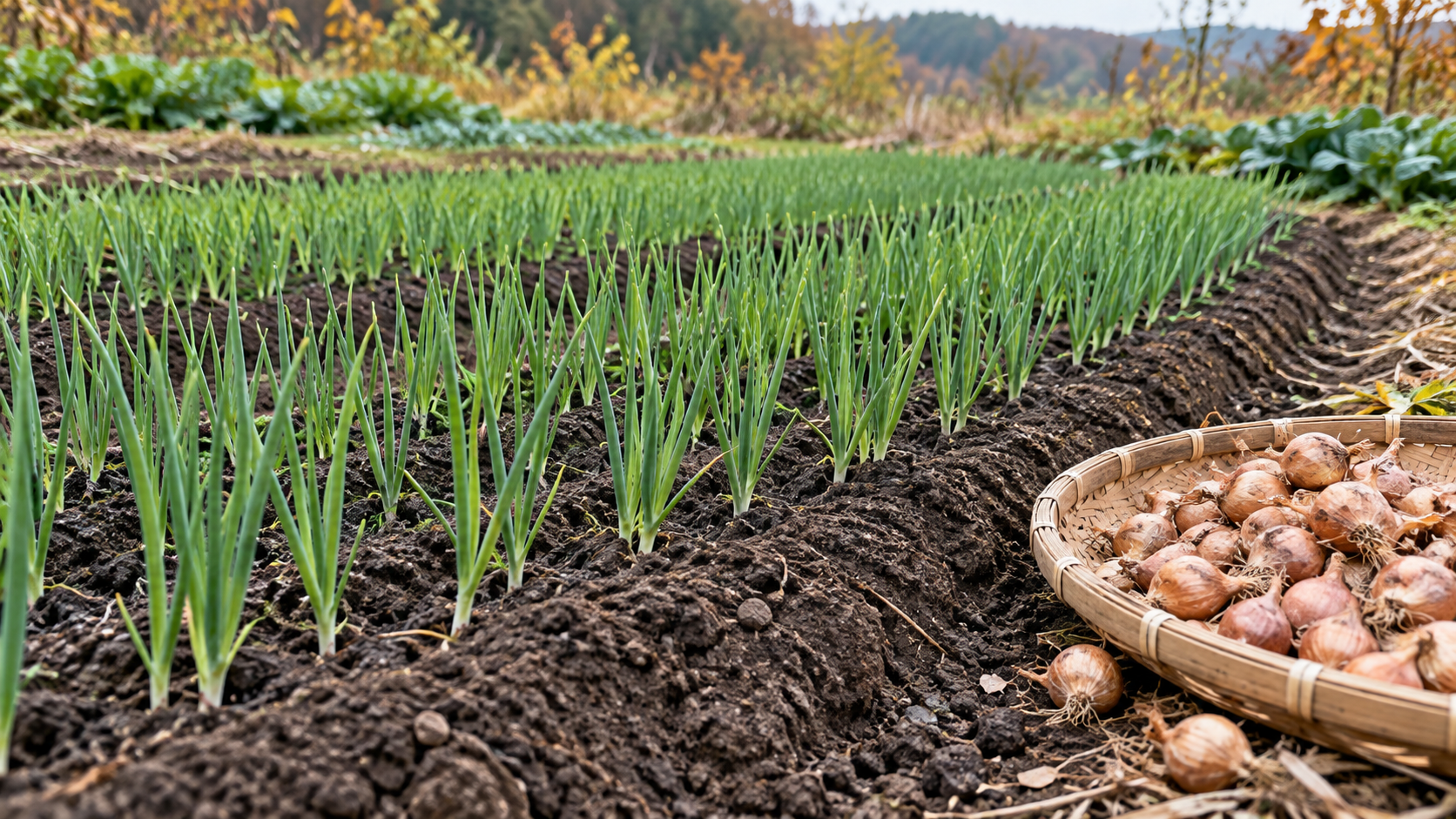
Korean scallions (jjokpa) for kimchi season are planted from bulbs in late August to early September and pulled about 40 days later. RDA guidance on choosing bulbs, spacing, depth and fertilizer, what to expect from October planting, and October 6, 2026 KAMIS wholesale prices.
Jjokpa, the slender Korean scallion used in kimchi and pajeon, is grown from bulbs rather than seed. Bulbs saved from last year go into the ground in late summer and are ready for kimchi-making about a month and a half later. The tricky month is October: bulbs are still on sale and garden beds are empty, but is it too late?
Bottom line: For the kimchi crop, plant jjokpa bulbs from late August to early September and harvest about 40 days later. The Rural Development Administration (RDA) lists no open-field schedule for October planting. Planted now, treat it as a crop for cutting leaves rather than thick kimchi scallions. In a home garden, space rows about 20 cm apart and plants 10 cm apart, 2–3 cm deep. On October 6, 2026, top-grade jjokpa sold for KRW 9,500 per kg at Seoul wholesale (KAMIS), up from KRW 7,370 a year earlier.
1. Planting windows
RDA’s cultivation guide puts the best planting time for the kimchi crop at late August to early September. Plant too early and bulbs grow oversized and age; plant late and yields fall.
| Method | Plant | Harvest |
|---|---|---|
| Open field (kimchi) | Mid-August | October–November |
| Greenhouse | Late Aug–early Sep | Mid-December–early January |
| Low tunnel | Early September | February–March |
| Open field (seed bulbs) | Early September | Early May |
| Retarded summer crop | Early June | July–August |
The ideal growing temperature is 15–20°C, and jjokpa tolerates temperatures around 0°C, though it is less cold-hardy than green onions, which is why the south suits it best. Planting in early October still gives leaves to cut in late autumn; winter and spring harvests in the official schedule come from greenhouse and tunnel crops.
2. Bulbs, spacing and fertilizer
Choose firm, glossy bulbs with no rot. Trim roots and outer skins, plant large bulbs singly and small ones in groups of two or three. Farms use 90–100 kg of bulbs per 10 a, about 0.3 kg per pyeong (3.3 m²), so 1 kg covers roughly 10 m². RDA’s farm guide uses 15×15 cm to 20×10 cm spacing with 2.5 cm of soil over the bulb; its home-garden guide uses 20 cm rows, 10 cm between plants and 2–3 cm depth.
For a garden bed, mix 2–3 kg of well-rotted compost and 300 g of compound fertilizer per m² about 30 days before planting. Keep top-dressing away from the delicate roots, apply the first when plants have three to four leaves, then roughly monthly. Water deeply about once a week. Onion maggot damage is common, and both RDA sources advise soil treatment before planting and a one-to-two-year break from alliums in the same spot.
3. Harvest and saving bulbs
Harvest from about 40 days after planting, pulling the largest plants first. For next year’s bulbs, lift plants after the leaves have fully dried and store them dry; summer heat and long days make jjokpa form bulbs and go dormant.
4. Prices
| City | Oct 6, 2026 | Sep 4, 2026 | Oct 2, 2025 |
|---|---|---|---|
| Seoul | 9,500 | 10,500 | 7,370 |
| Busan | 8,000 | 10,600 | 7,000 |
| Daegu | 9,330 | 10,600 | 7,830 |
| Gwangju | 7,000 | 10,000 | 6,750 |
| Daejeon | 3,660 | 9,000 | 5,770 |
KRW per kg, top grade, KAMIS middle-wholesaler selling price. Seoul has held at 9,500 since September 10, while Daejeon dropped into the 3,000s from September 30, out of line with other cities. Over ten years (October 2015 to September 2025), Seoul’s monthly average peaks in January (KRW 6,907) and bottoms out in April (KRW 3,635); October (KRW 4,811) is lower than September (KRW 6,221). September 2026 averaged KRW 9,850, nearly 60% above the ten-year September average. Daily prices are on the green onion (jjokpa) price page. For other overwintering crops, see When to Plant Onions in Korea 2026 and When to Plant Garlic in Korea 2026.
References
- RDA National Institute of Horticultural and Herbal Science, Agricultural Technology Guide 152 (Green onion), “Characteristics and cultivation of jjokpa” (December 2018).
- RDA webzine (September 2020), “Growing jjokpa in a home garden.”
- aT KAMIS wholesale prices (middle wholesaler selling price), jjokpa top grade 1 kg, five cities, September 2025 to October 6, 2026; Seoul monthly averages, October 2015 to October 2026.
- Actual planting dates, yields and prices vary with local climate, weather, growing method and sales channel.