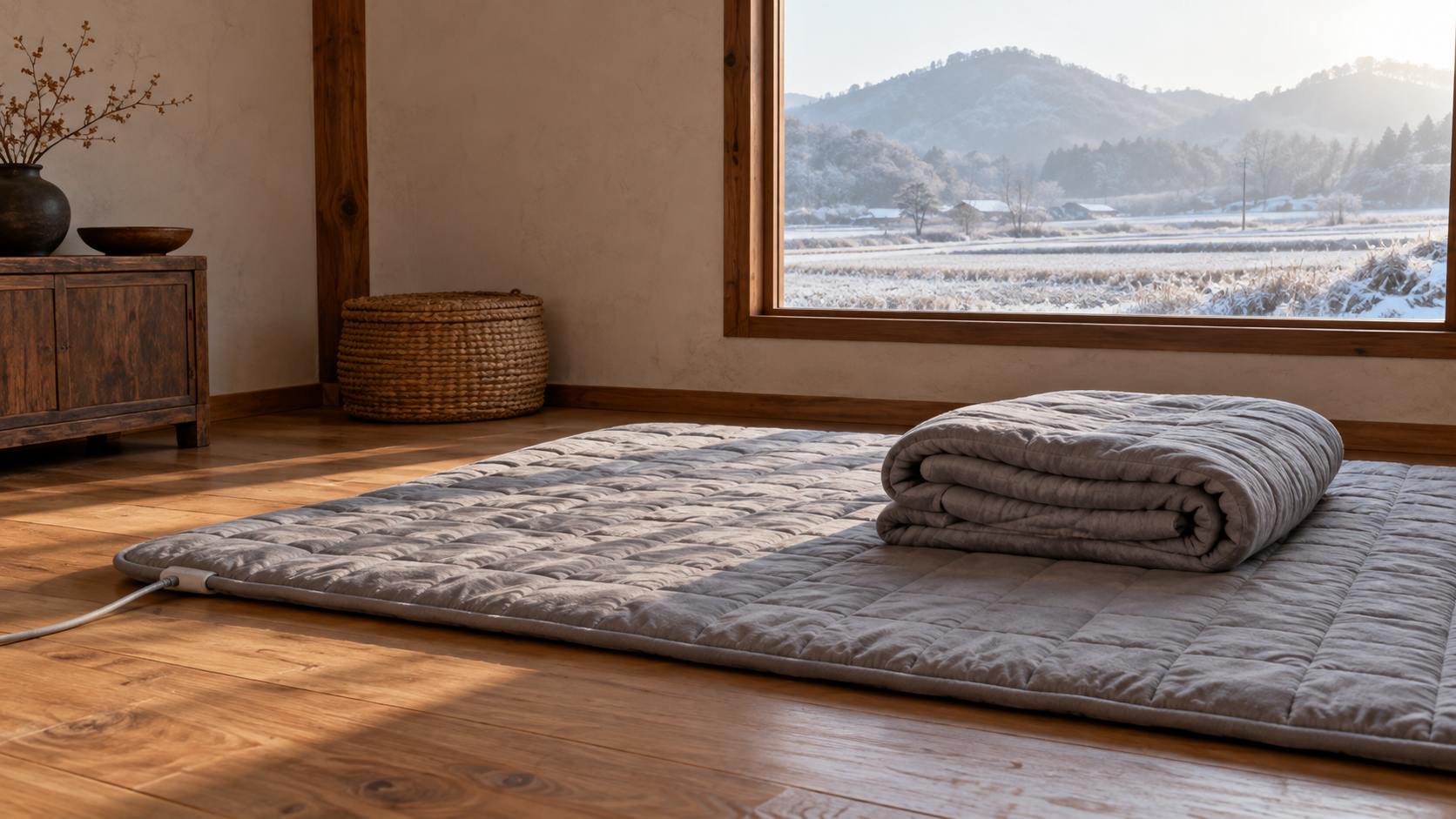
How carbon, electric and hot water heating mats work and differ on safety, a monthly electricity cost calculation using KEPCO residential tiers, and what to check for farm huts, rural homes and camping.
When October mornings drop into single digits, it is too early to run the boiler and too cold to sleep without heat. That is when Korean households pull out a floor heating mat. In stores, carbon mats, electric mats and hot water mats sit side by side, each claiming “low electricity bills” or “no EMF.” What actually differs, and what does a month of use cost?
Bottom line: A mat’s electricity cost depends more on how much electricity your household already uses (your progressive tier) than on the mat itself, by up to three times. Using KEPCO’s residential tariff, the same extra 48 kWh (200 W × 8 hours × 30 days) adds about KRW 6,600 for a household using 150 kWh a month, but about KRW 20,700 for one using 380 kWh, because it crosses 400 kWh. A carbon mat is a type of electric mat; a hot water mat circulates heated water, so the safety checks differ.
1. How the three differ
There are three names but two heating methods: an electric heating wire inside the mat, or heated water circulating through it.
| Type | How it heats | Pros | Watch for |
|---|---|---|---|
| Electric mat | Current through a metal heating wire in the mat | Cheap, light, heats quickly | Fold creases, crushed wires, overheating under thick bedding |
| Carbon mat | Current through a carbon-fiber heating wire | Same as electric; many thin, soft models | Same as electric; verify “no EMF” claims by certification |
| Hot water mat | A base unit heats water and pumps it through tubes in the mat | No electric wire in the mat, even heat | Base unit noise, refilling, hose leaks, thermostat faults |
A carbon mat is not a separate heating method; it is an electric mat with a different wire material, and electricity cost is calculated the same way. A hot water mat uses electricity in the bedside base unit, drawing more while heating water and less once at temperature.
2. EMF and safety
Korea’s human-protection limits for electrical products at 60 Hz are 4,166 V/m for electric fields and 83.3 μT for magnetic fields. Mats must meet these to be sold. Treat “no EMF” labels as seller claims and check for a KC certification number and published test results.
Fires and burns are the more common real-world accidents. The Korea Consumer Agency analyzed 2,411 electric-mat accidents reported from 2015 to June 2018: electric pads and blankets accounted for 1,467 (60.8%), and fire, overheating or explosion made up 62.9%. Fire-agency data show 1,403 fires from electric pads and heaters in 2021–2023, with 21 deaths and 142 injuries. Of 902 electric-pad burn cases from 2017–2019, 63.1% were second-degree, and 68.4% affected the lower body: low-temperature burns from long contact during sleep.
Quick checks before use:
- Look for loose plugs and scorch marks around outlets.
- Do not use mats with exposed or crushed cords or heavy fold creases, especially ones stored folded since last winter.
- Do not put latex mattresses or thick bedding on top; heat gets trapped.
- Do not plug two heaters into one power strip.
- Use a timer at night and add a thin pad so bare skin is not in direct contact.
- For hot water mats, check hose joints for leaks and whether the thermostat matches actual temperature.
3. Calculating the monthly cost
Power (W) × hours per day × 30 ÷ 1,000 = kWh per month
A 200 W mat used 8 hours a day uses 48 kWh a month. For real products, as listed on Coupang product pages on October 8, 2026, a Hanil carbon-wire electric pad (HL-D205, M, 100 × 180 cm) is rated 150 W and an Ilwol single hot water mat (100 × 200 cm) 240 W: up to 36 kWh and 57.6 kWh a month at 8 hours a day. The rated wattage is a maximum; thermostats cycle power, so actual use is usually lower. A plug-in power meter will show your mat’s real consumption after a day.
KEPCO residential low-voltage rates for the non-summer season (applies October–December):
| Monthly use | Basic charge | Energy charge per kWh |
|---|---|---|
| Up to 200 kWh | KRW 910 | KRW 120.0 |
| 201–400 kWh | KRW 1,600 | KRW 214.6 |
| Over 400 kWh | KRW 7,300 | KRW 307.3 |
Add the Q4 2026 fuel cost adjustment of KRW 5 per kWh and 10% VAT, and each extra kWh costs about KRW 137.5, 241.6 or 343.5 depending on the tier. Actual bills also include a climate and environment charge and the electric power industry fund.
4. The same mat costs different amounts in different homes
| Original monthly use | With mat | Added cost (incl. fuel adjustment and VAT) |
|---|---|---|
| 150 kWh | 198 kWh | about KRW 6,600 |
| 250 kWh | 298 kWh | about KRW 11,600 |
| 380 kWh | 428 kWh | about KRW 20,700 |
The 380 kWh household crosses 400 kWh: 28 kWh are charged at KRW 307.3, and the basic charge jumps from KRW 1,600 to KRW 7,300. So the same 48 kWh costs more than three times as much as in the 150 kWh home. (380 kWh: basic KRW 1,600 + 200 × 120 + 180 × 214.6 + 380 × 5, plus VAT ≈ KRW 72,700. 428 kWh: KRW 7,300 + 200 × 120 + 200 × 214.6 + 28 × 307.3 + 428 × 5, plus VAT ≈ KRW 93,500.)
So check last month’s bill first. Near 400 kWh, choose a lower-wattage single mat or one with a timer, and prefer dual-zone mats that heat only one side.
5. Farm huts, rural homes and camping
Farm huts. Most are poorly insulated, so a floor mat warms your body while sleeping, not the room. Blocking drafts first has a bigger effect; see our posts on draft stoppers and insulation film and greenhouse and farm hut heaters.
Solar-powered huts. Off-grid, mat power comes from the battery: 200 W for 8 hours is 1.6 kWh. Check whether panels and battery can supply that on short winter days; see small off-grid solar for farm huts.
Rural homes. With a whole-house boiler, the mat is supplementary. Lowering the bedroom boiler setting and using a mat can save fuel, but check whether it pushes you into a higher electricity tier.
Camping. Many campsites limit wattage per site. Check the mat’s rating fits, and do not use it folded or buried under many layers.
6. Checklist
- A carbon mat is an electric mat with a different wire; a hot water mat circulates heated water.
- Check KC certification and test results rather than “no EMF” labels.
- Do not use mats with creases, crushed cords or scorched outlets.
- Monthly kWh = W × hours × 30 ÷ 1,000. Measure real use with a power meter.
- Each extra kWh costs about KRW 137.5, 241.6 or 343.5 by tier (incl. fuel adjustment and VAT).
- Near 400 kWh a month, choose low wattage, a timer and dual zones.
- In farm huts, block drafts first; off-grid, size the battery first.
7. Conclusion
No mat type is inherently “cheapest to run.” At the same wattage they use the same electricity, and your household’s tier sets the price. Choose by KC certification, timer and wattage, and check creases and cords before switching on. One line on last month’s bill tells you this winter’s mat cost in advance.
References
- Korea Electric Power Corporation, residential (low-voltage) tariff, non-summer season basic and energy charges, effective November 9, 2023.
- Money Today, “Fuel cost adjustment held at KRW 5 per kWh, Q4 electricity rates frozen,” September 21, 2026.
- Seoul Metropolitan Government environment portal, household EMF survey (Korean limits at 60 Hz: 4,166 V/m, 83.3 μT).
- Segye Ilbo, “Using last year’s electric pad as-is is risky,” November 28, 2025 (Korea Consumer Agency accident and burn analyses, fire-agency data, safety checks).
- Bill figures are examples calculated from the tariff above and exclude the climate and environment charge, the power industry fund and rounding. Check your actual bill and KEPCO ON.