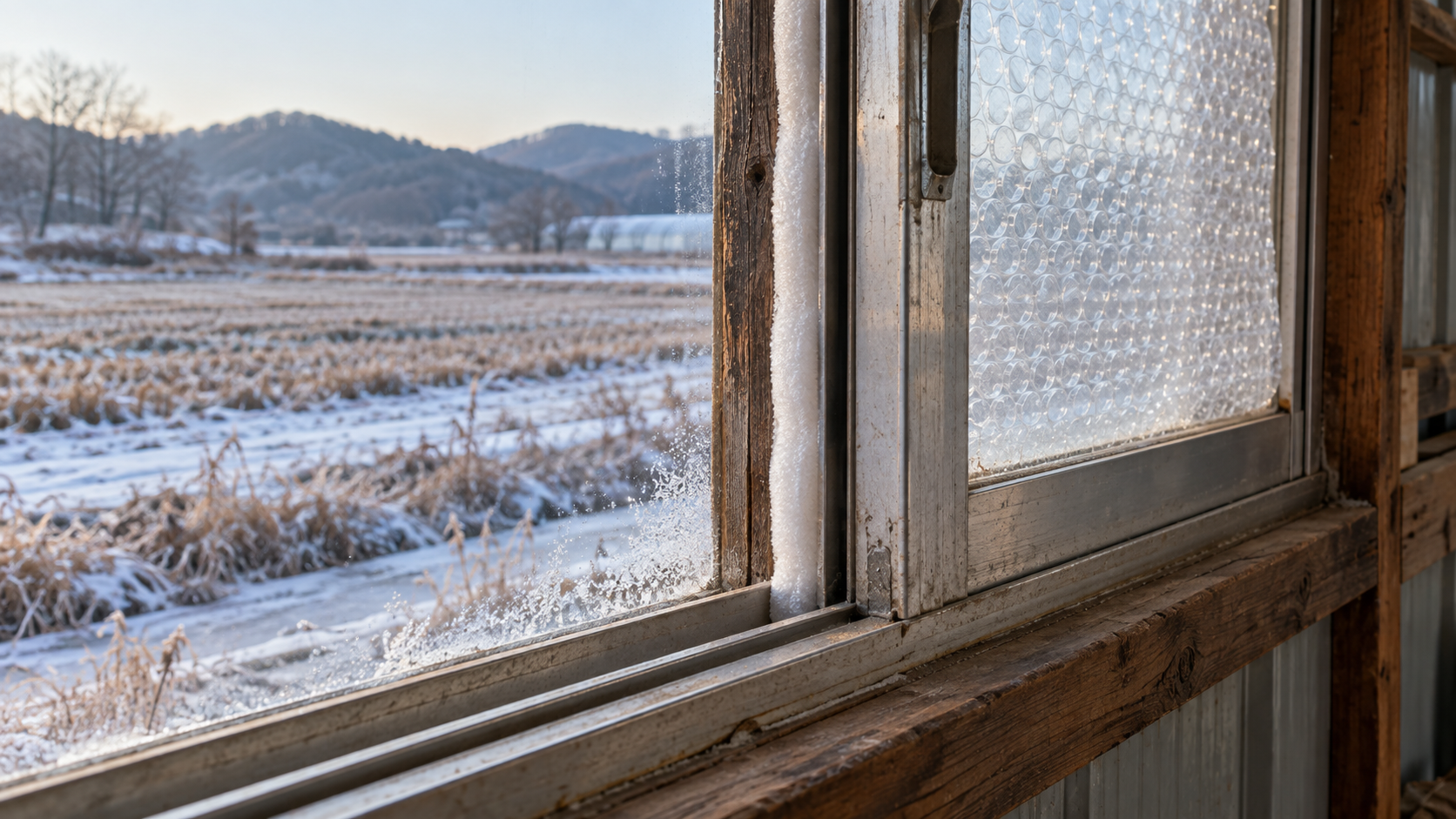
Farm sheds and rural homes leak heat through sash gaps and single glazing. Which weather strip to use where (foam, silicone, mohair, rubber gasket), how to apply bubble wrap and insulation film, cost per window, and what the Korea Energy Agency measured.
The first cold night in a farm shed tells you where the problem is. The heater is on, yet your feet are cold. Air comes in through the sliding-window rails, under the door, and through the seams of a container shed. Before buying a bigger heater, seal the gaps. Materials cost a few thousand won per window, and the job takes half a day.
Bottom line: The Korea Energy Agency reported that sealing leaks with bubble wrap, weather strips, and curtains cut monthly city gas use by 5.5%. Use weather strips and rubber gaskets where air blows in, and bubble wrap or insulation film on cold glass. For one window (1.8m wide, 1.2m tall), materials come to about ₩10,000.
Earlier: protecting pipes in an empty shed is in Farm Shed Winter Frozen Pipe Prevention, and choosing a heater is in Greenhouse and Farm Shed Heater Buying Guide.
1. Where heat escapes
There are two problems with different fixes: air blowing in through gaps (drafts), and cold glass or thin walls pulling heat out.
| Leak point | Sign | Fix |
|---|---|---|
| Sliding-window rails and frames | You feel air with your hand | Mohair or foam weather strip |
| Entrance and room door frames | Sound leaks with the door shut | Rubber gasket, silicone strip |
| Gap under the entrance door | The floor is unusually cold | Door-bottom sweep |
| Single or thin double glazing | Condensation on the glass | Bubble wrap, insulation film |
| Container shed sash seams | Frost forms in the corners | Rubber gasket, silicone strip |
To find leaks, hold an incense stick or a thin strip of plastic along frames on a windy evening. Where the smoke or plastic moves, air is coming in.
Korea’s Rural Development Administration found the same in greenhouses: sealing small gaps equal to 0.6% of the thermal-curtain area cut heat loss by about 12%. Small gaps leak a lot of heat.
2. Choosing a weather strip
| Type | Best for | Watch out |
|---|---|---|
| Urethane or foam | Wide gaps between frame and sash; cheap | Loses spring when compressed; wears in a year or two |
| Silicone tape | Door frames, sash seams; clear | Surface must be clean and dry |
| Mohair (brush) | Moving parts such as sliding rails | Brush alone cannot fill wide gaps |
| Rubber gasket (D or P profile) | Closing faces of doors and storage doors | Too thick and the door will not close |
Measure the gap before buying a gasket: close the door on a sheet of paper. If it slips out easily, go thicker; if it is tight, go thinner. Clean and dry the surface, and apply when daytime temperatures rise, since adhesives grip poorly in the cold. That is why October to early November is the time to do it.
3. Bubble wrap vs. insulation film
| Item | Insulating bubble wrap | Clear insulation film |
|---|---|---|
| How it works | An air layer blocks cold from the glass | A thin film applied to the glass |
| Visibility | View becomes blurry | Stays clear |
| Application | Spray with water; some need no water | Usually water and a squeegee |
| Best for | Sheds, storage rooms, back rooms | Living-room windows with a view |
For sheds where warmth matters more than the view, bubble wrap is cheap and easy. A December 2025 government winter campaign advised applying it on the inside of the window, in two layers, covering the whole frame. Leaving the frame bare lets cold creep in around the edges.
The Korea Energy Agency says bubble wrap, weather strips, and curtains used together raise indoor temperature by about 2–3℃. That figure is for all three combined; we found no official figure for a weather strip or bubble wrap alone.
4. Cost per window
Based on a typical shed sliding window (1.8m by 1.2m), at Coupang listed prices on October 6, 2026 (excluding personal coupons):
| Material | Amount needed | Price | Per window |
|---|---|---|---|
| Weather strip, 20m roll | About 6m perimeter | about ₩20,000 / 20m | about ₩6,000 |
| Bubble wrap, 100cm wide, 10m | Two 1.2m panes, two layers, about 5m | about ₩9,500 / 10m | about ₩4,700 |
| Total | about ₩10,000 |
A 20㎡ shed with four windows and one door needs one or two rolls of weather strip, two rolls of bubble wrap, and one gasket: roughly ₩70,000. Hiring a contractor adds call-out and labor fees, so unless the windows are high or very large, doing it yourself is the better deal.
5. More places to check on farms
- Container sheds: frost at sash-to-steel seams marks the leak. Seal with silicone strip or gasket, and consider proper wall insulation where condensation is heavy.
- Greenhouse staff rooms and workrooms: the gap under the door is usually the biggest. Add a door sweep.
- Storage doors: produce stores only need to stay above freezing. A gasket on the closing face alone evens out overnight swings.
- Keep ventilation. Fully sealing a room with a kerosene or gas heater lets carbon monoxide build up. The tighter the room, the more deliberately you ventilate, and keep a CO alarm.
6. Seeing the effect in numbers
The Korea Energy Agency recommends 20℃ indoors in winter and says each 1℃ lower cuts heating energy use by about 7%. Sealing drafts lowers the heating needed to hold the same temperature. Rural homes on electricity or city gas may also get paid for the reduction through the Carbon Neutral Point program: see Korea’s Carbon Neutral Point (Energy) 2026.
7. Checklist
- Find leaks with incense smoke or a strip of plastic on a windy day.
- Mohair or soft strip on moving rails; rubber gasket on closing doors.
- Measure gasket thickness with a sheet of paper first.
- Clean and dry surfaces; apply when it is warmer during the day.
- Bubble wrap goes inside, two layers, covering the frame.
- Where you use a combustion heater, ventilate and keep a CO alarm.
8. Conclusion
Winter cold in a farm shed or rural home often starts at the gaps, not with the heater. About ₩10,000 of materials per window closes the drafts and covers the cold glass, and the same heater feels very different. Do it in October or early November, before the first freeze, while adhesives still grip.
References
- Korea Energy Agency press release (February 28, 2025: bubble wrap, weather strips, and curtains cut monthly city gas use by 5.5%).
- Korea Energy Agency heating and cooling efficiency guidance (about 2–3℃ warmer indoors with bubble wrap, weather strips, and curtains; 20℃ recommended; 7% energy saving per 1℃ lower).
- Korea.kr policy briefing, Ministry of Climate, Energy and Environment winter campaign (December 18, 2025: bubble wrap inside, two layers, covering the whole frame).
- Rural Development Administration, thermal-camera heat-loss diagnosis for greenhouses (about 12% less heat loss after sealing small gaps).
- Coupang product pages (checked October 6, 2026, excluding personal coupons).
- Actual results vary with building structure, window type, heating method, and weather.